

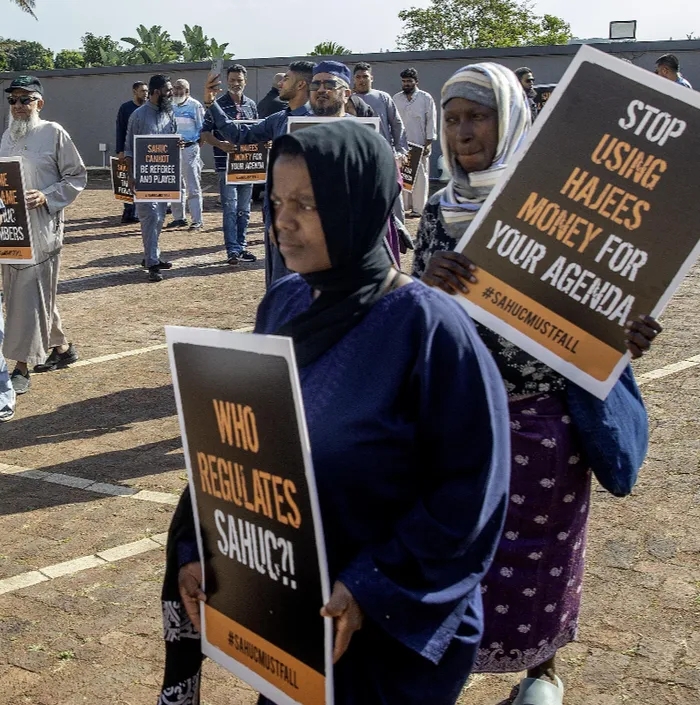
The Sunni Jamiatul Ulama staged a peaceful protest outside the SAHUC office at the NMJ Islamic Centre in Morningside, Durban on Friday
Image: Leon Lestrade
A LEGAL confrontation is brewing between the South African Hajj and Umrah Council (SAHUC) and the Sunni Jamiatul Ulama (SJU), over hajj operations in South Africa.
The SJU, a founding member of SAHUC and a body of theologians, has claimed that SAHUC wants to monopolise the hajj sector, undermine the rights of pilgrims and violate constitutional and competition law - a claim that SAHUC denies.
On Friday, the SJU staged a peaceful protest outside SAHUC offices in Durban, Johannesburg and Cape Town. Demonstrators held placards that read, "SAHUC cannot be referee and player", "Who regulates SAHUC?", "Stop using hajees money for your agenda" and "Down with the SAHUC Hajj mafia".
In a memorandum submitted to SAHUC, the SJU vehemently opposed the proposed constitutional amendments, asserting that SAHUC aimed to become the sole operator of hajj and umrah services in the country.
"The intention conveyed in this first proposed amendment is that SAHUC seeks to now serve as the sole and exclusive hajj operator for South Africa. This will entail SAHUC now intending to perform all the functions of hajj and umrah operators and travel agents.
"The impact of this proposed amendment has far reaching and detrimental effects on, among other things, the hajj and umrah travel industry, because effectively it will result in a number of Hajj and Umrah Travel agents suffering irreparable prejudice to the extent that a large number may well go out of business. This proposed amendment is unconstitutional and tantamount to a violation of the competitions act because it envisages a monopoly of the hajj and umrah travel industry," read the memorandum.
It further stated that SAHUC has no mandate to enter into agreements with foreign states because only organs of state are empowered to conclude such agreements.
"SAHUC is not an organ of state. Any purported agreements by SAHUC with the ministry of Hajj in the Kingdom of Saudi Arabia is therefore ultra vires, unlawful, and void ab initio," added the memorandum.
Mohamed Tariq, executive member and spokesperson for SJU, claimed that SAHUC wanted to change from a regulator to a business.
"Who will then regulate them? We have been engaging with them to say they can't do this. It should be a consultative process. We supported SAHUC as a regulator and not a business. We are calling for accountability and transparency.
"If SAHUC takes a decision to change its constitution then we shall take legal action to seek relief," said Tariq.
The SJU has reached out to the Department of International Relations and Cooperation (DIRCO) and the Cultural, Religious and Linguistic (CRL) Rights Commission to intervene.
They called on the government to act by publicly affirming SAHUC’s lack of mandate, declaring null and void all purported agreements SAHUC claims to have concluded, preventing monopolistic capture of the hajj sector; and to safeguard jobs and pilgrims’ rights.
In a statement, the SJU said SAHUC has no legal mandate to enter into agreements with foreign states.
"SAHUC has claimed that the Saudi Ministry of Hajj issued a single directive — the one SAHUC now enforces. The truth is different: the Ministry of Hajj presented three separate options to SouthAfrica. By suppressing this fact, SAHUC has engaged in misrepresentation, breach of ethical codes, and bad faith conduct, depriving pilgrims of their constitutional right to make informed decisions.
"The SJU has historically supported SAHUC’s role as regulator, but it cannot and will not support its unlawful attempt to reinvent itself as a monopolistic operator. Despite repeated calls for transparency, SAHUC has responded with aggression — even threatening disciplinary action against critics. Such authoritarian behaviour erodes public trust and delegitimise SAHUC’s standingintheMuslim community," read the statement.
The SJU added that hajj was a sacred duty and not a commercial monopoly.
"SAHUC’s conduct is illegal, immoral, and unconstitutional. By attempting to assume powers it does not have, SAHUC has undermined pilgrims' rights, destroyed livelihoods, and dragged the South African state into a potential quagmire of legal liability."
Moaaz Casoo, SAHUC president, said they had offered 20 travel operators the opportunity to submit business proposals to SAHUC to serve the pilgrims for hajj 2026, but only three travel operators submitted proposals.
"SAHUC will review the proposals and if approved, how best can the three travel operators serve the pilgrims. In the last hajj season, we also had three travel operators.
"SAHUC is a facilitator for hajj in South Africa and we are merely following the new hajj rules and guidelines from the Ministry of Hajj and Umrah which we have published all 16 points on social media this past week," said Casoo.
He said SAHUC has not stopped any travel operator from submitting a proposal.
"Certain travel operators have opted not to submit any proposals to SAHUC when we have asked them to inform us of any services which they can assist the pilgrims with. We have a recording of the meeting which was shared with the operators and four travel operators even requested follow up meetings with SAHUC to further understand the proposal requirements," said Casoo.