
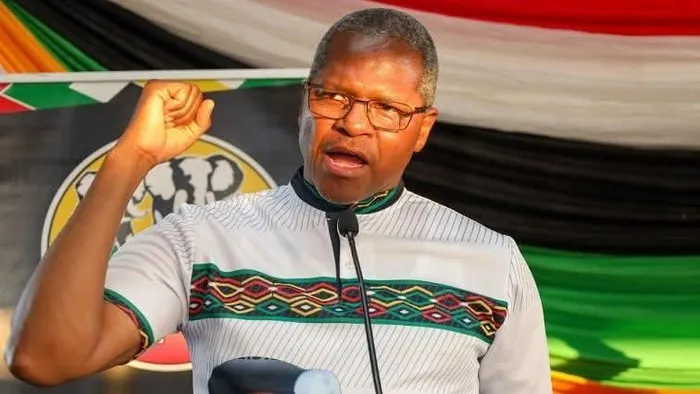
IFP Gauteng Provincial Chairperson, Bonginkosi Dhlamini recently suggested that party leader Velenkosini Hlabisa (pictured) remains the president for as long as he wishes as compared to a new candidate being elected when the party holds its next election conference.
Image: Supplied
Political parties in KwaZulu-Natal are grappling with internal disputes that could affect their election campaign preparations as the country edges towards the local government elections this year.
The province's main political players, including the Government of Provincial Unity (GPU) leader, the Inkatha Freedom Party (IFP), uMkhonto weSizwe Party (MKP), the ANC, and the National Freedom Party (NFP), were facing varying degrees of leadership tensions and organisational instability.
Within the IFP, comments by the party's Gauteng Provincial Chairperson, Bonginkosi Dhlamini, have sparked debate about internal democracy.
Dhlamini recently suggested that party President Velenkosini Hlabisa should remain in the position for as long as he wishes, a view that appears to contradict the party's earlier resolution to hold its elective conference in December after the local government elections.
The party previously resolved to postpone its leadership conference to focus on campaigning for the elections, which are expected to take place in November.
Speaking at the funeral of IFP Zululand deputy chairperson Thokozani Mkhize, Dhlamini defended Hlabisa’s leadership, stating that the party has historically allowed its president to remain in office until they choose to step down, a tradition established by the party's founder, Mangosuthu Buthelezi.
"We cannot change ourselves now as the IFP because it is our norm that in the IFP, a president holds the position until he decides to step down," said Dhlamini.
He said Hlabisa was Buthelezi's choice, and those who wanted a new leader were saying the founder of the party was wrong.
"Those who want Hlabisa to step down doubt the result of the 2019 conference, and they make it seem like a crime to have Hlabisa as president," said Dhlamini.
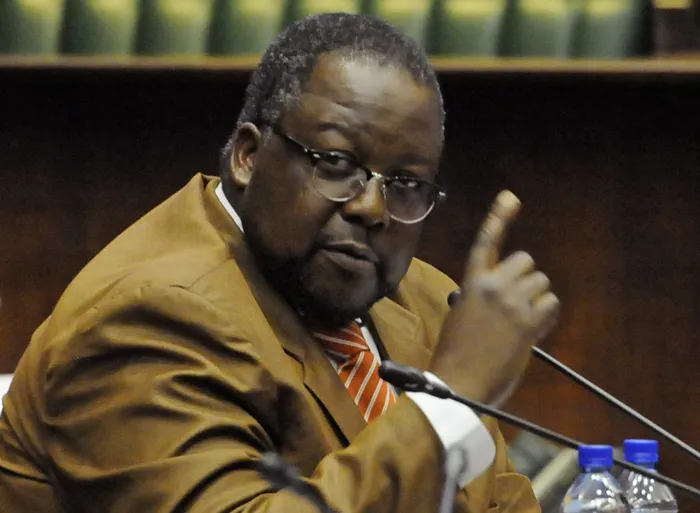
uMkhonto weSizwe Party National Chairperson Nkosinathi Nhleko this week announced several leadership changes.
Image: File
Meanwhile, the uMkhonto weSizwe Party (MKP), which performed strongly in KwaZulu-Natal during last year's general elections, continues to grapple with leadership instability.
MKP National Chairperson Nkosinathi Nhleko this week announced several leadership changes. Among them was the replacement of Secretary-General Dr Bongani Mncwango by Member of Parliament Sibonelo Nomvalo. Other changes included the appointment of Simphiwe Mpungose as provincial secretary and Gobizizwe Makhanya as provincial organiser in KwaZulu-Natal.
The reshuffle follows complaints from disgruntled MKP members, who have called on President Jacob Zuma to suspend the party’s provincial and regional leadership, accusing them of ignoring members' grievances and sidelining the party's founding supporters.
MKP spokesperson Nhlamulo Ndhlela dismissed suggestions that the changes reflected divisions within the party.
He said the party's interim leadership structure was designed to make it easier to remove individuals who misuse their positions.
"The interim structure came from the wisdom of President Zuma because he knows that people sometimes occupy positions for their own benefit rather than the advancement of the organisation," Ndhlela said.
The ANC's provincial leadership is also facing uncertainty after Secretary-General Fikile Mbalula indicated on the sidelines of the ANC's National General Council (NGC) in December that the party's Provincial Task Team (PTT) could be restructured, accusing it of moving too slowly in rebuilding party structures in the province.
The PTT has failed to rebuild structures to be ready enough for the elective conferences of the provincial and regional bodies.
The KZN Legislature's kingmaker, the National Freedom Party (NFP), is similarly facing internal tension.
The party is embroiled in a dispute involving its only Member of the Provincial Legislature (MPL), Mbali Shinga, who faces disciplinary action for refusing to step down as an MEC in the IFP-led GPU, where she heads the Social Development portfolio, and for not supporting a motion of no confidence backed by the MKP and EFF.
Acting NFP Secretary-General Sunset Xaba said the party had discovered a plot by disgruntled members to approach the Electoral Commission of South Africa (IEC) in an attempt to block it from contesting the upcoming elections.
University of KwaZulu-Natal political analyst Zakhele Ndlovu said the parties cannot afford to approach the local government elections with internal divisions.
He said each party needs to forge internal unity because voters cannot have confidence in parties with internal divisions.
"There is no party that shows unity. There is no party that seems to be united. So, because they are all facing similar problems, it is not going to be a train smash, and if there were a united party, it could have been able to capitalise on the others that are not united," he said.
Ndlovu said divisions create an impression that a divided party cannot hold its councillors accountable.
The IFP, ANC, and the NFP did not respond to requests for comment on their internal challenges.