

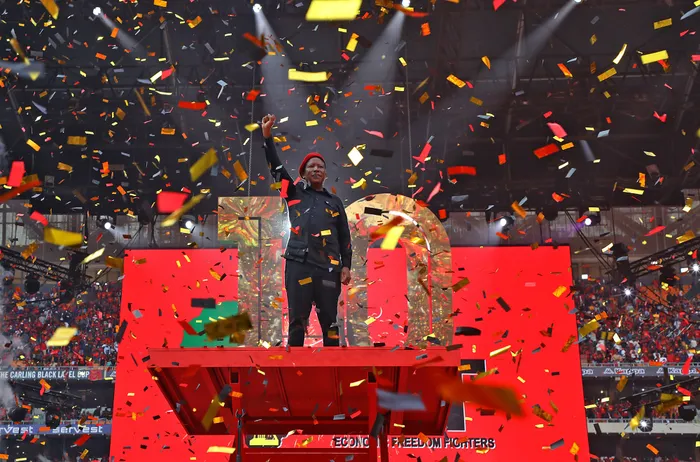
EFF leader Julius Malema is appealing a five year prison sentence handed to him this week.
Image: Oupa Mokoena / African News Agency
The EFF’s short-term future and its prospects in the upcoming local government elections are unlikely to be adversely affected by party leader Julius Malema’s five-year prison sentence for firearm-related offences handed down this week.
Malema was sentenced to a five-year jail term by the kuGompo Magistrate’s Court in the Eastern Cape on Thursday for discharging a firearm during the EFF’s fifth anniversary celebrations at the Sisa Dukashe Stadium in Mdantsane in July 2018.
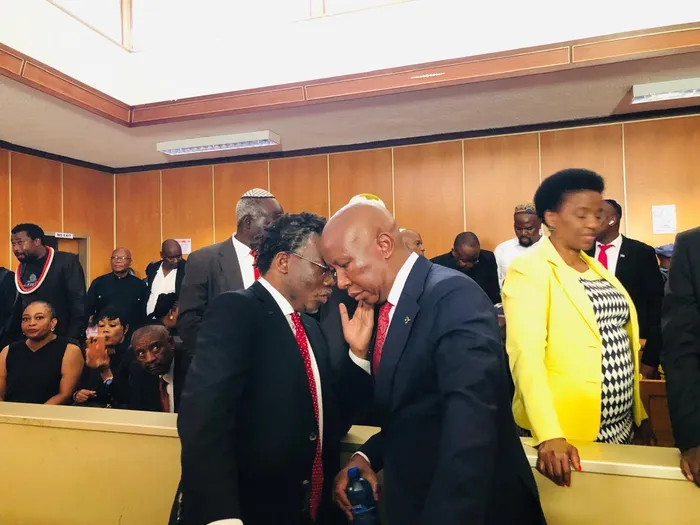
EFF leader Julius Malema in deep conversation with hi legal representative Advocate Tembeka Ngcukatoibi at the kuGompo Magistrate's Court, which sentenced him to five years in prison for discharging a firearm during the party's fifth anniversary celebration in July 2028.
Image: Abongile Ginya / I'solezwe lesiXhosa
Magistrate Twanet Olivier granted Malema leave to appeal only the sentence but not the conviction.
Professor Kgothatso Shai, the Head of the Department of Cultural and Political Studies at the University of Limpopo, stated that regardless of the outcome of the case, Malema is likely to emerge resilient.
“There is precedence to this effect. Like (former president Jacob) Zuma around the year 2006/7, Malema has successfully managed to play a victim of white power in South Africa and global imperial designs.
“The majoritarian of Black Africans in and outside the EFF buy into this narrative and they may uncompromisingly throw their lot behind him and his party,” Shai predicted.
North West University-based political analyst Professor André Duvenhage said while the Constitution determines that anyone sentenced to prison for more than 12 months is not fit to take a position in Parliament, there was an important qualification.
In terms of the Constitution, any person convicted of an offence and sentenced to more than 12 months' imprisonment without the option of a fine, either in the country or outside, the conduct constituting the offence would have been an offence in South Africa.
However, it states that no one may be regarded as having been sentenced until an appeal against the conviction or sentence has been determined or until the time for an appeal has expired and that the disqualification only ends five years after the sentence has been completed.
Duvenhage said it was too early to dig Malema’s political grave.
“That (appeal) process can take a long time, in fact even up to years, if he’s going right up to the Constitutional Court and if you’re following delaying tactics, the whole Stalingrad type of approach,” he said.
Duvenhage added that he did not see major implications for the EFF in the short-term because he believed Malema will still be around.
“I cannot see him not being there up until the 2026 local government elections coming from (Thursday’s) verdict. But we don’t know what may cross his road in future,” he explained.
According to Duvenhage, should Malema go to jail without the likes of his former lieutenant and deputy Floyd Shivambu, who dumped the EFF in August 2024, and the group of other leaders who also left the party, the EFF may be in crisis.
He continued: “In the short-term I cannot see the EFF without Malema and I don’t think this court case will have a major impact on their support base although their support base is dwindling, that is due to organisational and other challenges, losing some of their strong leaders and so on.”
The EFF’s constitution makes provision for the convening of a national general assembly, which is the only gathering that can replace an official who has vacated a position due to resignation, expulsion or death, and in the intervening period, the central command team can appoint an acting person from within its ranks, within six months, unless the national people’s assembly is scheduled within that period.
Shivambu’s position has not been filled since leaving the EFF two years ago.
loyiso.sidimba@inl.co.za