

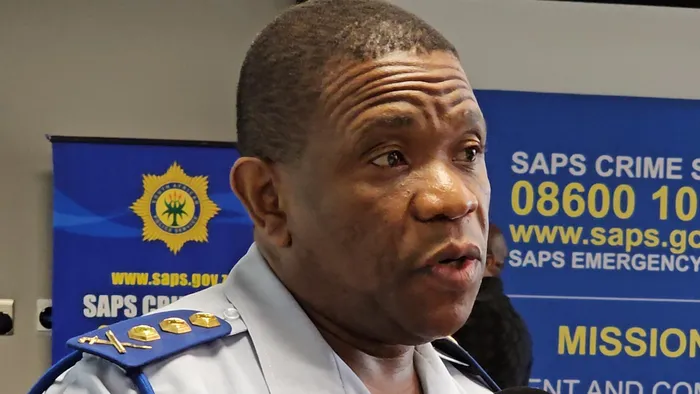
Lieutenant General Nhlanhla Mkhwanazi, KwaZulu-Natal Provincial Commissioner and head of the new national Organised Crime Task Team, calls on residents to report suspicious lavish lifestyles that may indicate organised crime and corruption, emphasising the crucial role of community vigilance in enhancing law enforcement efforts.
Image: Karen Singh/Independent Media
KwaZulu-Natal Provincial Commissioner Lieutenant General Nhlanhla Mkhwanazi, recently appointed to lead the new national Organised Crime Task Team, has called on communities to become the eyes and ears of law enforcement, particularly in rooting out corruption and organised crime linked to dodgy contracts and suspicious lifestyles among public servants.
In addition to the R1 billion budget and national coordination structure unveiled for the task team, Mkhwanazi stressed that the public’s active participation is a non-negotiable part of the strategy to fight deep-seated criminality.
"As I have always said, the residents of the province of KwaZulu-Natal have been very kind to us,” Mkhwanazi stated. “I want to encourage you [the public] to monitor what we do as a province, to stay a part of the line, but I want them to also share information with us, because if they share information with us, we'll be able to get those perpetrators and remove them from society."
The Commissioner highlighted that organised crime, which the new task team is focusing on, is heavily influenced by "dubious" tenders and construction projects that are not finalised.
He urged residents across the country to pay close attention to the financial habits of those in power.
"More importantly, when they start seeing the lifestyle of government employees, the lifestyle of even politicians, when examined, is often far beyond what their salaries would suggest, they might want to start giving us tip-offs so that we can look at it," he said.
Mkhwanazi explained that communities are often the first to notice suspicious affluence.
"The communities know things, that so and so who was nobody yesterday, today becomes a councillor or whatever position... and next thing he starts driving fancy cars, clothes, house where he lives in, starts drinking expensive alcohol. That lifestyle might need to be checked. We can only check that by registering enquiries and start probing some of these things," he said.
Beyond just organised crime, Mkhwanazi is driving a fundamental change in how local police stations interact with their communities to improve overall crime fighting. He has instructed station commanders across the province to hold mandatory monthly engagements with the community, regardless of the venue.
This commitment to transparency is designed to build trust and information-sharing. Commanders are required to provide status updates on local crime patterns and the performance of investigations.
Mkhwanazi detailed the crucial need for public updates on individual cases. "For instance, you will have someone in that community being shot or killed, the family members of the injured or the victim might get a briefing from the police, but the rest of the residents do not know the status of the case."
He confirmed that police have an obligation to keep the public informed, right up to the final legal outcome.
"The station commander has an obligation with the detectives...to inform the community that there was this incident in the area. And this is what we have done as the police, what is the status of the case involved, the outcome of the case involved and even if a person is taken to Correctional Services, there's going to be a parole hearing that will take place, the community must be informed that so and so who was arrested is now released on parole so that the community is aware of it."
The Commissioner is convinced that this dual approach, combining a coordinated national task team with granular, consistent community engagement, is the key to success.
"With that kind of sharing of information between the community and the police is going to strengthen our fight against crime. And we will be able to know exactly what is happening," he said.
While Mkhwanazi takes on the strategic role of coordinating the new national anti-crime body, which is tasked with targeting the highest levels of organised crime, international syndicates, drug trafficking, and corruption, he maintains his command in KZN.
"I will continue to work in the province, but I will be moving around and not necessarily based in KZN all the time," he confirmed.