

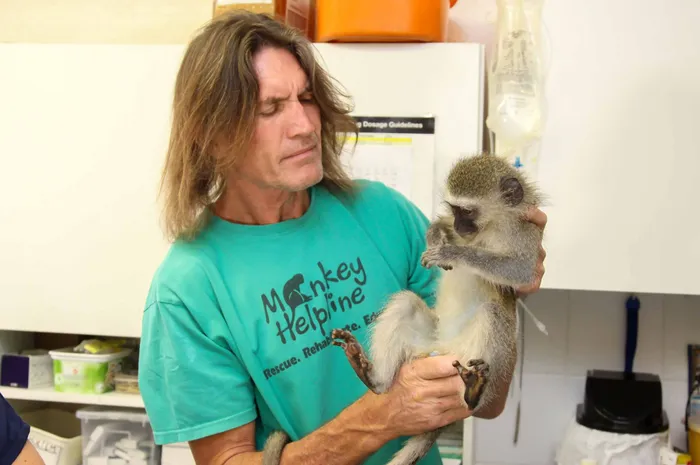
Monkey Helpline co-founder Steve Smit said he would be honoured to provide any input on an informed and scientifically supported approach to managing residents' challenges with monkeys. The eThekwini Municipality intends to collaborate with the University of KwaZulu-Natal, Pietermaritzburg campus (UKZN-PMB) on the project.
Image: File
Urban populations of vervet monkeys along Durban’s northern coastal belt have surged to levels estimated at six to twelve times higher than what the remaining coastal forest ecosystems can naturally support.
This finding comes from research conducted in November 2025 by Pete Graham, titled When fences go up, Monkeys move in — Vervet Monkeys in urban North Durban ecological overshoot, bird-life collapse, and human-driven population inflation. His study focused on areas including Durban North, La Lucia, Glenashley, Umhlanga, and uMdloti.
By the end of April, the eThekwini Municipality council is expected to approve a proposal to collaborate with the University of KwaZulu-Natal, Pietermaritzburg campus (UKZN-PMB). The aim is to develop a more informed, science-based strategy for addressing residents’ concerns about monkeys.
The municipality intends to partner with the UKZN-PMB to protect, conserve, and educate the public about the city’s unique biodiversity, plants, animals, and habitats. The municipality will undertake the proposed initiative through the eThekwini Natural Resources Division (NRD), the Durban Natural Science Museum and Biodiversity Management.
Zama Sokhabase, chairperson of the municipality's Community Services Committee, said that urban development has led to habitat loss and fragmentation, resulting in increasing human-monkey conflicts within eThekwini.
In a summary of Graham’s study, he found that the vervet boom is a modern ecological distortion caused entirely by human food subsidies, predator removal, garden-rich landscaping, waste access, artificial water sources and absence of ecological checks.
Graham said the result has been a vervet population that is numerically abundant but ecologically degraded. He found that this overshoot now significantly affects bird populations, especially small to medium species, including weavers, bulbuls, robins, barbets, and sunbirds, and creates public hysteria when the few remaining apex predators (e.g., Crowned Eagles, Martial Eagles) do their natural job.
“A persistent public claim is that humans moved into monkey habitat, so monkeys are only reclaiming their space, which is factually wrong. Monkeys only became a major suburban presence from the late 1990s onward,” Graham said.
His study found that the vervet boom in the last 25 to 30 years correlates perfectly with the growth of lush, irrigated gardens, the explosion of fast-food waste, fruit trees in every yard, and bird feeders on nearly every property and the loss of apex predators
“Monkeys are not victims of urbanisation. They are beneficiaries of it,” Graham said.
His study also focuses on the Crowned Eagle / Martial Eagle irony, a comparison with Johannesburg, the consequences of vervet overshoot, breakdown of natural troop structure and fertility control.
Ashok Rambharosa, animal rights activist and founder of Phoenix SPCA, said he was delighted to hear that the municipality is looking towards a science-led strategy to manage urban wildlife interactions between humans and monkeys.
“Due to rapid development, wildlife species such as vervet monkeys are starving and in desperate need of food, hence they will be seen in built-up areas attracted to refuse bins and within households themselves,” Rambharosa said.
Steve Smit and Carol Booth of Monkey Helpline said they are looking forward to contributing to something positive that will further the research on vervet monkeys. Both have a combined 40 years of experience with monkeys.
“When it comes down to research they will have to sift out folklore from reality. A constructive project cannot be done without some kind of workshop with all organisations and roleplayers and put forward their ideas and thoughts,” Smit said.
Sokhabase said the proposed project aims to promote the application of urban conservation principles informed by credible research and broad stakeholder collaborations to resolve human-wildlife interaction issues.
“Currently, there is a significant lack of scientific evidence regarding the expansion of the vervet monkey population beyond sustainable levels, and no comprehensive database exists on the number of monkey troops within the city,” Sokhabase said.
To address the knowledge gap and mitigate conflicts, the partnership with the UKZN PMB on a new citizen science project aims to record the numbers of mammalian species, particularly the vervet monkey, within neighbourhoods. She said, this will support evidence-based conservation and management solutions.