

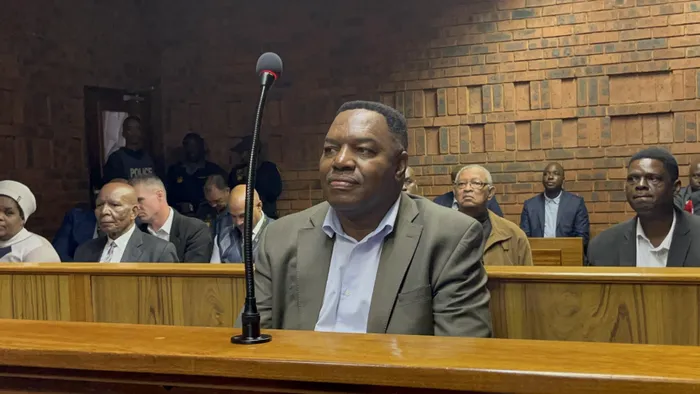
National police commissioner General Fannie Masemola at the Pretoria Magistrate's Court to face charges of contravening the Public Finance Management Act.
Image: Kamogelo Moichela / IOL News
National police commissioner General Fannie Masemola’s precautionary suspension by President Cyril Ramaphosa, following criminal charges for allegedly violating the Public Finance Management Act (PFMA), is unlikely to resolve the deeper challenges facing the SA Police Service (SAPS).
Ramaphosa announced this week that he and Masemola had agreed he would be placed on precautionary suspension pending the outcome of the case, after the police chief appeared in the Pretoria Magistrate’s Court.
The president has appointed divisional commissioner for financial management services Lieutenant-General Puleng Dimpane as acting national police commissioner.
Masemola is charged with contravening the PFMA in relation to the alleged irregular awarding of a R228 million contract to Medicare24, which is owned by controversial businessman and attempted murder accused Vusimuzi “Cat” Matlala.
Masemola and 16 co-accused, including Matlala, are expected back in court next month, with the others facing charges such as corruption, fraud, and money laundering.
Prof. Kholofelo Rakubu, criminologist and Assistant Dean: Research and Innovation at the Tshwane University of Technology’s Humanities faculty, described Masemola’s precautionary suspension as once again highlighting a recurring governance pattern within the SAPS: the reliance on suspension as a substitute for deeper institutional reforms.
“While suspension may serve as a short-term accountability measure, it does not address the systemic vulnerabilities that repeatedly place national commissioners in positions where suspension becomes inevitable,” she said.
According to Rakubu, the SAPS has long struggled with structural weaknesses such as opaque procurement systems, politicised appointments and inadequate oversight that create fertile ground for governance failures.
“These vulnerabilities mean that leadership instability is not an exception but a recurring feature. The result is a cycle where commissioners are suspended, acting appointments are made and the institution remains in a state of paralysis,” she explained.
Rakubu also stated that Dimpane’s temporary leadership must be understood within this context and that while she may bring professionalism and stability in the short term, the limitations of acting appointments are clear: they lack the authority and long-term mandate to drive reform.
“This is compounded by the fact that the police ministry itself is under acting leadership, which further weakens strategic direction and continuity,” she added.
Rakubu believes that the impact of having both an acting minister and an acting commissioner is significant and creates uncertainty, undermines morale within the ranks, and signals to the public that the institution is in a perpetual state of crisis management rather than reform.
“Without a commitment to institutional restructuring, strengthening governance frameworks, depoliticising appointments, and ensuring accountability mechanisms beyond suspension, the SAPS will remain trapped in this cycle,” she warned.
In addition, Rakubu stated that in the short-term, the current situation within the SAPS reflects not just the challenges of individual leadership but the failure to address systemic reform.
“Until governance is strengthened at its roots, acting appointments will continue to serve as placeholders rather than solutions, perpetuating paralysis within the SAPS,” she declared.
The Independent Police Union of South Africa (Ipusa) said Masemola’s precautionary suspension was a necessary move to uphold the SAPS’s integrity and that his court appearance highlighted the pressing requirement for accountability at the highest levels of policing.
Ipusa said Dimpane’s acting stint as national commissioner should emphasise the importance of utilising this interim period constructively to restore public confidence in SAPS.
“The institution faces deep-rooted challenges, including corruption, inconsistent enforcement of disciplinary measures, and political interference, all of which have steadily undermined public trust,” the union added.
Ipusa said Dimpane has a valuable, though possibly brief, opportunity to show that SAPS leadership can be defined by transparency, fairness, and robust protection for whistleblowers.
“Her effectiveness will be measured not by words, but by actions – specifically, the consistent application of disciplinary processes, safeguarding procurement procedures from manipulation, and ensuring that honest officers are protected rather than targeted,” Ipusa stated.
It suggested that to move SAPS forward, she must prioritise independent investigations that are allowed to proceed without fear or favour, and institutional reforms should reinforce compliance and oversight mechanisms.
The union also said that while Dimpane’s challenges will be rooted in operational experience, her relationship with the board of commissioners will be pivotal to her success or failure.
“Ipusa advises her to draw on the collective expertise of the board, uphold the Constitution, and avoid advancing personal interests,” the union opined.
The Freedom Front Plus said Dimpane was the SAPS’s chief financial officer during a period marked by extensive financial irregularities, in which significant sums of money were misappropriated and that evidence of this has recently been presented before the Madlanga Judicial Commission of Inquiry, among other platforms.
“This does not mean that Dimpane is directly implicated in any wrongdoing, but the fact that these transgressions occurred under her watch does not instil confidence,” the party said.
Brett Herron, secretary-general of the GOOD Party, said long-suffering South Africans should not have had to wait for Masemola to be suspended after appearing in court in relation to alleged tender oversight failures.
“He should have been pushed out last year when the levels of depravity in the senior ranks of police under his command became clear in the early proceedings of the Madlanga Commission and Parliamentary Ad-Hoc Committee probing police malfeasance,” he said.
Herron added that there is no evidence that Masemola benefitted from corruption but his weak management enabled corruption and that the police need stronger leadership.