

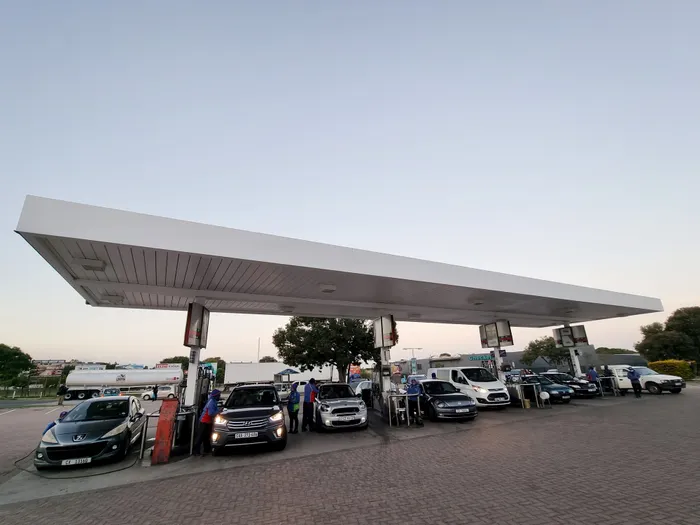
Recent fuel price hikes have left South Africans grappling with financial strain, as the Department of Mineral Resources and Energy announced significant increases in petrol and diesel prices. With the cost of living already high, consumers brace for further economic challenges.
Image: David Ritchie / Independent Media
Fuel price increases across the board announced this past week has left South Africans reeling.
The Department of Mineral Resources and Energy (DMRE) announced that motorists will pay R5.27 per litre more for diesel in May and R3.27 per litre more for Petrol.
While the continuation of the temporary fuel price levy reprieve of R3.00 per litre is good news, consumers need to brace themselves for a further blow. This is set to be halved to R1.50 per litre for petrol and R1.96 for diesel in June 2026, before falling away completely in July.
The latest price hikes are being placed firmly at the door of the ongoing Middle East conflict, and more specifically, the economic carnage being inflicted daily by the Strait of Hormuz staying closed.
“Regardless of the global headwinds that are causing oil prices to skyrocket, South Africans are caught between a rock and a hard place, and this spells imminent disaster for households and for the country,” said CEO of Debt Rescue Neil Roets.
“The reality is that the latest petrol price disaster exposes the extent of a far deeper cost-of-living crisis, driven by the fuel price increases, higher electricity and water tariffs and ongoing food inflation, which has pushed people to the very limits of their financial resources. This is deeply concerning,” he added.
For South Africans, the impact of the high oil price arrives at the petrol pump, in taxi and bus fares, in grocery bills and in the everyday costs of getting on with life.
According to new data from Discovery Insure, South African motorists have already significantly cut back on petrol and diesel use, following the sharp increases of April 2026, buying 35% less fuel in April compared to March. Data shows that trips taken are down 10%, and the total distance travelled dropped by 9%.
According to Roets, the country’s agricultural industry, which mostly runs on diesel, is among the hardest hit by the jump in fuel prices, and this will have devastating consequences for consumers, especially those in the lower-income range.
“The spiralling oil prices have triggered a severe economic impact in South Africa, creating a ‘cost of survival’ crisis for consumers and heavily taxing the agricultural sector. This is because fuel price hikes are raising production costs and driving up food prices,” Roets said.
“With petrol and diesel prices respectively climbing by around 15% and 40% per litre month-on-month in April, producers entering planting or harvesting season will face cost pressures as diesel consumption typically peaks during these times. Rising fuel prices also carry wider inflationary effects across the economy and may delay anticipated interest rate cuts,” Absa AgriBusiness sector executive for agriculture, Loffie Brandt said.
“The upshot of this is that, as petrol and diesel prices increase, the likelihood of a rise in consumer price inflation and higher interest rates also increase,. This does not bode well for already struggling households across the country, who have already tightened their belts in every which way possible,” Roets said.
“While the onus – rightly or wrongly - is on the man on the street to tighten his belt even further, it is essential that authorities respond with practical solutions to alleviate the financial pressure on South Africans, or we are looking at a consumer cost-of-survival crisis of immense proportions looming on the horizon,” Roets added.
My advice to those who cannot break free from their financial constraints is to seek help from a registered debt counsellor who can assist them to manage their financial predicament. This has been a very successful solution for thousands of consumers who are plagued by over-indebtedness,” he said.
Meanwhile, Trade unions and lobby groups have said that more needs to be done to help shield consumers from the soaring fuel price shocks by government as the effects of the United States and Iran war is beginning to reach our shores.
The Congress of South African Trade Unions (Cosatu) said that it is deeply concerned about the impact of the massive increase in fuel prices over two consecutive months.
"This is a painful blow that millions of struggling workers and commuters, and an already stagnant economy stuck at anemic 1% growth simply cannot afford. Government’s extended fuel levy relief for May and June is a welcome step forward, but more relief will be needed," Cosatu said in a statement.
The union said that the most important source of relief for workers, society and the economy, is to maintain the fuel levy relief whilst oil and fuel prices remain high.
"This is the most impactful and cost-effective solution to this global crisis. Additional relief should be sought by making public transport more affordable to commuters," Cosatu stated.
Follow Business Report on Facebook, X and on LinkedIn for the latest Business and tech news.