


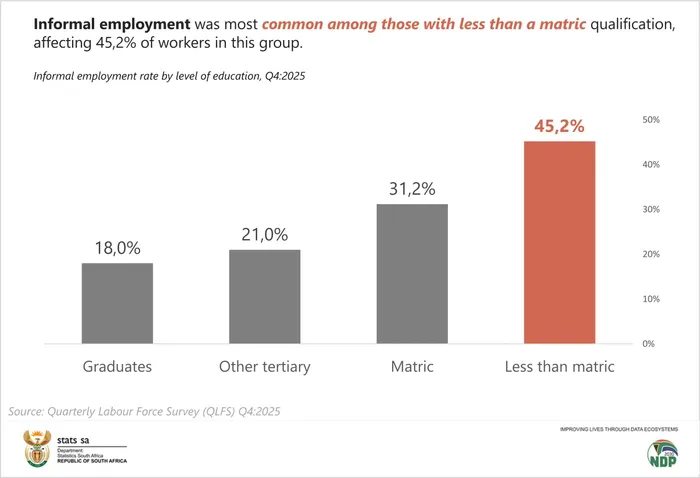
Workers with lower levels of education are far more likely to be in informal employment.
Image: Nicola Mawson | IOL
In cities and townships, on busy streets and in neighbourhood markets, a large part of South Africa’s economy operates outside formal business structures.
Although it functions without many of the protections or regulatory frameworks that define the formal economy, the informal sector supports millions of livelihoods in a country facing persistent unemployment and inequality.
“The informal sector is a vital source of income in a country facing persistent unemployment and inequality,” Statistics South Africa says in a recent report.
Its importance has come into sharper focus since the third quarter of 2025, when South Africa adopted refined definitions of informality recommended by the 21st International Conference of Labour Statisticians.
The updated framework shifts how informal businesses are identified. Instead of focusing primarily on the size of an enterprise, the definition now centres on whether a business is registered for value-added tax or income tax, keeps records for tax purposes, or is registered with the Companies and Intellectual Property Commission.
According to Statistics South Africa’s Quarterly Labour Force Survey for the fourth quarter of 2025, employment in South Africa edged higher during the period.
Most workers remain in the formal sector, which accounts for nearly three quarters of all jobs.
The informal sector is the second-largest source of employment, making up just over a fifth of the labour market, while a smaller share of workers are employed in private households.
Changes between the third and fourth quarters of 2025 highlight how uneven shifts in employment can be across different parts of the economy.
Most of the gains came from the formal sector, which added a substantial number of jobs. Employment in private households also rose slightly.
The informal sector moved in the opposite direction, however, losing a significant number of workers over the same period.
Across industries, employment growth was largely driven by increases in community and social services, construction, finance and agriculture. Trade recorded the biggest decline in jobs, followed by manufacturing and mining.
Employment levels by education level.
Image: StatsSA
The informal sector accounted for a large share of these losses. Trade alone shed a significant number of informal jobs, while agriculture and manufacturing also saw notable declines. Finance recorded smaller but still meaningful losses.
These shifts highlight how sensitive informal work can be to changes in economic conditions and illustrate the sectors where workers often face the greatest instability.
A distinction is also drawn between the informal sector and informal employment. While the informal sector refers to the characteristics of a business, informal employment focuses on the nature of the job itself.
Informal employment includes workers who do not have access to basic employment protections such as social insurance, pensions, paid annual leave or paid sick leave. These workers may be employed either in the informal sector or within formal businesses.
The data shows how widespread this form of employment remains. Of the country’s workforce, roughly one in three workers are in informal employment – meaning they work without access to benefits such as pensions or paid leave.
Informality affects both men and women, although a slightly larger share of men are employed informally.
For young people the situation is particularly challenging. Those aged 15 to 24 continue to face the highest unemployment rate in the country at more than half that cohort, and among those who do find work, about half are employed in informal jobs.
Education also plays a clear role in determining who is most likely to work informally. Workers with lower levels of education are far more likely to be in informal employment, while the likelihood drops significantly among those with tertiary qualifications, particularly university graduates.
IOL BUSINESS