
Geopolitical concerns amid modest GDP growth could postpone interest rate cuts.
Image: ChatGPT
South Africa’s modest economic growth is colliding with rising global risks, and economists now warn that interest rate relief may not come as soon as many households had hoped.
Statistics South Africa on Wednesday reported that the economy expanded by 0.4% in the fourth quarter of 2025, lifting full-year growth to 1.1% – the strongest annual performance since 2022, but still weak by historical standards.
PSG chief economist Johann Els said the fourth quarter figure was slightly stronger than expected, although underlying conditions remain fragile.
“South Africa's fourth quarter 2025 GDP came out a touch stronger than expected,” Els said.
Els noted that mining, manufacturing, electricity and construction all contracted during the quarter, while stronger performance from the financial sector and trade helped support the economy.
“The financial sector was more positive than expected, rising by 1.4% quarter-on-quarter. The trade sector also reflected consumer spending growth and was positive to the tune of plus 0.9% quarter-on-quarter,” Els said.
Despite the slightly better fourth quarter outcome, downward revisions to earlier quarters meant the economy still only grew by 1.1% for the year.
“The previously very strong middle quarters of the year were revised lower… resulting in the 1.1% annual average growth. So that's pretty weak growth, which is the same as the annual average growth on average over the last 16 years of 1.1%,” he said.
Els added “at least it's better than 2024, and we still expect better growth in 2026 as well”.
The broader economic outlook is also being complicated by global risks, particularly the conflict in the Middle East and its potential impact on energy prices and inflation.
“There’s huge question marks around the length of the Middle East conflict, which could potentially have downward impact on global and SA growth,” Els said.
Rising fuel prices could complicate the inflation outlook in the near term, Els said. “There will be an inflationary impact in April, significant petrol price increases coming,” he said.
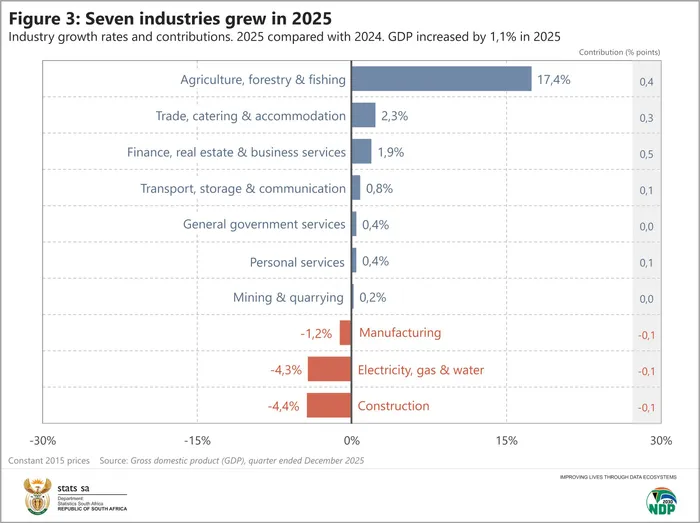
Seven industries grew in 2025.
Image: StatsSA
As a result, rising fuel costs and the risk of higher inflation could complicate the outlook for monetary policy. “I think interest rate cuts in South Africa are likely be delayed,” Els said.
Nolan Wapenaar, co-chief investment officer at Anchor Capital, said the geopolitical escalation had already started to change the outlook that investors and policymakers had expected earlier this year.
“At the start of this year, South Africa’s macroeconomic outlook had been gradually improving. Inflation had moderated, fiscal consolidation appeared to be gaining traction, and markets had begun to anticipate the likelihood of further monetary policy easing,” Wapenaar said.
Yet, the latest geopolitical developments have complicated this outlook, Wapenaar said.
“A sustained increase in oil prices could place upward pressure on inflation at a time when policymakers were hoping to anchor inflation expectations closer to the South African Reserve Bank’s (SARB’s) 3% target,” he said.
The central bank’s Monetary Policy Committee is due to meet on 26 March amid the uncertainty of the geopolitical climate.
Governor Lesetja Kganyago has indicated that the central bank may need to reassess its risk scenarios in light of the geopolitical escalation, Wapenaar said. “Policymakers are now confronted with a classic supply-side shock – rising energy prices that lift inflation while dampening economic growth,” he said.
“Cutting rates in such an environment risks undermining the SARB’s inflation credibility, while maintaining restrictive policy for longer would place additional strain on households and businesses.”
Maarten Ackerman, chief economist at Citadel, said the overall growth picture remained fragile despite the modest improvement in 2025.
Earlier on Tuesday, Statistics South Africa said the fourth quarter growth was driven mainly by finance, trade and personal services. However, the production side of the economy still showed significant weakness, with manufacturing and mining both lower.
“While this marks the strongest annual growth outcome in several years, it remains insufficient to meaningfully address South Africa’s deep seated structural challenges. Importantly, economic growth continues to lag population growth, meaning the country remains in a per capita recession,” he said.
Ackerman added that global risks – particularly the potential inflationary impact of higher oil prices linked to Middle East tensions – could further complicate the outlook for interest rates.
“In the current environment, further interest rate cuts by SARB’s Monetary Policy Committee appear unlikely until there is greater clarity on the inflation outlook and the eventual resolution of tensions in the Middle East,” said Ackerman.
Else noted that, “for now, I think it’s best to not make significant forecast changes. It is rather dangerous, but also difficult.”
IOL BUSINESS