

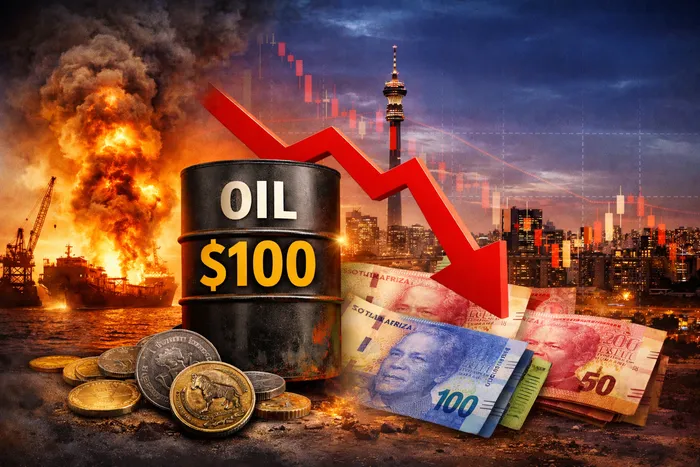
Oil prices remain elevated compared with levels seen at the end of February, keeping inflation and interest-rate concerns firmly in focus.
Image: ChatGPT
South Africa’s economic outlook is facing fresh uncertainty as the conflict in the Middle East drives oil prices higher, raising inflation risks, putting pressure on the rand and dimming hopes of an interest-rate cut later this month.
Investec chief economist Annabel Bishop said on Thursday that the country’s economic growth this year will depend heavily on how long the conflict lasts.
South Africa’s gross domestic product growth is currently forecast at 1.5% year-on-year in 2026, although risks are tilted to the downside should the war drag on. The 2025 figure, at 1.1%, was below the Bloomberg consensus of 1.3%.
While the conflict has heightened concerns about global economic growth, Bishop said a severe economic shock is not currently expected.
Instead, a mild to moderate impact on South Africa’s economy is more likely, with oil and related petrochemical supply not expected to face prolonged disruptions.
However, global markets have already begun reacting to the conflict, with oil prices surging and investors shifting into safer assets.
Trading Economics said the rand weakened towards R16.40 per US dollar as traders sought refuge in the dollar amid heightened inflation risks linked to the Iran conflict and volatile oil prices.
“The rand has been under pressure recently, weighed down by global risk aversion and volatile oil prices, a particular concern for South Africa as a net fuel importer,” it said.
Brent crude futures surged above $100 a barrel before trimming gains, marking a second straight session of increases as supply fears in the Middle East overshadowed efforts by major economies to release emergency oil reserves.
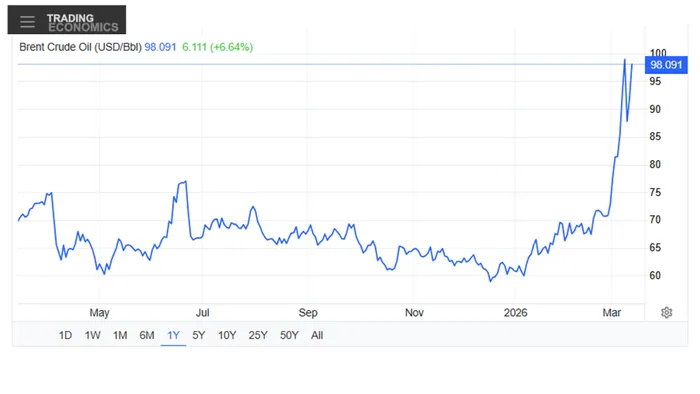
Developed countries are releasing oil as supply dwindles.
Image: Trading Economics
The Strait of Hormuz, which carries roughly a fifth of global seaborne oil supply, remains effectively shut amid the conflict, while attacks on shipping and energy infrastructure have heightened supply concerns.
Iraq halted operations at oil terminals after tankers were targeted in its waters, while several commercial vessels were reportedly struck near Iran.
The International Energy Agency approved the release of about 400 million barrels of emergency oil reserves to stabilise global markets, while the US plans to release 172 million barrels from its own reserves.
Bianca Botes, director at Citadel Global, said on Thursday that market sentiment remained fragile as the conflict intensified.
“Yesterday was testament to just how fickle sentiment is and how fragile the geopolitical situation remains.”
Botes said oil prices surged nearly 9.5% on Wednesday after ships in the Gulf were targeted and oil terminals were closed.
“High oil prices and their knock-on effect on inflation, now sees the possibility of a rate cut by the South African Reserve Bank later in the month decreasing significantly.”
Wichard Cilliers, head of market risk at TreasuryONE, said the conflict was already rippling through global energy markets.
“The war in the Middle East is starting to have a real impact on global markets, particularly oil markets.”
Cilliers said disruptions around the Strait of Hormuz, through which roughly 20% of the world’s oil normally passes, had intensified supply concerns.
“The rand and other emerging-market currencies are back under pressure this morning, as higher oil prices are pushing markets back into risk-off mode for now.”
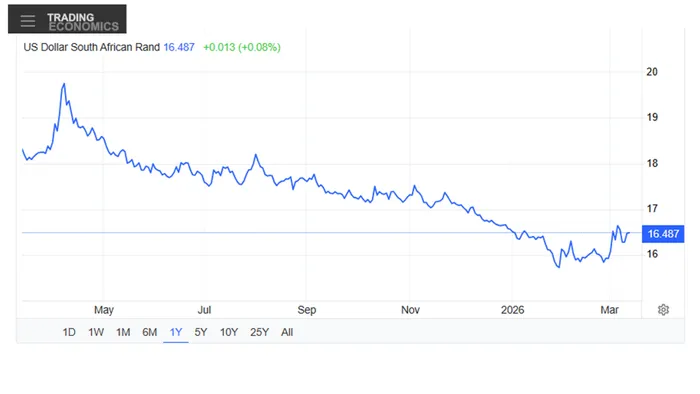
Investors are fleeing to safe haven assets.
Image: Trading Economics
Investec noted on Wednesday that oil prices are likely to remain volatile while the conflict continues.
The domestic fuel price calculation for April has already climbed sharply, with the under-recovery rising to R3.52 per litre.
However, the calculation has not yet captured the recent moderation in the oil price and strengthening of the rand to around R16.30 per dollar from about R16.91 earlier in the week.
Bishop said initial market fears of severe supply disruptions through the Strait of Hormuz had eased somewhat because global oil inventories remain high.
Even so, oil prices remain elevated compared with levels seen at the end of February, keeping inflation and interest-rate concerns firmly in focus.
IOL BUSINESS