

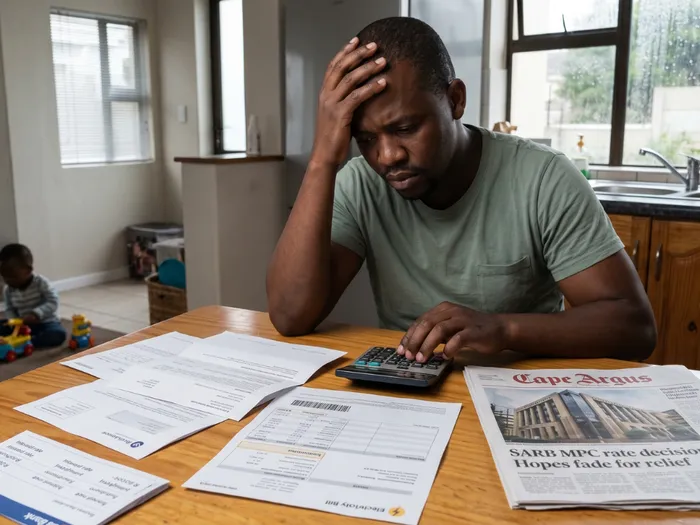
The SARB’s Monetary Policy Committee (MPC) is due to announce its latest interest rate decision on Thursday, with growing expectations of a 25 basis point increase aimed at containing inflation risks linked to the Middle East conflict and rising oil prices.
Image: Gemini/Ai
South Africans are once again bracing for higher borrowing costs as economists increasingly expect the South African Reserve Bank (SARB) to raise interest rates this week after inflation accelerated to 4%, its highest level in 19 months.
The SARB’s Monetary Policy Committee (MPC) is due to announce its latest interest rate decision on Thursday, with growing expectations of a 25 basis point increase aimed at containing inflation risks linked to the Middle East conflict and rising oil prices.
If implemented, the repo rate would increase by 25 basis points, pushing the prime lending rate from 10.25% to 10.50%.
The prospect of higher rates comes as many households remain under pressure from rising living costs, sluggish economic growth and unemployment, which officially stands at 32.7%.
Samuel Seeff of Seeff Property Group urged the SARB not to raise rates, arguing that the recent inflation increase was driven largely by external factors rather than excessive consumer spending.
“The higher inflation is largely imported. It is not the fault of consumers overspending in the economy,” Seeff said.
He said rising fuel prices linked to the Middle East conflict, together with higher electricity tariffs, were behind the inflation increase rather than overheating in the domestic economy.
Seeff warned that another rate hike could further weaken economic activity and add pressure on consumers already battling high debt costs.
The property sector remains particularly vulnerable to interest rate movements.
Bradd Bendall from BetterBond said a 25-basis point increase would still affect affordability for many consumers, despite rates remaining below 2024 highs.
He noted that repayments on a R2 million home loan would still be roughly R1,700 cheaper per month than two years ago.
However, Bendall said first-time buyers were already under strain, with upfront deposit requirements for this segment increasing by 38% in April alone.
He added that younger buyers were increasingly turning to “rentvesting” — renting in preferred areas while buying more affordable investment properties elsewhere to enter the property market.
Economists and currency analysts, meanwhile, believe the SARB may still be compelled to act because of growing inflation risks tied to global oil prices and pressure on the rand.
Escalating tensions in the Middle East and uncertainty surrounding the Strait of Hormuz have pushed oil prices sharply higher in recent weeks, raising concerns about increased fuel and transport costs feeding into broader inflation.
Lara Hodes from Investec said inflation risks had increased because of the conflict.
“The SARB is likely to hike rates by 25bp to 7% this week, acting pre-emptively to prevent any second-round effects from becoming embedded in inflation,” she said.
Lerato Ntuli from Anchor Capital said inflation risks remained “skewed to the upside”, noting that inflation had moved closer to the upper end of the SARB’s newly adopted 3% target framework.
She warned that prolonged conflict in the Middle East could keep global oil prices elevated, placing continued pressure on domestic fuel and transport costs.
Currency markets are also closely watching the SARB decision.
Harry Scherzer from Future Forex said a higher-for-longer interest rate environment helped support the rand and reduce imported inflation risks linked to fuel and energy prices.
Bond markets, meanwhile, are focused not only on whether the SARB hikes rates this week, but also on what signals it gives about future policy moves.
Kristof Kruger from Prescient Securities said markets had already largely priced in a 25-basis point increase, with investors now watching whether the SARB hints at further hikes should inflation and oil prices remain elevated.
However, Kruger said the SARB was “not signalling the end of the cycle”.
IOL
Lara Hodes from Investec said inflation risks had increased because of the conflict.
“The SARB is likely to hike rates by 25bp to 7% this week, acting pre-emptively to prevent any second-round effects from becoming embedded in inflation,” she said.
Lerato Ntuli from Anchor Capital said inflation risks remained “skewed to the upside”, noting that inflation had moved closer to the upper end of the SARB’s newly adopted 3% target framework.
She warned that prolonged conflict in the Middle East could keep global oil prices elevated, placing continued pressure on domestic fuel and transport costs.
Currency markets are also closely watching the SARB decision.
Harry Scherzer from Future Forex said a higher-for-longer interest rate environment helped support the rand and reduce imported inflation risks linked to fuel and energy prices.
Bond markets, meanwhile, are focused not only on whether the SARB hikes rates this week, but also on what signals it gives about future policy moves.
Kristof Kruger from Prescient Securities said markets had already largely priced in a 25-basis point increase, with investors now watching whether the SARB hints at further hikes should inflation and oil prices remain elevated.
However, Kruger said the SARB was “not signalling the end of the cycle”.
IOL