

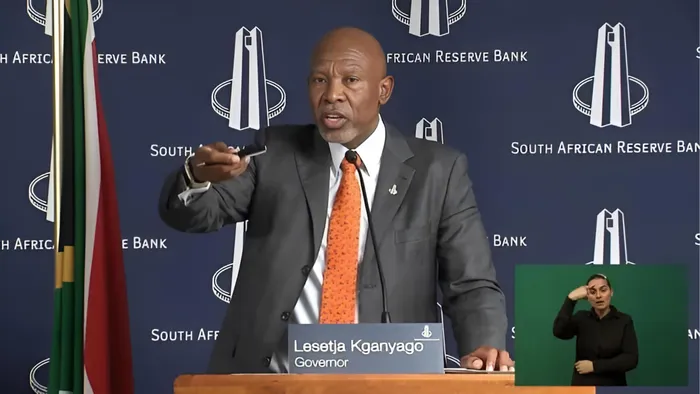
Lesetja Kganyago was appointed Governor of the SARB with effect from 9 November 2014.
Image: IOL | File
The South African Reserve Bank (SARB) is expected to keep interest rates on hold as global tensions and rising fuel costs cloud the inflation outlook.
While earlier expectations pointed to possible rate cuts this year, the latest geopolitical developments have shifted the outlook, with policymakers likely to wait for clearer signals on inflation before moving.
Johann Els, chief economist at PSG, has said that, prior to recent conflicts, a rate cut seemed probable. However, these geopolitical strains have swiftly shifted the outlook for SA's economy. "The MPC is very unlikely to cut rates in the current environment," he said.
Economists broadly expect the repo rate to remain at 6.75%, with policymakers opting for caution“, as policymakers navigate one of the most uncertain economic environments in recent years, Trading Economics said.
Just weeks after the last Monetary Policy Committee meeting, the global backdrop shifted sharply, with conflict in the Middle East driving oil price volatility and raising concerns about inflation, Nedbank said.
“Like every other central bank in the world, the Reserve Bank will now have to weigh the likely impact of the war in Iran on inflation in the months ahead,” said Nedbank.
Market risk expert Wichard Cilliers from TreasuryONE has indicated that that central banks globally may tilt towards a more aggressive monetary stance, primarily due to the escalating energy costs intertwined with the conflicts in the Middle East.
Andre Cilliers, currency strategist at TreasuryONE, noted that
Annabel Bishop, chief economist at Investec, said the rate-cutting cycle now appears to have stalled both locally and globally. “No change in the interest rate is expected, with the interest rate cutting cycle now seen to be halted domestically and globally.”
Bishop added that markets are increasingly factoring in the possibility of interest rate hikes, rather than cuts, later this year.
Els concurs, having noted that continued conflict and lingering inflation pressures could compel the SARB to consider rate hikes, a scenario that should not be overlooked. He said the outlook for interest rates now hinges directly on the developments in the Middle East.
If tensions subside and oil prices decrease, there may be potential for rate cuts before the year concludes, Els has stated.
Stephan Potgieter, chief executive of BetterHome Group Mortgage Origination and BetterBond, has said that ongoing uncertainties caused by the Middle East war would result in interest rate hikes.
"If inflationary pressures from fuel and transport costs prove persistent, the prime lending rate may remain unchanged for longer or even rise modestly if inflation risks intensify," Potgieter said.
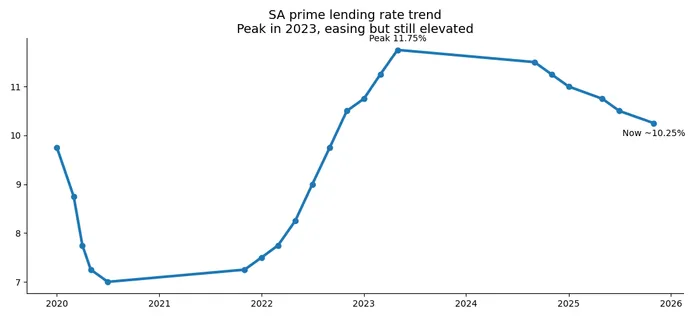
A historical view of the prime interest rate.
Image: ChatGPT with FNB data
Petrol is expected to surge sharply in April, with under-recoveries pointing to a potential jump of more than R6 a litre, Bishop said.
Independent economist Elize Kruger has said that “these increases will be the highest ever to be implemented in a single month in South Africa and will likely derail the fragile economic recovery envisaged for South Africa in 2026. She added that “it is also likely that fuel prices will increase over several months.”
That would push inflation higher in the coming months, with knock-on effects filtering through the broader economy.
Inflation, which hovered near 3% in recent data, is now expected to climb above 3.5% and run closer to 4% in May as fuel costs feed through, according to Bishop.
IOL BUSINESS