

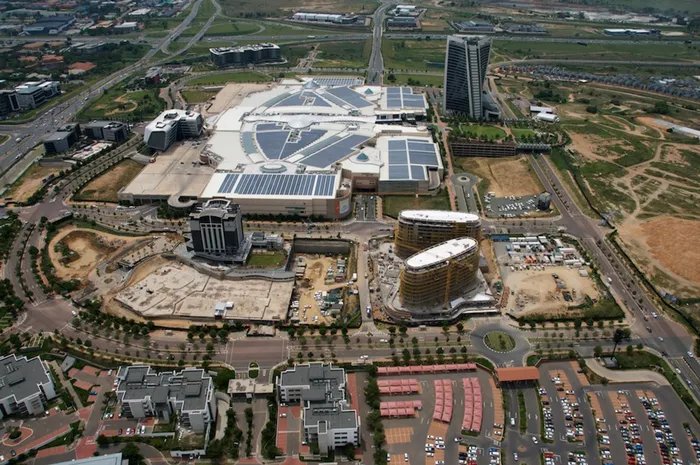
The South African Real Estate Investment Trusts (SA REITs) rely on debt to acquire, develop and manage income-producing commercial property.
Image: Supplied
Holding the interest rates steady amid the geopolitical turbulence will protect South Africa’s real estate investment trust (REITs) sector’s hard-won recovery.
As the South African Reserve Bank (SARB) governor, Lesetja Kganyago, will deliver the Monetary Policy Committee interest rates decision on Thursday afternoon, the SA REITs Association is urging them to hold.
The real estate investment trust sector has worked exceptionally hard to reach this point, says Joanne Solomon, chief executive officer of the SA REIT Association.
She says two years of disciplined capital allocation, strengthened balance sheets and accelerating distribution growth have restored institutional investor confidence and delivered tangible returns for investors.
“We urge the MPC to hold the repo rate at 6.75% on Thursday and to avoid reacting to what we believe is a temporary, externally driven supply shock. A rate hike at this juncture would risk derailing the sector’s hard-won momentum and undermining the very economic recovery that monetary policy should be supporting.”
The local REITs sector says it approaches the March MPC meeting decision from a position of demonstrable strength.
It says that over the past two years, SA REITs have delivered consecutive total returns of 29.8% and 30.6%, pushed total market capitalisation past R350 billion and secured world-beating five-year annualised returns of 21% in local currency, outperforming the United States, Australia, Japan and the United Kingdom.
In early March, the JSE confirmed the inclusion of Spear REIT, Dipula Properties and Octodec Investments in the FTSE/JSE All Property Index (ALPI) and the SA REIT Index, a development that broadens the benchmark and reinforces the depth of the sector, it adds.
Yet, Solomon says the escalating conflict involving the United States, Israel and Iran, which began with joint military strikes in February, has injected severe uncertainty into the global economic outlook.
She says oil prices have surged more than 40% to above $100 a barrel, the Strait of Hormuz faces credible disruption risk, and South Africa, which depends heavily on imported refined fuels, is bracing for what economists have forecast will be the largest single-month fuel price increase in the country’s history from April 1.
This external shock threatens to reverse the favourable domestic inflation trajectory that saw CPI fall to exactly 3.0% in February 2026, right at the Reserve Bank’s revised target, she says.
The SA REITs Association says interest rate movements are felt directly and immediately across the real estate investment trust sector.
It says REITs rely on debt to acquire, develop and manage income-producing commercial property.
“When borrowing costs fall, debt-servicing charges decline, distributable earnings improve, and the sector becomes more attractive to yield-seeking investors relative to fixed-income alternatives. Conversely, any unexpected tightening raises the cost of capital, compresses margins and risks reversing the dramatic re-rating the sector has experienced since mid-2024.”
It adds that the transmission mechanism extends well beyond the REITs sector.
“Lower interest rates reduce monthly bond repayments for residential homeowners, free up disposable income for consumers, stimulate property transactions and support the construction and services industries that underpin South Africa’s urban economies.
"The sector raised over R11 billion in fresh equity capital during 2025 through heavily oversubscribed bookbuilds, and distribution growth across the sector stands at 8.06% on a rolling 12-month basis.”
According to the association, a stable or falling rate environment is essential to sustaining this capital formation and ensuring that the real estate investment trust sector continues to function as an engine for economic activity, job creation and infrastructure investment.
The SA REITs Association says the MPC should hold the repo rate at 6.75% on Thursday.
It says while a rate cut would ordinarily be justified by an inflation print at the Reserve Bank’s 3% target and by domestic economic conditions that warrant continued monetary support, the scale of the geopolitical disruption means the Committee must first assess how oil prices, the rand and global supply chains respond before adjusting the policy stance.
“A hold would preserve the credibility of the monetary policy framework, anchor inflation expectations and signal to domestic and international investors that the Reserve Bank will not be rushed into reactive decisions by events beyond South Africa’s control.
"Equally important, the MPC must resist pressure from some commentators to raise rates in response to the oil price shock. The inflationary impact of higher fuel costs is supply-driven and externally imposed.
"Tightening monetary policy in response to a supply shock would dampen domestic demand, constrain the property sector’s recovery and achieve nothing in terms of restraining imported energy costs.”
For the real estate investment trust sector specifically, Solomon says a hold would allow the current momentum to be sustained. She says earnings guidance across the sector remains robust, with distribution growth guidance ranging from 3% to over 10% among the major REITs.
“Institutional investors have pivoted decisively back to overweight positions, and the physical economy is reflecting this confidence, as evidenced by the return of construction cranes to major commercial hubs such as Sandton and Rosebank.
"Any signal that the Reserve Bank intends to tighten, or even that the easing cycle has been abandoned, would risk reversing this institutional re-allocation at a critical juncture.”
The SA REITs sector enters this period of heightened global uncertainty from a position of structural resilience that would have been unimaginable just two years ago.
Balance sheets have been materially strengthened, with loan-to-value ratios falling and interest cover ratios rising across the sector. The massive discounts to Net Asset Value that characterised the post-pandemic period have narrowed to an average of just 3% to 4%.
The association says SA’s credit rating upgrades, its removal from the FATF grey list and the macroeconomic stability delivered by the Government of National Unity (GNU) provide a domestic foundation that was absent during previous external shocks.
Furthermore, it says that with significant international portfolios in Central and Eastern Europe, Iberia and other markets, it benefits from diversification that insulates it against localised disruptions.
However, it says resilience is not self-sustaining.
According to the association, the sector requires three forms of support to withstand and ultimately outlast the current global headwinds.
SA’s REIT market capitalisation as a proportion of total commercial real estate value stands at 19%, second globally only to Singapore, says Solomon. She says that it is a competitive advantage worth protecting.
“It is the SA REITs Association’s firm view that with the right policy support, the sector is more than equal to the task of navigating this period of global turbulence and continuing to deliver for investors, tenants, communities and the national economy.”
Holding rates would help preserve the momentum currently building in the property sector and give the market time to consolidate its recovery without the risk of sudden policy shifts, says Raeesa Kader, an academic programme leader at the Management College of Southern Africa's School of Accounting, Finance and Tax.
For the broader economy, Kader says a hold would also help anchor inflation expectations close to the SARB's preferred target range.
“This supports gradual economic growth while reducing the risk of capital outflows or renewed rand weakness that could place additional pressure on households and businesses. In my view, stability at this stage would help sustain the recovery without increasing the risk of higher rates later,” Kader says.
Independent Media Property