

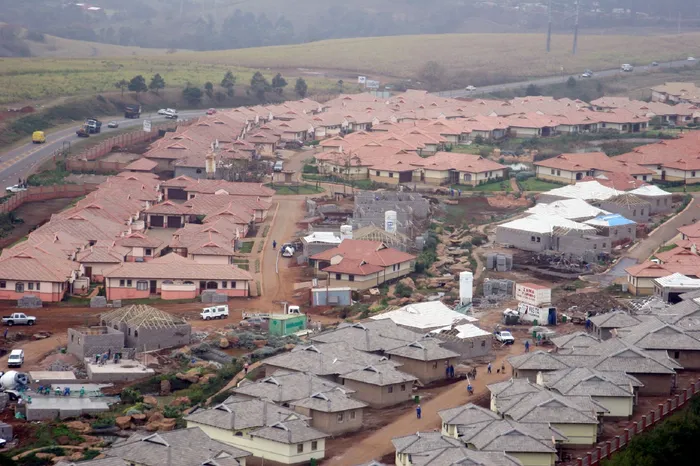
A coordinated national effort is essential to ensure that all South Africans benefit from the opportunities presented by economic growth and property development. This critical objective requires government, traditional leadership, and the private sector all to play their respective roles.
Image: Shelley Kjonstad
While South Africa reflects on its remarkable transformation since 1994, the country must also confront ongoing challenges, including the housing backlog, limited access to finance, and the need for greater empowerment of women and youth in the property sector.
These challenges demand focused and continued collaboration between government, private sector and traditional leadership, says the RB Property Group.
As South Africa celebrates Freedom Day on April 27, it reflects on the remarkable transformation since 1994, from the shackles of apartheid to the promise enshrined in the Constitution and Bill of Rights, which guarantee dignity, equality, and access to housing and property ownership for all, says Rob Buthelezi, the chairperson of RB Property Group.
He says these constitutional achievements provided the foundation for socio‑economic inclusion and have helped shape SA's journey toward inclusive growth.
As South Africa marks another year of democratic rule, the question Buthelezi poses is crucial: Who owns the South African economy today?
He says while black South Africans have gained significant ground in property ownership, with millions now holding title deeds, the broad-based ownership of the economy, including property, remains concentrated among a small group.
“Economic inequality continues to persist, with many still excluded from the ownership of land, businesses, and assets that drive wealth creation.”
The property investment company says the question of accountability is also central. It asks who is responsible for driving change to address these disparities?
“Government, traditional leadership, and the private sector all have critical roles to play, but there needs to be a coordinated national effort to ensure that all South Africans benefit from the opportunities presented by economic growth and property development.”
The company says the government holds the power to enact policies, legislate for inclusive growth, and provide access to finance and land for historically marginalised groups.
However, it adds that the private sector must also play its part by designing inclusive business models, offering financing solutions for low and middle-income households, and actively contributing to job creation and economic empowerment.
“Traditional leadership, with its connection to land and rural communities, plays an important role in overseeing the sustainable use of natural resources and land, ensuring that rural communities benefit from property development and have a stake in the nation’s economic growth.”
Since the advent of democracy, SA has made significant strides in broadening access to land and property ownership, a fundamental pillar of economic empowerment, the chairman says.
He says that in 1994, approximately 1 million South Africans held title deeds. By 2025, that number will have increased to around 5.5 million, part of a total of 7.5 million title deeds issued to date.
The estimated value of land and property associated with this growth exceeds R1 trillion, marking a profound shift in wealth creation opportunities for previously excluded communities.
South Africa’s broader property market is one of the largest in the economy, with current valuations estimated in the trillions, reflecting the critical role of property in wealth accumulation and economic stability.
These milestones underscore how property ownership has become a cornerstone of socio‑economic empowerment and a mechanism that contributes to reducing historical inequality, says Buthelezi.
As the late Dr Gomolemo once said: “We joined the struggle for three reasons: majority rule (democracy), the return of the land to its rightful owners, and lastly, equitable redistribution of wealth in our country.”
While we have partially achieved these objectives, realising them fully remains an urgent national priority, Buthelezi adds.
According to Buthelezi, an important part of South Africa’s property landscape is Ingonyama Trust land, held in trust for communities in KwaZulu‑Natal, for which His Majesty King Misuzulu ka Zwelithini serves as sole trustee.
He says this expansive land base presents a significant development opportunity for rural economic growth, investment and job creation, especially where government, private sector and traditional leadership align around shared goals.
“At RB Property Group, we were honoured to partner with UNISA in 2021 to develop a comprehensive property master plan for the Ingonyama Trust Board. This initiative exemplifies how traditional leadership can unlock the economic potential of land while adhering to cultural and historical values.
"Our work with the Ingonyama Trust demonstrates how traditional and government leadership can combine forces to drive inclusive development and bring much-needed resources to rural communities.”
The property investment company says that although global urbanisation trends indicate that populations will increasingly concentrate in cities, SA’s development landscape is unique.
According to official projections informed by UN and government data, more than 70% of South Africans are expected to live in urban areas by 2030, a continuation of rapid rural‑to‑urban migration.
It says that urban growth offers benefits, but it also creates pressure on housing, services, and infrastructure.
“At the same time, we believe the largest opportunity for sustained, inclusive economic growth lies beyond urban centres - in township economies and rural communities. This belief is supported by measured return on investment (ROI) for projects that focus on these areas, where land has historically been under‑utilised and underserved.”
Township and rural development not only supports local employment and enterprise, says Buthelezi, but also aligns with national priorities around spatial equity, transforming places that were once economically marginalised into hubs of sustainable prosperity.
Despite progress thus far, RB Property Group says these critical gaps remain:
Participating in a panel discussion at the Mzansi Young Farmers Indaba convened recently in Pretoria, Nkosinathi Mahlangu, head of the Youth Employment & Entrepreneurship Portfolio at Momentum Group Foundation, highlighted the specific challenges that young women encounter in agriculture.
He said young female farmers play a vital role in food security and rural development, yet they remain constrained by systemic, cultural and economic obstacles.
“Land-transfer customs that reinforce power imbalances, restricted access to credit and advisory services misaligned with their needs often confine them to subsistence production. A lack of vocational training and tailored mentoring further impedes their progress towards commercial farming.”
It says: the future of South Africa’s property sector must be shaped by harmonious collaboration between government and traditional leadership:
By bridging the strengths of both systems, SA can unlock the full potential of property development to uplift previously marginalised areas, ensuring that rural and township communities have equal access to opportunity.
Financing remains a critical issue in the property sector, says Buthelezi. He says the government, in collaboration with traditional leadership and the private sector, must explore new and innovative financing mechanisms to address the housing backlog and promote property ownership.
He adds that this could include introducing more flexible financing products, subsidies for low-income earners, and targeted support for women and youth.
“At RB Property Group, we believe that property is not just about buildings-it is about creating vibrant, sustainable communities.
"We are committed to continuing our work alongside traditional leaders, government bodies, and other stakeholders to ensure that property development remains a catalyst for economic growth, social equity, and the empowerment of South Africans across all communities.”
As SA celebrate Freedom Day, the country must celebrate how far it has come, from constitutional achievements to expanded property ownership and economic inclusion, Buthelezi says.
“Yet, the journey continues.”
SA’s success in property transformation will be measured not only by growth in urban markets but by how effectively it extends opportunity to every citizen in cities, townships and rural communities alike.
“The future of the property sector hinges on collaboration, innovation, and long‑term commitment. By continuing to work together, we can unlock the full potential of our land, our people, and our economy,” Buthelezi says.
Meanwhile, the selected building statistics of the private sector as reported by local government institutions, February 2026, show that the value of building plans passed (at current prices) decreased by 5.7% (-R834.1 million) during January to February 2026 compared with January to February 2025.
The data published by Statistics South Africa (Stats SA) on Thursday shows that decreases were reported for non-residential buildings (-R709.3 million) and additions and alterations (-R442.0 million).
An increase was reported for residential buildings (R317.2 million).
The value of buildings reported as completed (at current prices) decreased by 1.2% (-R76.3 million) during January to February 2026 compared with January to February 2025. A decrease was reported for non-residential buildings (-R1 272.9 million).
Increases were reported for residential buildings (R833.5 million) and additions and alterations (R363.0 million).
Independent Media Property