

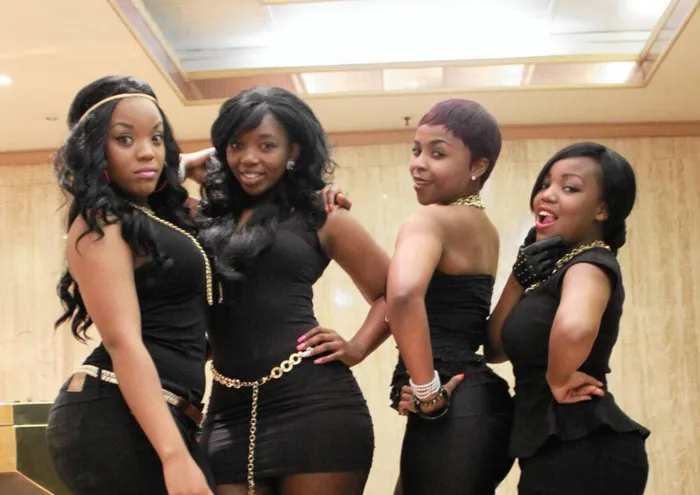
Dance group The ProTwerkers leave their male supporters wanting more of their raunchy dance moves. From left are Theresa Malinga, Samantha Malinga, Refiloe Nketsi and Kimberly Kholiwe. Dance group The ProTwerkers leave their male supporters wanting more of their raunchy dance moves. From left are Theresa Malinga, Samantha Malinga, Refiloe Nketsi and Kimberly Kholiwe.
Black women have been twerking for years, but the dance phenomenon that is sweeping through the country is only being recognised now after a “white” girl performed it on stage.
That is the view of seductive dance group, The ProTwerkers, who were reacting to American actress and singer Miley Cyrus’s provocative performance at the MTV Video Music Awards.
“I honestly believe that the white complex had an influence because black females have been twerking for ages, but the dance is only getting recognition now,” said group member Theresa Malinga.
The four-member group skyrocketed to overnight fame after their debut performance in Joburg alongside American rap star Kanye West early this year. Since then, they have twerked alongside other international artists, including Busta Rhymes and have travelled outside the country performing their gyrating moves, which are often frowned upon by conservative people and feminists.
The moves, which do not leave much to the imagination, have the group’s male spectators begging for more.
The ProTwerkers have 14 582 followers on Twitter and more than 50 000 likes on their Facebook fan page.
Malinga said she had watched Cyrus’s performance when she took the stage to sing a duet with Robin Thicke singing his smash single Blurred Lines, where the 20-year-old former Disney star ground against the 36-year-old married father’s genitals.
The performance subsequently generated negative response from parental groups and Cyrus was dropped this week by one of the world’s top fashion magazines, Vogue, as its December front-cover star.
Vogue editor Anna Wintour cancelled the shoot and story after she saw the controversial act.
Reacting to the uproar, Malinga said they were in full support of Cyrus’s dance moves, giving it a thumbs up.
She, however, said Cyrus’s outfit was inappropriate. “That was a family show and we would never twerk in what she was wearing.”
Claire Craighead, manager of the Durban-based contemporary dance company, Flatfoot, and co-ordinator of the Jomba! festival, said that although twerking was in its infancy, it should not be excluded from other dance forms.
“There are so many different dances available such as popular, classical and traditional forms. Twerking should not be excluded from this.”
She said dance forms that were less technical tended to be questioned as a valid type of dance, adding that gumboot dance, a non-traditional dance, raised similar debates when it was introduced.
Craighead said twerking should be developed so that it could be identified as a dance in its own right.
After Cyrus’s performance, the word has been added to the Urban Online Dictionary, which describes twerking as “the rhythmic gyrating of the lower fleshy extremities in a lascivious manner with the intent to elicit sexual arousal”.
This can also be done in various positions – standing, squatting, while doing a handstand or the splits.
Malinga said the addition to the online dictionary was long overdue.
“At first, twerking received different reactions as people hadn’t seen it yet. It’s time that twerking was recognised,” she said. - The Independent on Saturday