

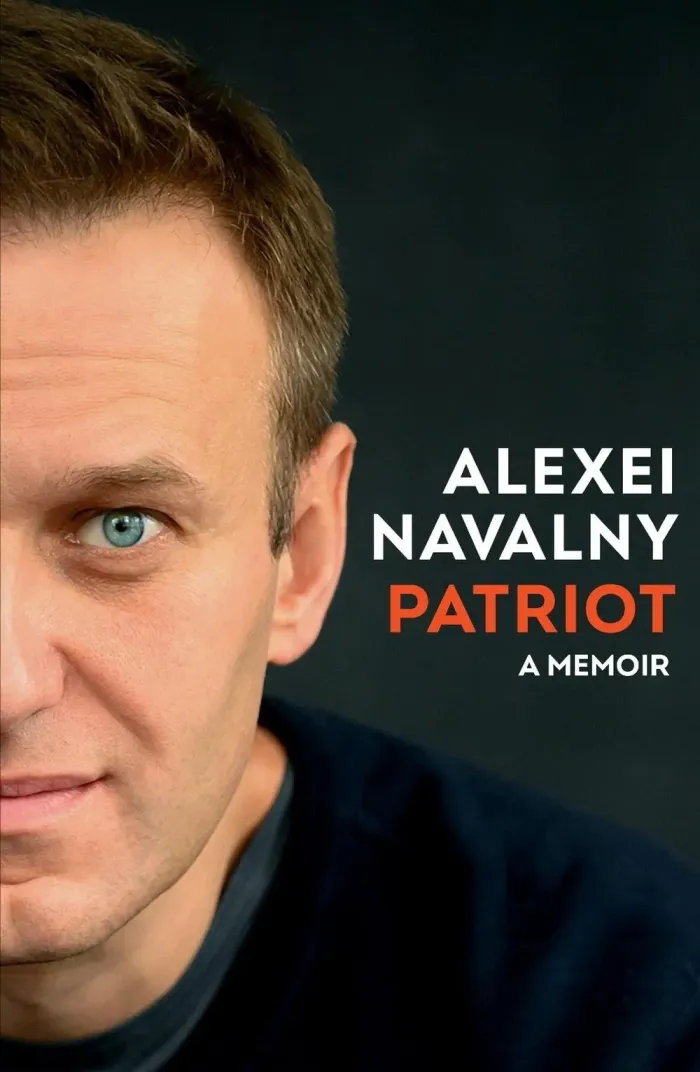
Book cover
Image: Supplied
I’ve never written a review halfway through a book. But this one hit so hard, I had to get it off my chest.
Reading Patriot by Alexei Navalny doesn’t feel like flipping through pages—it feels like sitting across from someone who’s been to hell and back, scarred but unshaken, somehow still able to crack a joke.
It’s not just political. It’s personal!
He’s not posturing for attention or playing the hero. He’s just telling the truth. And he makes you feel like he’s telling it to you.
The book opens with Navalny being poisoned, and it’s brutal. He doesn’t sugar-coat the experience. “I was drowning in my own body, unable to breathe or think,” he writes. His brain is slipping, his body is collapsing, and you’re right there with him in the haze, the panic. He wakes up in a Berlin hospital. Alive, barely. And that’s when the writing begins.
What gets me is that even in this chaos, he keeps his sense of humor. “In Russia, you don’t just pay to pass, you pay to survive.” That line made me laugh and ache at the same time. The absurdity of it all. The courage it takes to joke in the face of that kind of terror.
He survives. Barely. He’s flown to Germany. What follows is five long months of recovery. And not just physical recovery. Psychological, emotional, spiritual. He’s rebuilding from the inside out.
During this time, he meets with German Chancellor Angela Merkel. There’s something surreal about it. This man, who nearly died now standing across from one of the most powerful leaders in the world. But even then, he’s not basking in the moment. He’s planning his return.
And this is where the tension rises again. He knows what’s waiting for him in Russia. Prison. Retaliation. Maybe worse. But he decides to go anyway.
Before leaving Berlin, he observes an old Russian tradition. He pauses for a moment of silence before the journey. “I don’t believe in God,” he says plainly, “but I stood silently, honoring the moment.” That hit me. The contradiction. The reverence. It’s not religion. It’s something older, deeper. And I felt like I was standing right there with him.
And then. God. The part that made me so angry I could barely keep reading. He landed in Moscow. And just like that, they arrest him. Right there in the airport. After everything. After he was poisoned, after months of recovery, after walking back into danger with eyes wide open, they’re waiting to throw him in prison like it’s nothing.
I wanted to punch the officers. Literally. I was furious. And he knew this would happen. He chose it anyway.
What follows is brutal. His descriptions of prison life are bleak. Solitary confinement. Hunger strikes. Psychological torment. Endless humiliation. But he doesn’t write them to gain sympathy. There’s no begging. No performance. He just tells it straight. Sometimes almost too straight. And that’s what makes it so powerful. The restraint. The refusal to collapse into victimhood. That’s resistance.
The line that keeps echoing in my mind, is this: “Silence is complicity. I choose to stand.” It’s not just a slogan. It’s a commitment. A way of being. A choice you make again and again, even when no one’s watching.
That sentence cracked something open in me. Where am I staying silent? Where should I be standing? Navalny’s story doesn’t let you look away from that question. It dares you to answer it honestly.
Then, just when you think you've seen the full picture, he takes us back. Way back. To a memory that completely caught me off guard. His secret baptism. His grandmother took him, as a boy, to a small church in a Soviet village and had him baptised quietly, away from the eyes of the regime. I was struck by how gentle that memory was. Tender. Almost sacred. In a world that tried to erase identity and faith, she gave him both. It reminded me that quiet acts of love and resistance are sometimes the most powerful.
He writes about his childhood in Soviet military towns, the impact of Chernobyl, and the eerie, controlled monotony of those years. I learned so much I didn’t know about life under Soviet rule. It’s not just history. It’s lived experience.
What stood out most to me was how all of that shaped his mind. The way he saw injustice early. How he started noticing the cracks. And when he talks about leaders like Gorbachev and Yeltsin, it’s so clear-eyed. Respectful. But unromantic. He helps you understand how power shifted, how Putin slipped in through those cracks, and what changed when he did. It’s the kind of clarity I wish more people had.
He joins the liberal opposition party Yabloko because, as he puts it, “I wanted to be part of something that stood for change, for honesty, for a better Russia.” There’s no big speech. No grandstanding. Just a young man making a choice.
That’s what keeps hitting me with this book. It’s full of big courage that starts with small decisions. A conversation. A meeting. A yes.
Then Yulia. He meets her on a trip to Turkey, and he just knows. “This is the girl I will marry.” It’s funny. A little wild. And somehow deeply him. That decisiveness. That instinct to move boldly when something matters. It shows up everywhere in his life. In love. In politics. In prison.
When their daughter is born, something shifts. “When my daughter was born, I suddenly felt something change in me. I found myself praying, even though I didn’t know to whom.” That line wrecked me. In the best way. It’s so honest. He’s not pretending to suddenly be religious. He’s just opening himself to the mystery of it all.
That vulnerability. That depth. That’s what makes this memoir feel like more than a book. It feels like a conversation you keep having with yourself.
This book has challenged me. Not just intellectually. Emotionally. Spiritually. Ethically. I’ve learned so much. About the Soviet Union. About post-Soviet Russia. About corruption and courage and consequence.
But more than anything, I’ve felt this book. It got under my skin.
Here’s what I’m taking with me:
Patriot doesn’t just make me admire Navalny. It makes me ask who I want to be when things get hard. And that’s the kind of book that matters.
So, if you read this, I hope you’ll ask yourself too: What would you risk for the truth? And when the moment comes, will you choose to stand?
*Patriot is currently available from Exclusive Books.