

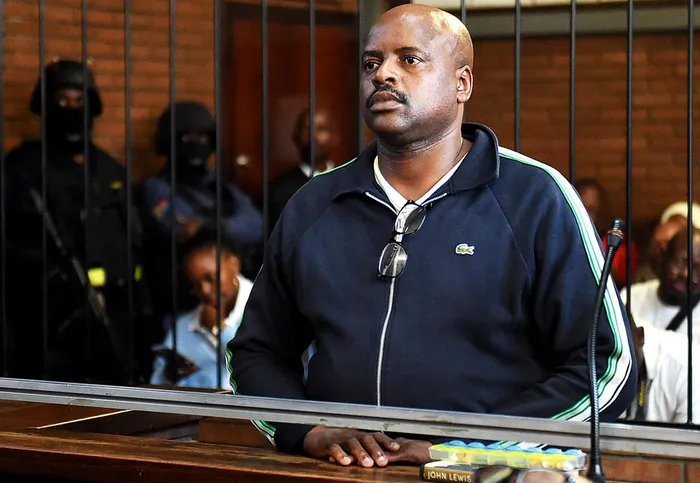
Suspended Ekurhuleni Metro Police Department deputy chief Julius Mkhwanazi appears at the Boksburg Magistrate’s Court, where he was seen carrying a book titled "Carry On" amid proceedings linked to fraud, corruption and defeating the ends of justice charges.
Image: Itumeleng English/ Independent Newspapers
Suspended Ekurhuleni Metro Police Department Deputy Chief Julius Mkhwanazi appeared at the Boksburg Magistrate’s Court on Monday, April 20, alongside Ekurhuleni City Manager Kagiso Lerutla.
Both face charges of fraud, corruption and defeating the ends of justice.
The state alleges that the pair arranged for an associate to impersonate Lerutla in court during a previous matter. Prosecutors say this was done so Lerutla could attend a job interview while the court appearance was handled by the impersonator.
Mkhwanazi arrived at court under heavy police guard. He was dressed in a dark navy tracksuit and was seen carrying a book titled “Carry On" by the late United States civil rights leader and congressman John Lewis.
He also carried a plastic container resembling a multi-compartment pill organiser.
The matter could not proceed on Monday. The court postponed the case to Thursday, April 23. The state opposed bail and said that it required additional time for verification of details linked to the investigation.
Questions have been raised about why Mkhwanazi was carrying the book. There has been no explanation provided in court or by his legal team at this stage.
“Carry On: Reflections for a New Generation” is a collection of reflections by Lewis written in the final months of his life while he was receiving treatment for cancer.
The book presents short chapters drawn from his experiences in public life and activism.
It was co-written with Kabir Sehgal and includes a foreword by Andrew Young. The chapters focus on themes such as social justice, non-violence, voting rights and civic responsibility.
It also reflects on personal values including courage, humility, forgiveness and faith. Lewis also addresses modern events, including the Covid-19 pandemic and protest movements in 2020.
The book is structured as brief reflections intended to pass on lessons to younger generations and encourage civic engagement and public service.
For now, Mkhwanazi’s choice to carry the book remains unexplained. Whether it was coincidence, personal reflection or something more deliberate is unclear.
The question remains: in moments of legal pressure, do the personal items people bring into court reveal meaning, or are they simply incidental?