

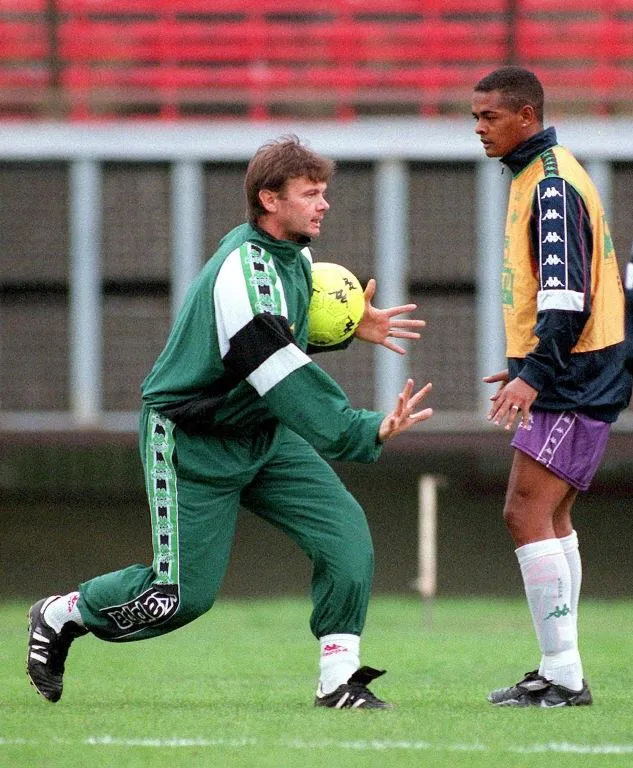
FILE PHOTO: Former Bafana Bafana coach Phillipe Troussier at a training session with striker Shaun Bartlett.
Image: AFP
The 1998 Fifa World Cup was meant to be a celebration of South Africa’s first appearance at the global quadrennial football extravaganza.
But the road to France ‘98 was one of much sadness and regret for a group of players who had bathed their country in glory just two years earlier by winning the 1996 AFCON on home soil at the first attempt, and then earning World Cup qualification under their beloved coach Clive Barker.
“When you have a coach who stands by his team and really supports them, it's a glue between everyone that will never … never break,” said striker Shaun Bartlett, who would go on to score a double against Saudi Arabia in Bafana Bafana’s final group game in Bordeaux.
“He [Barker] could make you feel like you could run against Usain Bolt. That’s the type of character he was.”
Barker had formed a unique bond with his players during his three-year tenure as Bafana’s head coach. He was seen more as a father figure and mentor than just a football coach.
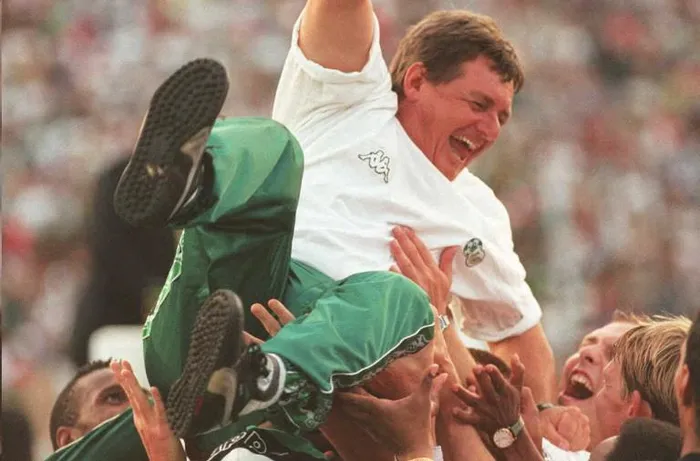
AFCON-winning Bafana Bafana coach Clive Barker was universally loved by his players.
Image: AFP
But despite his previous success, there was growing discontent with Barker’s perceived lack of tactical prowess and loyalty to his AFCON-winning squad.
“People who were in football, they started to complain, saying, ‘Ah, this is not a national team,’” said former Bafana winger and current national team assistant coach Helman Mkhalele.
AFCON 1996 final hero Mark Williams, who famously scored both goals against Tunisia at the FNB Stadium, was more blunt in his assessment.
“Politics came in,” Williams stated.
The relationship between Barker and Safa was beginning to disintegrate rapidly in 1997 — less than a year out from the Fifa World Cup.
“They prevented him from calling up certain players, setting him up not to succeed,” Bartlett said.
“I was part of that interference; I wasn’t even selected [for the 1997 Fifa Confederations Cup in Saudi Arabia].”
Bafana failed to live up to expectations at the showpiece in Saudi Arabia and returned home from with a solitary point from three matches, drawing with the Czech Republic (2-2) before losing to both the UAE (1-0) and Uruguay (4-3).
Safa now wanted heads to roll, and Barker was set to be their ultimate scapegoat, even though the players were adamant the lack of results was not the fault of their coach, but instead due to their own lack of performance.
“I don’t think any of the players who were there would say Clive had failed. We failed as players,” admitted Doctor Khumalo.
“It was missed chances all the way. There’s no way a coach could have gone onto the pitch and converted the chances we missed.”
A principled man by nature, Barker did not wait for the guillotine to fall. By then, he had become fully cognisant of the fact that he was no longer wanted by Safa, and due to all that he had achieved with Bafana Bafana, felt he deserved greater loyalty from his employers.
Barker informed the squad of his decision to quit on the plane back from Riyadh.
“He really felt that he was not supported enough, and that by the time he went to Saudi Arabia, their decision was already made,” said the then-team doctor Dr. Victor Ramathesele.
Despite desperate pleas from the players, headed by Khumalo, for Barker to reverse his decision, the coach was steadfast in his resolve, with Safa stating, “We have parted amicably,” at a media conference.
But this was only the beginning of Bafana’s nadir. Despite Safa appointing the eccentric Frenchman Philippe Troussier on January 9, 1998, as Barker’s successor and tasking him with leading Bafana Bafana to their first-ever Fifa World Cup, he was only available for duty in March. This led Jomo Sono to take charge of the national team in a caretaker capacity at AFCON 1998 in Burkina Faso.
Although Bafana delivered credible performances under Sono, with the tournament also serving as the unveiling of Bafana legend Benni McCarthy, the team failed to defend their AFCON title, losing the final 2-0 to Egypt.
Troussier’s appointment at such a late stage was disastrous, though.
“He tried so hard to change our way of playing. You can’t change a team within two months and expect to get good results,” said the late striker Phil Masinga, with Khumalo adding, “It takes years for a coach to build a team, for the coach to build a formidable side.”
McCarthy was more forthright and termed Troussier’s tenure at the Fifa World Cup “a disaster.”
“Unfortunately, it didn’t work for us. It was a disaster bringing in someone who reaped the rewards of others by going to a World Cup. We could have at least gone to the quarter-finals,” said McCarthy, who scored Bafana’s maiden goal against Denmark in the second group game.
Ultimately, Bafana failed to reach the second round after a 3-0 defeat to hosts and eventual champions France in the opening game before playing to two stalemates with Denmark (1-1) and Saudi Arabia (2-2).
*All quotes are attributed to the Class of ’96: ‘Rise of the Nation’ documentary on the streaming platform Netflix.