

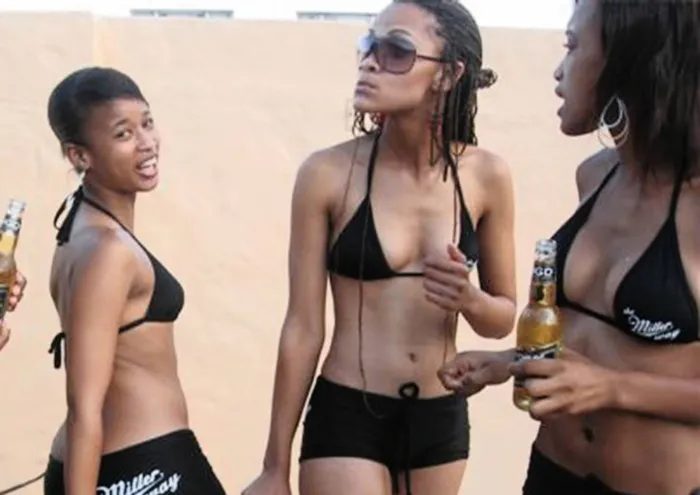
Thanks to their new-found economic wealth and “girlpower”, South African women are drinking like never before.
According to staff members at several nightclubs and restaurants, women now form a bigger part of their booze clientele, unafraid to splurge on cocktails, shooters, mojitos, tequilas, bubbly and vodka.
And usually that’s before getting behind the wheel and driving.
Women accounted for nearly 30 percent of motorists arrested for drinking and driving over the festive season – an unprecedented statistic, according to Road Traffic Management Corporation spokesman Ashref Ismail. He said most of the female offenders were single professionals under the age of 35 who drove expensive cars.
“It was shocking, we’ve never seen anything like it,” Ismail said.
The new drinking phenomenon has caused concern in the anti-alcoholism movement and sparked a debate over whether offenders should be classified by sex.
The issue is certainly on many people’s lips. Ukhozi FM presenter Dudu Khoza, who recently hosted a show on the subject, told the Tribune she was concerned at what she saw during the December holidays: scores of young women queueing at liquor outlets to buy booze.
“There were lots of them and it didn’t seem to raise an eyebrow. At festivals, I saw young girls drinking in groups. At clubs in the Durban CBD, it seemed like the women outnumbered the men.”
Kgolo Temba, a Durban entertainment consultant, said: “There has been an increase in women drinking. And they are into heavier cocktails, which come with a higher liquor content.
“French vodka, which is one of the most versatile drinks, has become a favourite with many of them. Women like hot stuff, some of which is sweet. They don’t realise the high alcohol content. Beer only has 6 percent, so if guys are drinking whisky on the rocks, or with water, they pace themselves. But women don’t.”
Temba said some of the drinks, such as Grey Goose vodka, were promoted through popular media and made to look irresistibly “cool”.
“When (US rapper) T-Pain sings ‘Blame it on the Goose’ in a music video, that alone creates the feeling subconsciously that ‘I need to have that type of drink’.
“And when they do, they feel like they’re in that video.”
Research conducted in 2008 showed that South Africa’s independent, financially secure and ambitious black women’s spending power had increased to R120 billion.
That represented about 40 percent of the annual spending of the country’s women.
Between 2005 and 2008, the number of upwardly mobile middle-class black South Africans increased from 1 million to 3 million people.
Irma du Plessis, a sociologist at the University of Pretoria, said the statistics were a sign of women’s changing role in society.
“It’s not that women have never consumed alcohol in the past, but historically women were not often drivers, they didn’t often have independent incomes. What we’re seeing is that women in post-1994 constitutional rule have gained rights to all the excesses that men enjoyed before.”
She said the new trend was a manifestation of contemporary social culture, which says that to be free is to consume alcohol – and lots of it. “I’m not in the least surprised, I think it’s likely to increase. Women are taking their place in society as full men. They’re learning all the rights of men.”
Although there was nothing new about the statistics, it was high time the issue formed part of the national discourse, said Du Plessis.
“We have underplayed socially what the impact of alcohol is. It’s a good thing that alcohol consumption by women is causing outrage.
“It is reminding us that alcohol consumption is part of wrongful behaviour in general.”
Ismail may have been talking for the broader society when he said alcohol consumption was “extremely worrying” because women were expected to be the heart of the home, family and community.
However, this has not gone down well with some feminists. Zethu Mathebeni, a sociologist at the Wits Institute for Social and Economic Research, said classifying traffic offenders by gender only fed into stereotypes and assumptions that women were supposed to behave in a certain way.
“It distorts the way in which gender functions in society. Women should be able to do anything a human being’s able to do.
“We’ve always assumed that women do not drive, or are bad drivers. Now that they have access to finances, we’re seeing that, like anybody in society, women can behave like anyone on the road.”
Mathebeni cast doubt over whether the drinking was a new phenomenon. “I think it’s something we’ve just picked up, because of the way we’ve always wanted to see and package women. I really don’t understand the fuss. When I first heard the report, I was like, duh, what did you think?
“I fully disagree with the notion that women are supposed to be sitting at home while the man goes out and has drinks with his friends.
“I don’t think the future of society lies only with women, it’s the responsibility of every person to make sure that society works.” - Sunday Tribune