
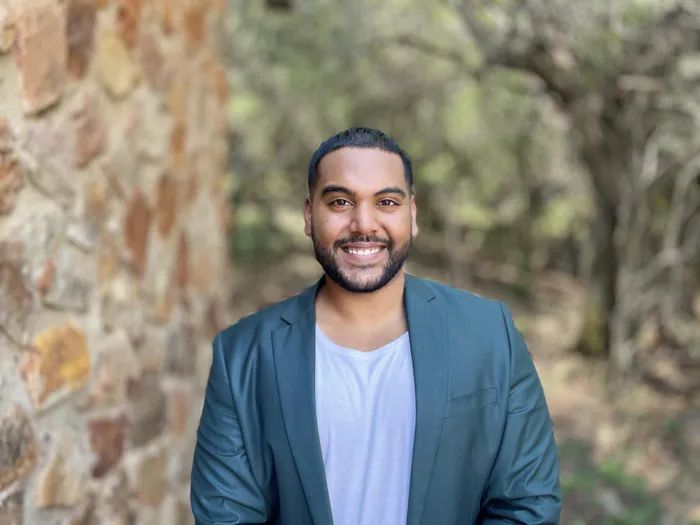
Nevern Subermoney, a clinical psychologist, shares his insights on mental health.
Image: Supplied
"I received a bursary to be an engineer, but realised that halfway through, I wanted to work more directly with people and make a positive impact in their lives.
"This is where I switched over to psychology and never looked back. Since then, I have become a clinical psychologist and currently specialise in helping people move out of stress and into calm."
Those are the words of Nevern Subermoney, a clinical psychologist who has made a name for himself through his commitment to helping individuals navigate the complexities of stress and burnout.
Born in Chatsworth, Durban, and raised in the small town of Secunda, Subermoney's path to psychology was shaped by a desire to make a meaningful impact on people's lives.
We spoke to Subermoney to learn about his motivations and the insights he has gained from his work with high-performing professionals seeking balance in their lives.
You’ve built a growing following online. What inspired you to start sharing mental health insights on social media?
Since I was young, I have always enjoyed the creative process and sharing knowledge.
When I was in primary school, I used to play director and use my VGA camera to film short films with my younger cousins cast as the lead roles.
As I began to study psychology, I realised that I could use this naturally creative and playful side of myself to be of value to others.
What further motivated me to share this psychological knowledge was a painful awareness of misinformation being spread about the nature of the human mind, which I have seen leads to keeping people stuck rather than liberating them from their suffering.
In your experience working with high-performing professionals, what are some of the most common emotional or psychological challenges people are facing today?
Based on my experience, I have seen that many people are suffering nowadays because they have normalised stress and burnout in their lives.
We live in a day and age where rushing through your life and failing to be present is the norm.
I believe that this lack of awareness, intention, and presence is what causes so much suffering for people today.
Our inability to slow down and experience life, rather than get stuck in imagination about the past and the future, is what keeps many of us from feeling well.
Your content often encourages people to slow down and reconnect with themselves. What does calm and balance look like for you in your own life?
I have consciously made an effort to redesign both my external and internal life to cultivate calm.
Externally, my journey has involved saying yes more to the things that genuinely captivate me (such as my therapy practice, online membership, and social media) and no to the things that drain my energy or place me under pressure.
Internally, I navigate my mind and heart with self-compassion, awareness, and encouragement.
I do this through daily gratitude and meditation practices.
I also do this through getting the basics right of being human (social connection, time in nature, movement, and good nutrition).
I don't always get this right, but getting it right most of the time is what has allowed me to intentionally shift my state of mind over my adult years.
I also attend 10-day silent meditation retreats every other year, which always helps with a big life and consciousness reset.
Therapy can sometimes require stepping into difficult conversations or unfamiliar territory. What has been one of the biggest professional or personal lessons you’ve learned through your work?
One of the biggest lessons I have learned through my own personal journey, both giving and receiving therapy, is that the mind can turn a heaven into a hell, and a hell into a heaven.
An individual can be in the best of circumstances and still have a heart of desire and lack.
Vice versa, an individual can be in the most trying of circumstances but still feel blessed.
This lesson can sound trite on the surface, but having personally seen the perspective shift that can occur in therapy within a matter of seconds, and just how life-changing that can be, is what continually encourages me to keep doing the work I do.
There are still many misconceptions about therapy and psychologists. What is one myth about mental health that you wish more people would let go of?
I would like people to let go of the idea that some people are mentally healthy and others are mentally sick. We live in a world where psychological problems are too readily pathologised.
That is to say, we live in a world where people think that you are healthy or sick.
But I believe that mental health is a lot more complicated than that. That being human is a lot more complicated than that. As human beings, our birthright is not that of peace and calm.
Our standard mode of operating is stress, tension, and anxiety because that is what helps us survive.
Therefore, calm, joy, and happiness must be earned. You are not broken if you are not feeling well; you are simply human.
Who or what continues to inspire your work in the mental health space today?
My current inspiration is found in the moments of compassion that I witness.
Whenever I see an individual who moves toward someone else's suffering with the intention of alleviating it, I feel inspired to do the same.
There is so much pain, turmoil, and misery in the world. It can be so disheartening. But seeing people move toward that suffering and engage in acts of kindness is equally profound.
Looking ahead, what projects, initiatives, or goals are you most excited about as you continue to grow your platform and impact?
There are two big projects that I am very excited about.
The first is an online membership that is for anyone who is stressed out and burnt out and wants to try a new way of being.
It is a platform for people who want to move toward their goals and dreams but who are not willing to sacrifice their mental health to do so.
This membership answers the question: how can I move toward success without sacrificing my sanity?
The second is a medium-term project, where I plan to help the helpers. I want to create a "Heroes Haven," where those who help society are helped by me.
This would be a place for self-care for those in helping professions, such as healthcare professionals, educators, social entrepreneurs, activists, and so on.
This space aims to ensure that those who are trying to pour into society are not pouring from an empty cup.
Finally, what would you say to young people who want to pursue psychology or contribute to mental health awareness in their communities?
I would say that the journey to becoming a registered psychologist is a long and tricky road.
Not only do you need to obtain an undergraduate and honours degree, but you also have to get into an incredibly selective master's programme, after which you still need to submit a good research dissertation, get through a gruelling internship, and sometimes, even do a year of community service.
That being said, it is also an incredibly rewarding field. Studying psychology is one of the few professions out there that allows you to learn about yourself, learn about others, help others, and even have good job security and make good money.
It is a field I would highly recommend to those who are willing to commit the next seven years of their lives to becoming a registered psychologist. I cannot overstate the joy I have found in my own life in being a psychologist.