

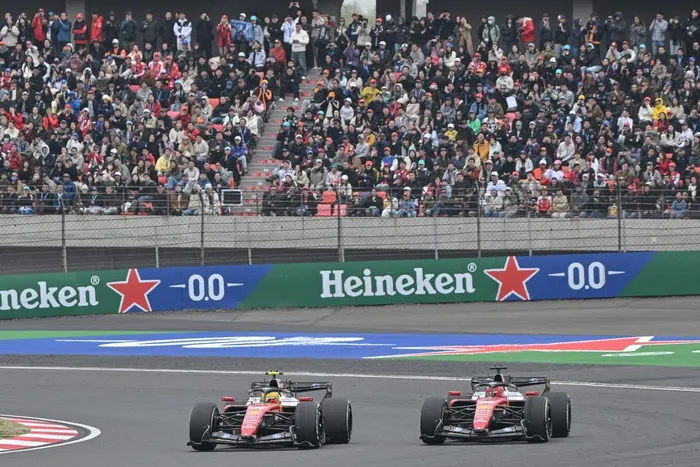
As the controversial 2026 regulations spark Mario Kart comparisons and paddock alarm bells, Formula One's powerbrokers look set to embrace a glorious regression.
Image: AFP
Evolution does not always benefit humanity, and in the case of Formula One, that has proved true this season amid the implementation of the new regulations.
Now, in a bold new move, the FIA and F1 seem to be agreeing on bringing V8 engines back to the sport. A naturally aspirated V8 screaming past you at 10,000rpm is what once defined the sport. It is what made it so enticing for both fans and drivers alike.
After intense pushback from fans, drivers, and pundits regarding the watering down of F1 through the 2026 regulations, the powers that be look as though they are going back on their decision.
And for once, regression may be exactly what Formula One needs.
For over a decade, the sport has chased technological relevance. Hybrid engines, battery deployment, fuel efficiency, and highly complicated energy recovery systems became the centrepiece of Formula One’s modern identity. Engineers loved it; manufacturers sold it as innovation. But somewhere between sustainability targets and electrical deployment maps, the sport lost part of its soul.
Formula One simply stopped sounding like Formula One. The current generation of cars are undeniably fast. In many ways, they are absolute engineering masterpieces. But they are also cold, overcomplicated, and increasingly disconnected from the raw emotion that built the sport into a global phenomenon. More than that, the cars of today lack any real personality.
Drivers now spend more time talking about battery harvesting than wheel-to-wheel racing. Fans practically need engineering degrees to understand overtaking strategy. even the spectacle itself feels much more controlled.
The 2026 regulations were supposed to usher in an exciting new era. Instead, they have triggered major alarm bells throughout the paddock. Concerns over excessive energy management, reduced straight-line racing, and artificial overtaking systems have become impossible to ignore. Max Verstappen famously compared the new dynamic to Mario Kart. Others have warned that drivers could end up lifting off halfway down straights simply to recharge their batteries.
Not being able to go flat out is arguably the worst feature of this season, and Verstappen has been highly critical of this shortfall.
The growing support for a return to naturally aspirated V8 engines is not nostalgia for the sake of nostalgia. It is an admission that the sport drifted far too away from what originally made it special. Those loud engines were not just noise — they were theatre. They created immense anticipation before the cars even appeared around a corner. The vibration in your chest, the raw aggression of the sound, and the sheer unpredictability of old-school racing formed the bedrock of Formula One’s identity.
Modern F1 has become obsessed with efficiency. But sport is not meant to be efficient; it is meant to be emotional. The ultimate irony is that Formula One’s desperate attempt to look futuristic may have actually weakened its global appeal. Fans did not fall in love with fuel-saving exercises. They fell in love with danger, drama, speed, and complete sensory overload.