Zuma opens up to South Africans
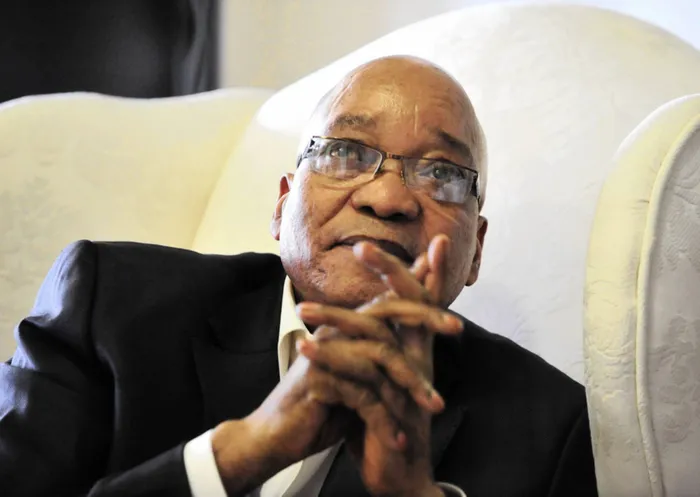
670 President Jacob Zuma contemplates during an interview with The Star at Mahlambandlopfu in Pretoria. 120212. Picture: Bongiwe Mchunu 670 President Jacob Zuma contemplates during an interview with The Star at Mahlambandlopfu in Pretoria. 120212. Picture: Bongiwe Mchunu
“It was actually along uMgeni road, as I stayed with my brother in Greyville (near Durban’s city centre). There was a particular sweet I liked… soft. And I bought my sweets and [this white boy came into the shop]. He was looking at this glass (where the sweets were kept) and he was wondering which one to buy and the fellow on the other side, who knew me, got so angry that I was doing what I was doing (by advising the boy what to buy). And he (the shop steward) gave me such a klap. And he said: ‘You can’t be telling a white boy what to do and what not to do. Who are you?’ I never forgot it.”
President Jacob Zuma had been recounting his childhood experiences in Durban in the 1950s to East Coast Radio presenter Ndumiso Ngcobo on Thursday evening when this tale was told.
It was part of an interview in which Zuma discussed aspects of his life in Durban as a boy, his political stirring as a youth and his eventual ascension into the top tiers of politics as the President of the ANC and of South Africa.
Zuma told listeners about his early childhood in rural Nkandla (in northern KwaZulu-Natal).
“Some people take it to mean very little (growing up a rural setting where subsistence farming is the way of life),” he said referring to the moral and ethical grounding he received while living in Nkandla.
He said that after having lost his father at an early age his mother relocated to Durban to take up work as a domestic servant in the more affluent areas of Morningside and Musgrave. His brothers, Zuma said, would join their mother in leaving Nkandla. They would take up residency in Greyville, also near Durban's city centre, and enter the job market as unskilled labourers.
In the 1950s, a young Zuma, would noticed the inequalities between whites and non-whites in the then oppressive government.
He said he also took up piece-meal jobs and informal employment to contribute financially to his family. This he did in Durban.
He told listeners that his awareness of the ANC came about during these stints when he would hear of public meetings held to discuss the oppressive government, but his political stance was formed much earlier - in Nkandla - through an uncle who was a trade unionist.
Speaking of those latter years in Durban during the late 1950s and his ascension into the ANC’s top ranks, Zuma said it was not being able to even visit his mother in a way a child should that carved much of his reasons to serve the ANC and the country.
“We (his brothers and him) were not allowed to come and visit (his mother). It was quite a hassle. If I had to come in and sleep there (at his mother's employee's house) I would have to come in while the owners of the house were sleeping. In other words, I had to creep in. We were not allowed… even a child, was not allowed in,” he said.
Instead he and various friends he'd made would make up for the lack in parental socialising by playing with each other. Zuma said he made friends in Cato Manor, where his mother lived when she didn’t stay at her employer’s servant quarters. He said the kids loved to push bicycle wheels with a stick.
“We would push the rim of a bicycle, which [at that stage] was a very nice ‘car’ with a stick,” he said.
“I remember at some point (in the 1950s), Chesterville (south of Durban) was still very new. Chesterville was the first place in the African township that had tarred roads (while Cato Manor where his mother lived still had dirt roads). I loved to take photos. I loved to go to bioscope (the cinema). “
Government had demarcated Chesterville in the 1940s as a township reserved for Africans. It was part of the Durban City Council’s bid to separate the races under what would be labelled the Group Areas Act.
Zuma said, as he aged, the disconnect in treatment between the races became too apparent to ignore.
In 1959, he joined the ANC in its youth division. By the 1960s, with the banning of the ANC, Zuma submitted himself to Umkhonto We Sizwe (MK), the military arm of the ANC.
He told listeners of that time and of the sentiment behind the MK’s that “knowing there would never be any freedom without any fight,” was the most prominent reason for his decision to serve.
“We (he and other youth members of the ANC and Umkhonto We Sizwe) attended meetings on Thursday’s of the youth and I think it was [on] Wednesday it was ANC [meeting] day and Tuesday, it was Sactu [meeting] day. Suddenly, the ANC is banned and we are asking what is happening, should we agree (with the party's banning)?”
He said it was then that “a lot of debate [took place]” and “of course the instruction came, and the instruction that came from the national executive committee was that the ANC was going underground”.
“It was a different method, because in the 1950s… as a youth, you were saying why? But why? Let us fight.”
Zuma told listeners that during that time he and his youth group members would stage secret meetings disguised as casual “picnics” and “trips to the beach” to discuss a strategy to fight for their rights.
He admitted to host Ngcobo how immature their way of dealing with their oppressors were.
“We used to look at the seas and pretend (to be on a casual outing) but we would have serious discussions. It was childish. We actually thought we should buy bush-knives and start butchering the whites.”
He added that at the time they believed it would be an action that would kickstart the top-tier leaders of the ANC into gear and a revolution for change would begin.
But Zuma said conversations with those early leaders of the ANC would calm their antsy ways and the MKs would abandon their plots of revenge attacks.
“We all realised how stupid we were,” he said to listeners.
Asked to recall the night he was to have gone into exile to Mozambique (to spread awareness of the ANC and act as support for those who left South Africa), Zuma said it was a difficult time. He never reached his destination during that 1963 attempt.
Zuma recalled for listeners how his arrest unfolded. He said he and a few others met at the Durban station to travel to Johannesburg. They had formulated a secret way of communicating which included carrying specific items (an umbrella) and having a specific way of greeting each other that would identify them as MK and ANC members.
Zuma said they departed for Johannesburg on a Friday and having reached there many hours later, they were stranded at Germiston station, in Johannesburg, for about 11 hours before their backup plan (a team from Soweto) arrived to take them to shelter.
“On that Sunday,” said Zuma, he and the MKs would set out in a kombie (minibus taxi) to the boarder post at Mozambique, but, their driver who opted to use secondary roads instead of national highways, became lost and said it was unlikely they were going to meet their contact at the boarder post at the appointed time.
Nevertheless, said Zuma, they persisted with the trip and whilst getting back onto a national highway, two cop cars had spotted them and they were arrested.
He and the crew he was travelling with were charged with attempting to overthrow the government and Zuma was sentenced to 10-years imprisonment on Robben Island in the Western Cape.
Zuma also shed a light on his now-broken relationship with former president of South Africa Thabo Mbeki.
He said in their early days as ANC members, their friendship was bonded on their ability to agree and share a likeness in most areas of their lives - both politically and personally.
He said they rarely disagreed on things, adding that so closely knit was his friendship with Mbeki that the pair were often referred to as “twins”.
“I had always regarded his father (Govan Mbeki) as my father,” he told listeners.
He said he regretted their eventual parting of ways - the virtual end of their longstanding friendship - but he knew it was coming.
“… I knew our closeness and how much that had helped the ANC move forward. There was a sense of that kind of complimenting situation (the mutual aim to see the ANC lead the country and the disadvantaged masses)… I knew that this (his friendship with Mbeki) was getting to a point where this was not going to happen (because their mutual agreement on how the country and ANC should be lead had changed).”
Zuma also spoke to any fears he has in present-day South Africa, as well as of the past. He said he felt none.
“As I said, I grew up (in Nkandla)… [and] if you see a… snake in the grass, you don’t read a book to know how to deal with it.” Zuma was referring to the leadership and confidence he gained while farming the land in Nkandla.
He did admit to feeling nervous in 1977 when he was elected into the national executive committee (NEC) of the ANC. “I can tell you there was one moment in 1977. I was elected into the NEC. I felt I was very young. Why should I be [elected]?”
Zuma said he confided in Alfred Nzo (the ANC’s secretary-general between 1969 and 1991), who told him that if party members expressed faith and confidence in one's ability to do a job, that there was nothing to fear and only the job to get on with.
“I've never doubted my political understanding of the country, of the world,” Zuma said to listeners.
“Once the ANC says to me 'this is your task”, I should do everything in my power to do [it]...”
Zuma said despite being past the age of retirement - he will turn 70-years-old on April 12 - he would continue to serve the ANC as they needed him to.
The President ended off his hour-long chat with a message that South Africans should hold onto their hope for the country.
“I think the final word would be [that] South Africa has a history and its history is complex. We come across a lot of challenges but South Africa has always overcome, whether the challenges were political or economic.
“As a country, people must know we have a leadership that has been given the task to lead this country… [The leadership has] defeated apartheid. [We] must indicate we are a capable people to move forward. There is clarity (of what the challenges are). We know where we are going,” he said. -IOL
*E-mail Benita: benita.enoch@inl.co.za