

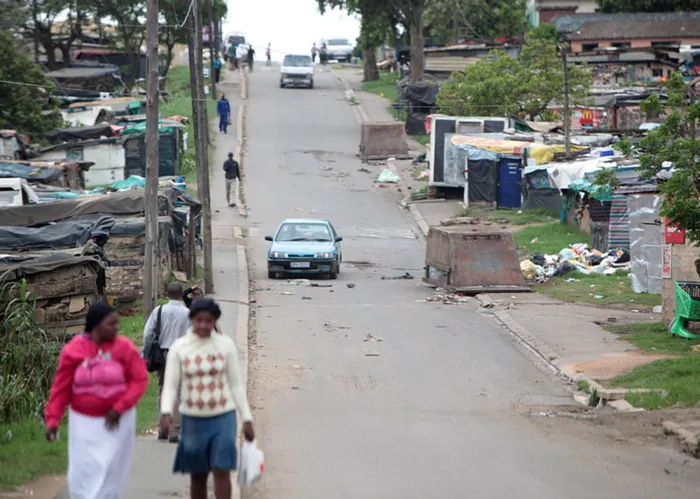
An overview of KwaMashu Hostel, where tensions are palpable and competition for scarce resources characterises hostel dwellers' daily existence. Picture: Doctor Ncgobo An overview of KwaMashu Hostel, where tensions are palpable and competition for scarce resources characterises hostel dwellers' daily existence. Picture: Doctor Ncgobo
While the spectre of death looms all around him, Mantende Mthethwa is philosophical about life at KwaMashu Hostel, the bloody political battleground he has called home for more than three decades.
“Maybe things will change here one day, but I’ll probably be dead by then,” says the 63- year-old, shrugging his shoulders as he lets out a deep sigh.
Amid the filth of overturned metal rubbish bins and puddles of murky water from leaking pipes, the hostel remains in the grip of tension after a week of violence that claimed the lives of IFP ward councillor Themba Xulu, an off-duty policeman and Cebisile Shezi shot in separate incidents last week.
The area is now crawling with police, brought in in the aftermath of the murders.
Xulu’s murder is believed to be a revenge attack for an NFP rival councillor’s son killed three weeks ago.
Eshowe-born Mthethwa runs a laundry-cum-shoe repair business outlet from his two-roomed corrugated iron shack, which he shares with his 14-year-old son.
When we meet him, he is seated behind a table, painstakingly repairing a brown and cream lady’s handbag.
For someone who makes others look good by fixing their rags, his own appearance is a contradiction: he is scruffy, sports a thick grey beard, has on an old green cap, torn grey T-shirt and faded apron.
It is clear that Mthethwa’s stature as a local mainstay has made him popular, as he nods approvingly to young and old passing by who greet him. However, he flatly refuses to be photographed, saying he doesn’t want to be seen to be “siding” with the media in the current volatile climate.
Mthethwa, a former Putco bus mechanic, once lived relatively comfortably in KwaMashu’s F-section – until locals destroyed his four-roomed home,after claims that his wife, a sangoma, was a witch.
“I was forced to sell the house. I didn’t make much from it, and that was painful.” But more pain and heartbreak was to follow.
After his wife’s death from an unknown illness, Mthethwa met another woman, with whom he fathered three children before she left him. His first daughter died while an infant. Another, who is 18 years old, dropped out of school in matric to co-habit with a young man – much to his disapproval.
“I chased her away to go and live with her mother. I’m now left with my son. I have big hopes for him - I want him to be a mechanic or an architect. He is very good at drawing.”
Sporting a calmness that perhaps belies his own anxiety, he says, “We’re always nervous here. We have never seen an improvement to this place.
“The only thing that’s changed are some of the buildings. They destroyed the old blocks, but instead of housing people like us [who are] living in the shacks in the new ones, they brought people from outside.”
Life is tough, he says.
“But robbery and murder are the biggest problems. There are just too many thugs. Dead bodies are found all the time. I’m not lying, we just survive through luck.”
In fact, on the same Friday of Xulu’s abduction, a delivery van with Mthethwa’s clients’ laundry was held up outside his outlet - the third such robbery over the past year.
“A group of boys just mushroomed out of nowhere, carrying guns. They took everything from the driver and his assistant. Now the company won’t come here anymore and I’m currently speaking to other laundry operators about finding another vehicle.”
He blames the situation on unemployment.
“People have no jobs - that is the problem. When we talk among ourselves, we say it was better under the white man.” - Sundat Tribune
agiza.hlongwane@inl.co.za