

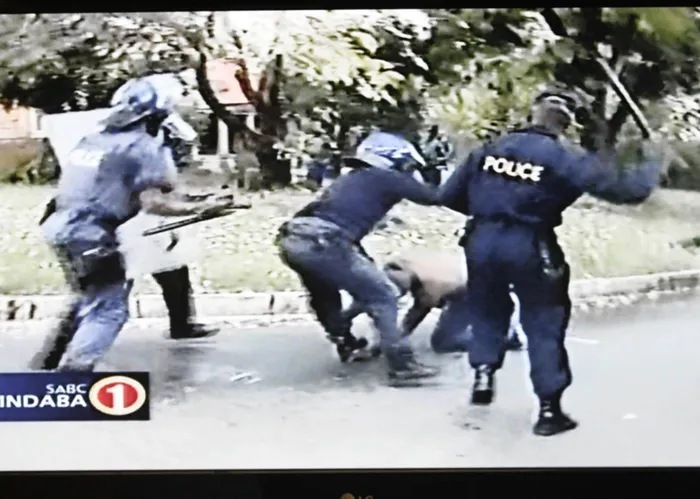
File photo: Riot police surround and beat Ficksburg protester Andries Tatane. File photo: Riot police surround and beat Ficksburg protester Andries Tatane.
Durban - Forty-six more investigators and an extra R36 million in funding are some of the few tangible changes recorded in the year since the police watchdog changed its name from the Independent Complaints Directorate (ICD) to the Independent Police Investigative Directorate (Ipid).
But analysts are divided on whether the new set of teeth can, for example, force police to act on findings made against them, as outlined in the new Ipid Act.
So, has the Ipid done anything to change a police approach that leads to “unnecessary” killings, such as in the case of Ficksburg protester Andries Tatane, whose killers have now been acquitted? Or circumstances that led to police shooting and killing 34 striking miners in Marikana? Or the officers involved in the death of Mozambican taxi driver Emidio Macia?
Members of the SAPS, society’s protectors, continue to fall foul of the law, meaning Ipid has its work cut out.
Police Minister Nathi Mthethwa responded to parliamentary questions by the DA’s Dianne Kohler Barnard, saying 144 officers had been charged for murder, 91 for rape, 38 for armed robbery and 1 050 for corruption by December.
This week Ipid national spokesman Moses Dlamini was asked to provide evidence that Ipid was able to fulfil its mandate, including highlighting its biggest achievements and ensuring that findings were acted upon.
He said: “The details of this are contained in the bi-annual report which is due for tabling in Parliament in the next few weeks.”
Dlamini said the staff complement had grown from 303 before April 1, 2012, to 349. Of these, the biggest growth was in the ranks of investigative staff, whose numbers had grown from 157 to 191 in the period.
Ipid was granted an extra R36m in funding to implement the Ipid Act in the 2012/13 financial year.
“This brings the total budget for the current financial year to R196m. This will allow us… to employ more investigators to ensure successful implementation of the new mandate.”
Dlamini said in the 2014/15 financial year, Ipid’s budget would grow from R170m to R215m, eventually rising to R233m.
For those with expectations of a more efficient and accountable police watchdog, organisations like the Umbilo Action Group say Ipid has been as woeful as the police themselves.
Umbilo resident Vanessa Burger, who founded the action group in 2008, says that, out of 32 complaints of police misconduct she lodged at the end of 2011 with the ICD, Ipid made recommendations against only nine SAPS members for various instances of gross misconduct. These included officers being drunk on duty, intimidating victims and failing to investigate serious crimes. Of these, the only departmental action was a “sanction of suspended dismissal”.
“We have numerous complaints dating back to 2010 that remain unanswered, let alone unresolved. Despite numerous attempts to escalate these cases over two years, Ipid, including its national division, failed to respond to all further queries.”
KZN violence monitor Mary de Haas believes improvements, if any, at Ipid would probably take some time to manifest.
“I have not seen any real difference with the new name, but to be fair Ipid itself has undergone its own upheavals in the past year.
“The former national head (Francois Beukman), who had shown encouraging signs of taking the new mandate seriously, left suddenly. As did some other senior national staff, leading to new acting leadership – which weakens organisational structure and line management.
“Similarly, new leadership was put in place at the Durban office, following years of leadership upheavals, and it would probably take some time to see change.”
De Haas, who has been monitoring the province’s violent crime – including that perpetrated by police – since the 1980s, said her experience was that staff capabilities varied greatly, especially in the Durban office.
“There is a crying need for proper training and close supervision. Another problem may arise if investigators who were formerly police members are deployed in areas they formerly worked in, which does happen. Of course, Ipid needs the support of proper forensic services, which are very problematic in KZN, so they should be calling for them. It also needs good prosecutors and the Tatane case raises questions about both Ipid and prosecution services.”
De Haas said she was aware of instances whereby management at both Port Shepstone Cluster and the province had “covered up” for the controversial Tactical Response Team, who had allegedly abused many people in the Donnybrook and Creighton area by stalling and not providing information for ID parades.
“Ipid has been told about this, but to my knowledge has done nothing.”
However, a senior researcher at the Institute for Security Studies’ (ISS) Crime and Justice programme, Johan Burger, said there were a number of signs that Ipid was now a stronger body.
“I’m convinced they now have more teeth, but we will only know later this year to what extent they’ve been able to make improvements.”
Burger cited the dire consequences that could arise should police fail to implement the findings and recommendations of an Ipid investigation.
“We’re talking about an act of Parliament, where if they don’t abide, the provincial or national commissioner can be criminally charged for failing to implement disciplinary procedures as instructed by Ipid. That is a significant bite.”
Burger said it was difficult to gauge how South Africa fared on oversight of police brutality and other serious crimes by police when compared with its international counterparts, but said its command and control structures were often found wanting.
In an article published on the ISS website last month, Burger argued that blaming errant police behaviour on militarisation was “barking up the wrong tree”.
Police agencies across the world generally shared similar responsibilities and legal powers, Burger wrote.
“In most cases they are armed and trained in the use of force, including deadly force. When command and control systems are weak, chances are that these powers will be abused. However, even in countries where control systems are generally well established, incidents of police brutality still happen.”
According to Ipid’s annual report, the number of deaths as a result of police action or in police custody decreased by 10 percent in the past year and by 21 percent (from 912 to 720) since 2009.
Criminal cases opened against members of the police by Ipid rose by 363 percent from 531 in 2001/02 to 2 462 in 2009/10. However, Burger noted, the situation appeared to have stabilised in 2010/11, when there was a 1.3 percent increase, before criminal cases against the police decreased by 7 percent to 2 320 in 2011/12.
“As much as ‘militarisation’ was not the answer to the problems facing the SAPS in 2010, so too will ‘demilitarisation’ or another change in the police rank system miss the fundamental issues. These include weak command and control and a lack of proper internal oversight structures that result in poor discipline.”
Burger added, “What is needed is the appointment of capable officers to senior positions as well as internal structures that can hold them accountable.”
Sunday Tribune