

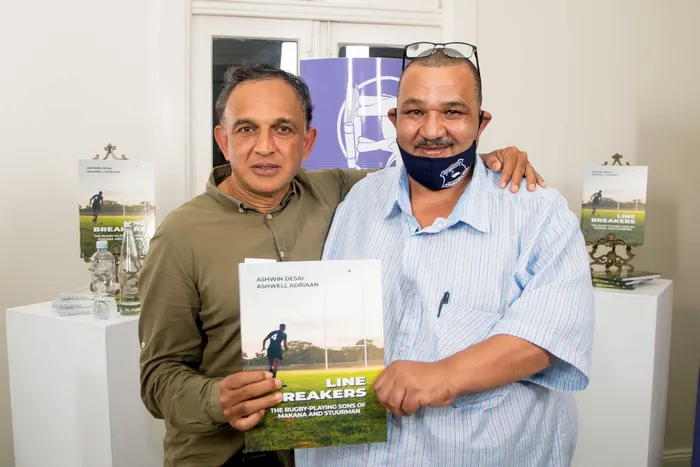
Authors Professor Ashwin Desai and Ashwell Adriaan at the launch of their of book Line Breakers: The rugby playing sons of Makana and Stuurman
DURBAN - WHO would have believed that blacks in South Africa played rugby as far back as the 19th century, that’s because the annals of history carry a lopsided view of the game played with an oval ball.
That’s according to sociology Professor Ashwin Desai at the University of Johannesburg and Ashwell Adriaan, a researcher at the Robben Island Museum, who was a part of the curatorial team at the Apartheid Museum and curated the history of black rugby in Grahamstown.
Moved by their own personal convictions, they took on the challenging task of authoring a book that homes in on the Eastern Cape town of Makhanda, formerly Grahamstown, and lifted the lid on what was once a hotbed of black rugby.
Their book, Line Breakers: The Rugby-playing Sons of Makana and Stuurman, was launched in Durban at Ike’s Bookshop this week.
How Makhanda was able to produce teams of brilliant rugby players and resourceful administrators for more than a century, in spite of the political climate, socio-economic challenges and bare minimum resources, is a history that the authors set out to reveal in their book.
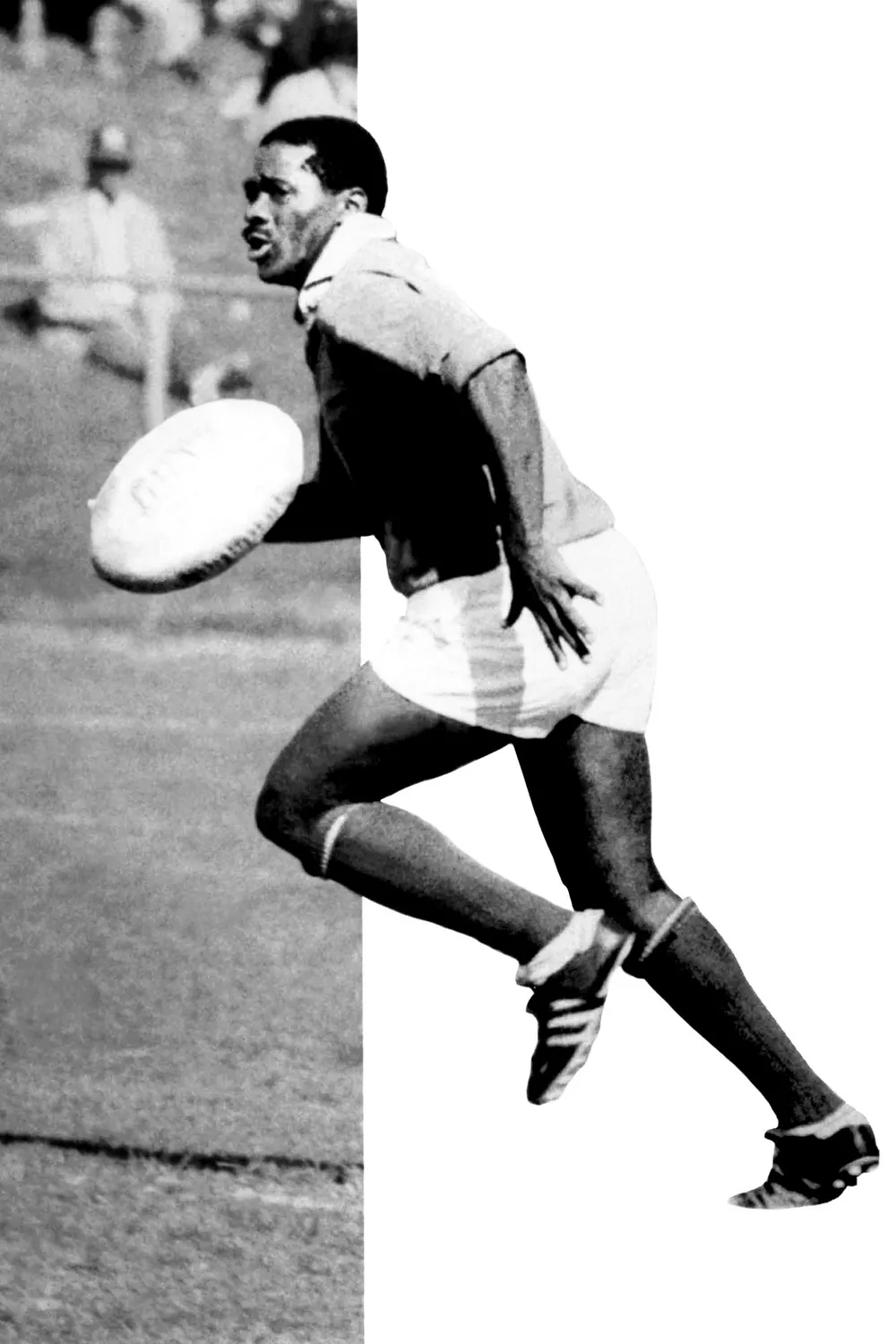
With empty archives on their subject matter and non-existing newspaper articles, their labour of love began 15 years ago.
At times they thought they would never be able to tie this history together. Then they had the idea to gather photographs from families. They collected a large cache of images that gave their storytelling more impetus, and it evoked emotions in some homes.
“We basked in the reflected glow of those who had played the game at the highest levels and marvelled at those players and supporters who dreamt that, one day, a bearded black man would arise out of the Eastern Cape and hold aloft the Webb Ellis Cup,” read an extract from the book.
It was a glorious moment when Siya Kolisi led the Springbok team to victory in the 2019 Rugby World Cup. As a son of the Eastern Cape, he brought the trophy to Makhanda in March 2020. It also provided a reminder that Kolisi was not the product of a white rugby-centric school, and had no previous history. The book showed his rugby pedigree was deeply connected to Makhanda.
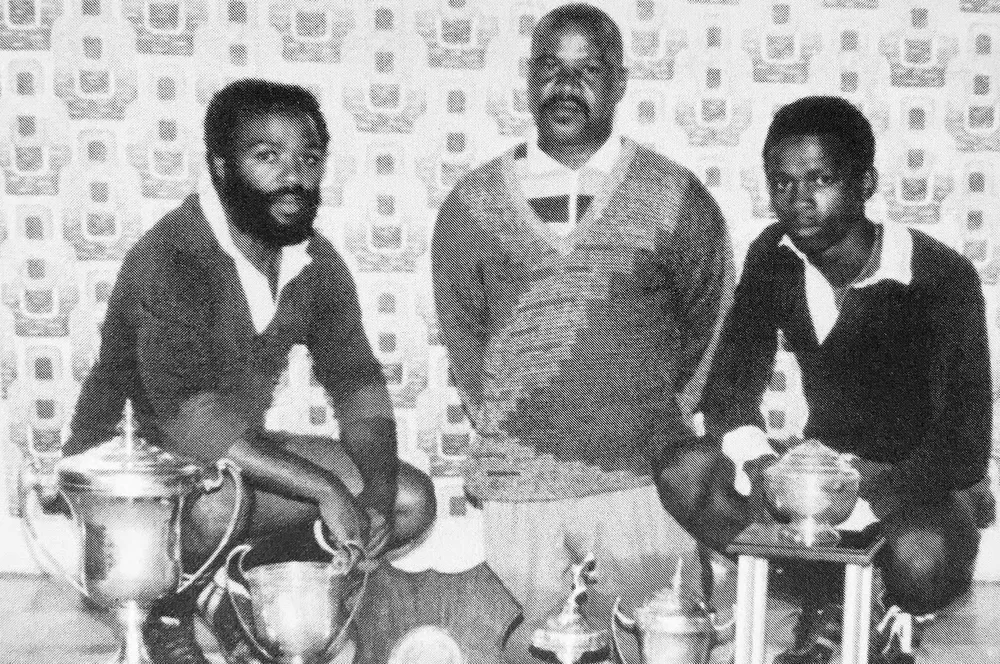
It dates back to when a “Kolisi” was among the founding members of the Easterns rugby team, one of the pioneering clubs in the area.
Someone with the Kolisi surname also kicked the conversion of the winning try in the 1937 Parton’s Cup Final between Eastern Province and Transvaal. Then there was a Vuyani Kolisi who played for the Eastern team in the 1980s and also captained the South Eastern Districts Rugby Union (Sedru) side.
Vuyani was also a dynamic loose-forward who wore the number 6 jersey, just like Siya.
There was the perception that Thando Manana, another son of the Eastern Cape, and the third black player to don the Springbok jersey, was the only Manana to have played the game. According to the authors, Fanna Manana, one of the founders of Winter Rose Rugby Football Club, the first club to be formed in Makhanda in 1887, was a prolific spreader of the “gospel of rugby”.
He planted teams in East London, Cape Town and in Orlando.
The next team to sprout in Makhanda was Lily White in 1894.
Nyaniso George Lamani, a legend of the club, said their founders were kitchen workers, mainly from St Andrew’s College, while the others worked at Kingswood College.
During their lunch break, the kitchen workers would play the students. A Reverend White, a “nice” English person, spotted their affinity for the game and became instrumental in them forming their club. He had a daughter named Lily, and they were the inspiration behind the club’s name.
In penning the book, the authors hoped to “illuminate the game within and beyond the rugby field as a great human drama infused with a tumult of passions”. They also got to see how people reshaped their circumstances, broke racial barriers and confronted colonial and apartheid rule, instead of holding the line. Delving into the history of Makhanda, which started out as a military outpost in 1812, they learnt that the British army grabbed masses of Xhosa territory, for the benefit of white settlers. That triggered waves of attacks on the settlement from the disenfranchised Xhosa people. Grahamstown’s name change recognises Makhanda ka Nxele (also known as Makana), the Xhosa warrior and prophet, who led the attacks and was captured in 1819 and imprisoned on Robben Island.
It was in Grahamstown that Dawid Stuurman connected with Makana, having escaped from Robben Island in 1809.
Stuurman, a Khoi leader, was a wanted man in the colony. The British constabulary realised that breaking his pact with the Xhosa people was key to ejecting the natives from their land.
He was also eventually arrested in 1819 and sent back to Robben Island. He escaped for a second time but Makana did not survive their bid for freedom. Stuurman was rearrested in 1823 and banished to Australia.
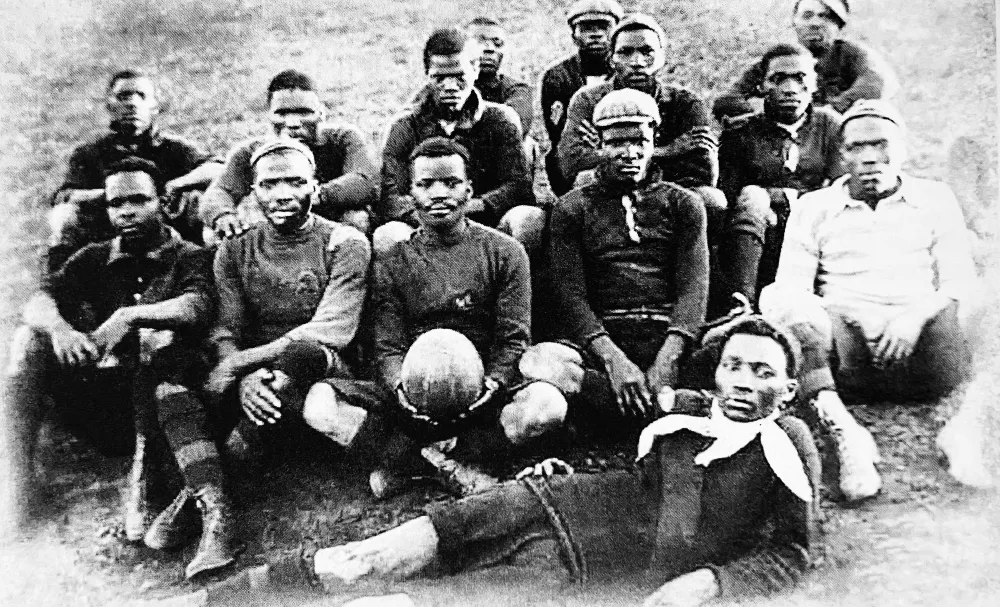
Makana and Stuurman’s joining of forces marked the beginning of an alliance between the Xhosa and the Khoi people in tackling their oppressors.
That fighting spirit has been carried through the generations by the communities of Makhanda, who challenged the commands of those who controlled them, especially when they dictated that they should play in separate leagues and venues.
Adriaan is one such player who was bent on the de-racialisation of rugby, even if it meant defying his family’s wishes.
His family team was Swallows, which was formed in 1944 by soldiers returning from the World War II.
But he also played for Mary Waters and Lily White as a forward. He later became an administrator of the game.
Adriaan and Desai first connected in the 1980s at an activist’s funeral. Desai was among the first handful of black students who got to study at Rhodes University.
Desai gave Rhodes’ manicured fields a miss, and played soccer for a township team loaded with student activists called United Teenagers.
He said the book was a story of sacrifice and redemption, as it previously seemed like black people hadn’t played rugby, unless they played under the tutelage of whites.
“Our book is focused on a case study of a particular place that changed the nature of rugby and the history of a town. They had a vision of non-racialism. These were not only rugby players, but agents of change,” Desai said.
◆ The book is published by Shuter & Shooter.
SUNDAY TRIBUNE