

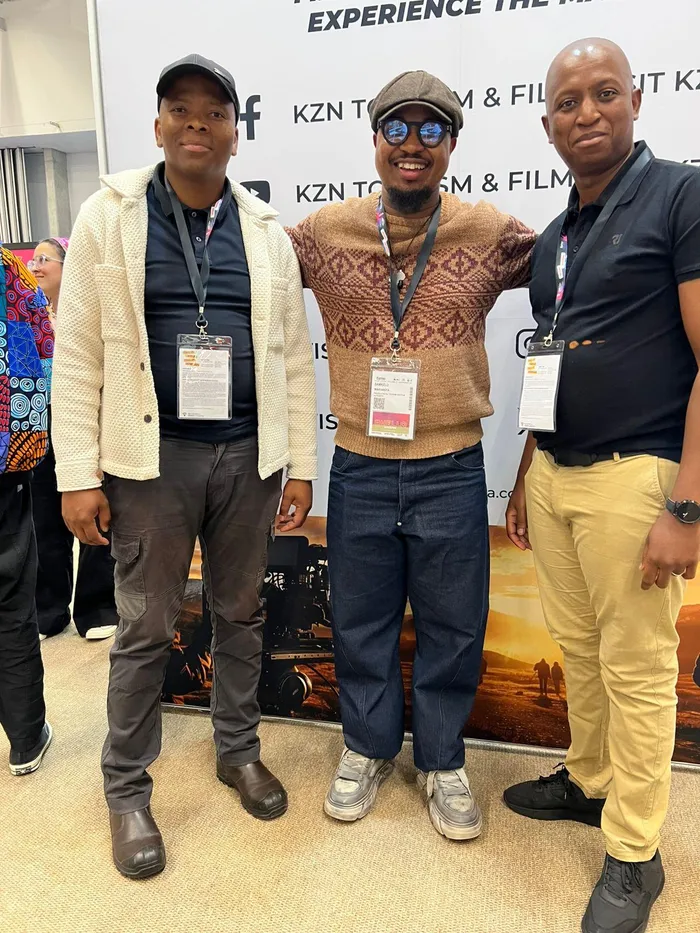
KwaZulu-Natal filmmakers Lungisani Gwadiso, Charlie Samson and Zama Msibi are turning stories into business, chasing global deals, and proving film drives jobs and growth at MIT Africa.
Image: Supplied
As KwaZulu-Natal’s storytellers step onto the global stage at MIP Africa in Cape Town, they are proving that film is as much about commerce as it is about culture.
Backed by the KwaZulu-Natal Tourism and Film Authority (KZNTAFA), local filmmakers - Charlie Samson, Lungisani Lucas Gwadiso, and Zama kaMafikeni Msibi - are marketing homegrown stories as business ventures, engaging international buyers, and pursuing partnerships that can generate investment, jobs, and growth for the province’s economy.
The three are part of the official KZN delegation to MIP Africa, the continent’s foremost content market, currently taking place.
In this bustling forum of deal-making and high-level networking, content creators sit across the table from international distributors, co-producers, and financiers. Here, creative pitches translate into business contracts, and stories are positioned as exportable products for global markets.
For KZN, the stakes are significant. MIP Africa offers direct access to distribution pipelines, co-production agreements, and global networks that transform creative projects into sustainable enterprises.
By sponsoring and organising the KZN delegation, KZNTAFA is positioning the province’s talent in front of the world’s media decision-makers, ensuring that local filmmakers are not just seen but also taken seriously as entrepreneurs. This move reflects a broader vision: to place KwaZulu-Natal at the heart of Africa’s creative economy, where culture, commerce, and investment intersect.
For the filmmakers, the opportunity is more than just a showcase of talent - it is a chance to position their work as viable business ventures in front of a global audience. Each brings a unique story rooted in KZN, but all share the same ambition: to turn creativity into commerce, and to demonstrate how film can fuel jobs, tourism, and economic growth.
Gwadiso, an award-winning filmmaker and founder of the Harry Gwala International Film Festival, notes that international accolades proved the universal appeal of their narratives. “It meant our stories are not just local; they resonate with an international audience,” he says of winning film awards abroad.
By staying true to local culture while speaking to shared human experiences, they are finding receptive markets overseas.
At MIP Africa, Samson, a Durban-based director is seeking partners for his upcoming projects without compromising their roots. “I’m positioning select indie titles for global lanes without diluting their local truth. Strategic, not desperate,” Samson says of his approach to courting distribution and co-production deals.
“We want to bridge the gap between creativity and commerce,” says Gwadiso, whose community-based film festival doubles as a development platform, “and foster business acumen” in the creative sector.
"None of this would be possible without the backing of the KZNTAFA. They’ve helped me evolve from being an artist making work to a professional building an industry footprint. Their support for markets like MIP transforms access into tangible deals - providing credibility, putting us in rooms that matter, and generating measurable momentum,” says Samson.
Msibi sees KZNTAFA’s hand in his rise as a validation of his talent and story. “Even if you come from a previously disadvantaged background…if you tell stories that have impact, you will be recognised,” he says, “and this connects me with global partners that have interest in our heritage-driven work”.
Beyond funding and logistics, KZNTAFA provides credibility. Official backing signals to international partners that these creatives are the real deal, and it gives the filmmakers added confidence, he said.
As Samson puts it, KZNTAFA’s support translates into “credibility, access, and confidence - three levers that change careers. Their support gets us in the room; our craft keeps us there”.
The impact of these film ventures extends far beyond festival awards or distribution agreements. A vibrant film sector feeds directly into business development, job creation, and even tourism.
When a movie or series shines a spotlight on KwaZulu-Natal’s landscapes and culture, it can trigger what Samson describes as a tourism domino effect. “Cinema is the best billboard,” he notes. “When audiences connect emotionally with a place, they want to experience it for themselves”.
Gwadiso has witnessed this effect through his own festival held in rural KZN. “They bring visitors into small towns and communities. Hotels, transport, local businesses all benefit while cultural pride grows”. By promoting film projects and hosting events like MIP Africa, KZN not only elevates its storytellers but also invites investors and visitors to engage with the region.
It’s a strategy to develop what Msibi envisions as “the continent’s hub for heritage-rich and socially urgent cinema – a place where culture and commerce meet. No matter where you are from, your story matters… With KZNTAFA’s support, your voice can travel the world,” says Msibi.
Meanwhile, KZNTAFA-funded documentary And She Didn’t Die will be screened at Labia Theatre at 6pm on September 2.