

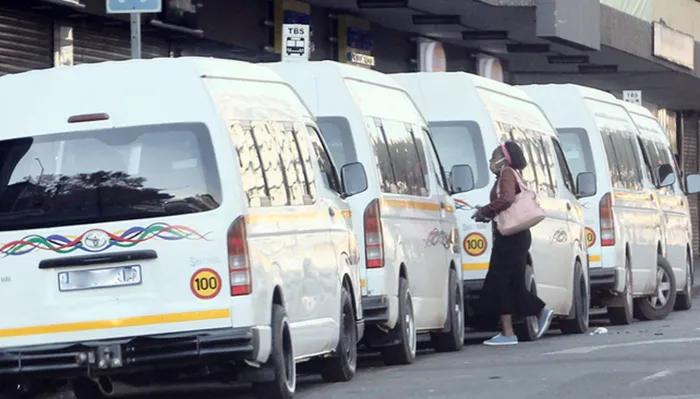
Santaco has appealed to the eThekwini Municipality to conduct a study to determine the number of taxis that operate in the city.
Image: File
THE story of South Africa’s taxi industry is a mirror of the country’s social and economic transformation, from a tightly restricted sector under apartheid which served only white commuters to today’s contested space between minibus taxis and e-hailing vehicle operators.
Taxis first appeared in the early 20th century, but ownership and operation were largely reserved for white South Africans. Despite these restrictions, black taxi operators managed to offer essential transportation services to the marginalised communities.
During these times, taxis came in the form of sedans, with bus routes limited to mainly urban and suburban routes. Unable to obtain permits to operate, from 1975 some black taxi owners purchased minibuses that operated illegally.
In the 1980s the government deregulated the taxi industry, which led to a surge in the number of black-owned taxis, offering economic opportunities for many; however, the deregulation was a gift and a curse.
It opened the window for those who wanted to cut corners, which led to violent turf wars between taxi associations.
The late 1980s and early 1990s saw an exponential boom in taxi ownership, birthing many moguls. Even after the dawn of democracy in 1994, minibus taxis continued to operate as a private business that absorbs the bulk of the workforce's transport needs.
Enjoying the lion's share of the workforce's transport needs is the reason why minibus taxis continue to be misnamed by even the government as public transport, when in reality they are privately owned businesses that have managed to organise under the informal transport sector with no government subsidy.
In 2006, the Department of Transport introduced the Taxi Recapitalisation Programme (TRP). The main objective of the TRP was to increase road safety by removing the unroadworthy taxis off the road via the scrapping process and utilising the scrapping allowance as a deposit to recapitalise with new compliant taxi vehicles.
However, at R50 000 per minibus, the grant fell too short for a deposit on the newly launched Toyota Quantum. Many owners held on to their paid-up Toyota Hi-Aces which didn't pass the TRP's rollover test. The rollover failure of the Hi-Aces was the reason Toyota SA discontinued that minibus model.
Despite the rollover failure nearly two decades ago, Hi-Aces still roam the public roads. However, many taxi associations have prohibited the model from operating.
The chairperson of eThekwini Metro Taxi Council (ETMC), Mathula Mkhize, was at pains this week to explain that they find it unfair as an industry that government expects them to pay for taxi rank stands when they are in a debilitated state, and commuters can't even use ablution facilities due to lack of maintenance.
Even under a democratic government, the issue of permits still exercises the minds of Mkhize and his colleagues in the industry.
Of the competition from e-hailing, Mkhize was bullish, maintaining that there are minibus taxi owners who have relatives who own e-hailing taxis.
"Even us as chairmen of associations, I doubt there's anyone who's never used e-hailing service. Our issue is when they (e-hailing operators) deviate from the app-based request and pick up a group of commuters," said Mkhize.
He said such deviation encroaches on the minibus taxi's territory, which is unfair, as minibuses need permits to operate, whereas e-hailing operators don't."We have no issue with e-hailing operators; the differences that exist can be sorted out without any difficulty, but they shouldn't operate like taxis when their operation should be app-based," said Mkhize.
He described the Clermont KwaDabeka issue, which became the trigger of Thursday's shutdown, as the tip of the iceberg.
The local association withdrew its minibuses after 25 of them were seized by the Durban Metro Police for operating without permits.
Mkhize says some of these minibuses have permits and blamed the municipality's strong-arm tactics against the industry.
"Minibus taxis that have no permits should not be on the road. Even we as the industry fine taxis that are not roadworthy through our Hlokomela (a road safety initiative by Santaco aimed at improving the industry's customer service, standards and operations). We won't defend unroadworthy vehicles and those without permits, but it has become a norm for taxis to be impounded even when they have valid permits."
Santaco has appealed to the eThekwini Municipality to conduct a study to determine the number of taxis that operate in the city.
A task team was announced by eThekwini Mayor Cyril Xaba on Thursday that will address daily challenges within the transport sector.
Sifiso Shangase, the provincial spokesperson of Santaco highlighted shortcomings within the municipality regarding the management of the process around the issuing of operating licences.
The permits are issued by the Transport Department and the city recommends the issuing. At the moment there's a moratorium due to what the city deems as saturation of the market.
“Several problems contribute to this situation, chief among them being an outdated database. For instance, if you sell your car and buy a new one, then the new car is listed above the old car in the database, which makes it look like you have many cars (taxis), which is the basis upon which they say it is full, and they are not recommending the issuance of more licences,” said Shangase.
The unavailability of permits drives the industry back to where it started in the dark days of apartheid as illegal operators.