

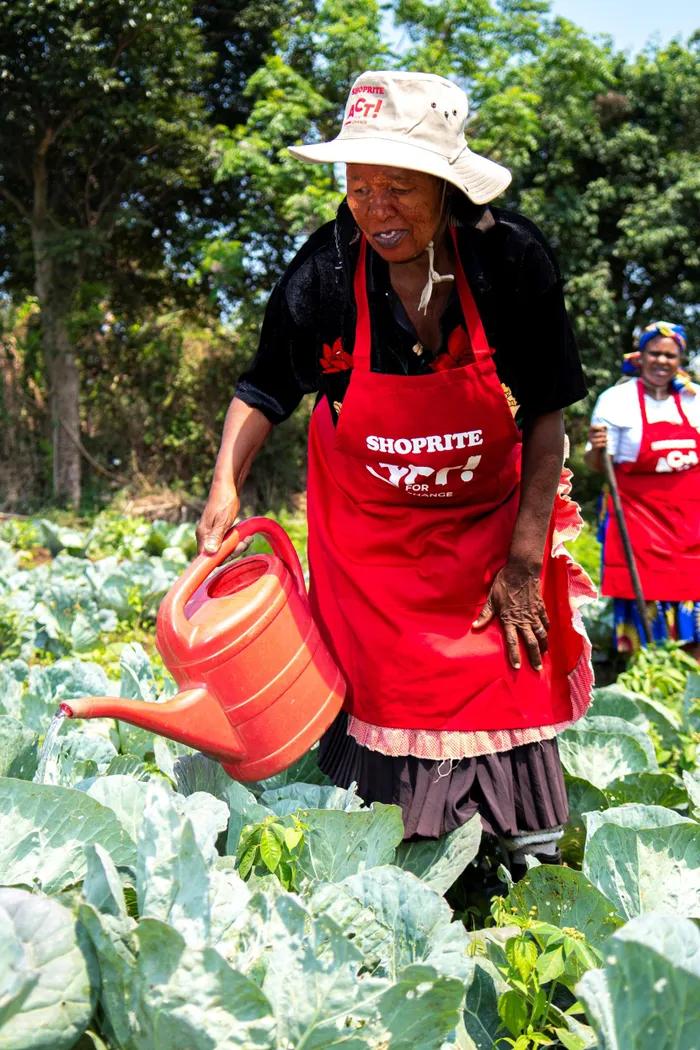
The Siyaphambili Women’s Club from Umgababa, in KwaZulu-Natal, is among the many community food gardens invited to enter the inaugural Shoprite Act For Change Food Garden Competition, where R1 million in tailored support forms part of the prize for gardens that fight hunger and uplift neighbourhoods. Community food gardens across South Africa are encouraged to enter.
Image: Supplied
ACROSS South Africa, small pockets of green hope are rewriting the story of hunger, one harvest at a time. From city centres and rooftops, to rural villages and township corners, schoolyards and church plots, neighbours are joining hands to grow food and friendships.
Now, Shoprite is shining a light on community gardens through the inaugural Act For Change Food Garden Competition, a national celebration of local heroes growing change from the ground up.
With collective prizes of R1 million in the form of support tailored to each garden’s needs, the competition aims to recognise community food gardens’ contribution to local nutrition, environmental sustainability, and community upliftment.
And beyond acknowledging their efforts, the competition sets out to join hands with these gardens, helping them grow stronger and make an even greater impact in their communities.
Over the past decade, Shoprite has invested in almost 300 community gardens as part of its commitment to tackling food insecurity and promoting sustainable livelihoods in the communities in which it operates. Together these gardens produced over 106 000 kg of fresh produce last year. But they do more than put affordable food on the table. They also help people develop agricultural skills and earn an income by selling surplus produce.
“We believe that lasting change starts at the grassroots,” says Sanjeev Raghubir, Chief Sustainability Officer at the Shoprite Group. “By investing in community food gardens, Shoprite is not only increasing access to fresh, nutritious produce but also equipping local communities with skills and opportunities.”
One of the communities is the Siyaphambili Women’s Club in Umgababa on KwaZulu-Natal’s South Coast. The club has become a source of friendship, mentorship, and food security for women farmers in the area. Each woman tends her own plot on the 2.5-hectare site, growing fresh vegetables to feed her family and sell locally.
Through Shoprite’s Act For Change programme, the group received tools, seeds, compost, and 18 months of permaculture training. They also received a new water-harvesting system to sustain their crops year-round.
“Shoprite has given us hope,” says founder Nonhlanhla Mkhize. “Their support proves that what we’re doing matters. It motivates us to keep growing.”
According to a recently published South African Food Security Index 2025, food access and affordability remain among the country’s most pressing challenges. Even though the Index improved from 44.9 in 2023 to 56.5 in 2025, millions of households still struggle to access nutritious food.
That is where community gardens offer a powerful solution. They don’t just feed people, they uplift them, increase access to fresh produce, build local skills, and foster shared responsibility, helping communities grow stronger.
The Act For Change Food Garden Competition is open to all community gardens, whether independently run or currently receiving support from any local businesses in SA.
Winning gardens will receive tailored support in line with its specific needs – whether it be irrigation systems, shade netting, fencing or training for members.
The winner will receive support to the value of R225 000, second runner up R200 000, and third place R170 000. The fourth, fifth, and sixth prize winners will each receive R150 000, R130 000, and R120 000 respectively.
To enter, participants should:
Entries close on 30 November, and winners will be announced by 30 April 2026.