

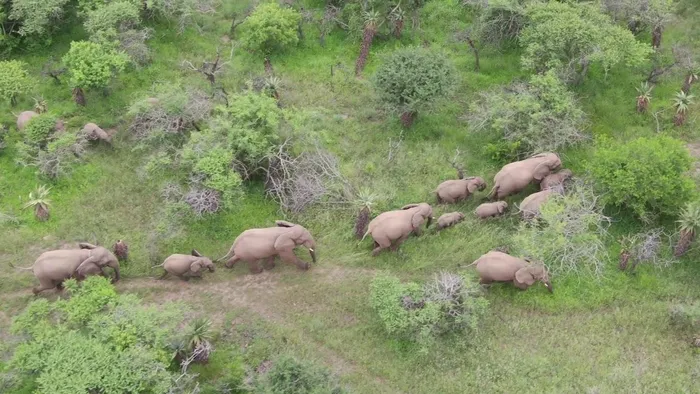
A groundbreaking partnership between Ezemvelo KwaZulu-Natal Wildlife, Humane World for Animals, and Loziba Wildlife Reserve has safeguarded one of South Africa’s iconic free-roaming elephant populations.
Image: Loziba Wildlife Reserve/ The Human Elephant Foundation
A JOINT effort by Ezemvelo KwaZulu-Natal Wildlife (Ezemvelo), Humane World for Animals, and the Loziba Wildlife Reserve has resulted in securing one of the country’s smallest and most isolated free-roaming elephant populations.
The move follows years of conflict between the elephants and nearby communities, driven largely by damaged fences and mixed land use.
For roughly a decade, the Mawana/Loziba elephants have ranged across northern KwaZulu-Natal without consistent containment, often moving onto residential and agricultural land.
When the original reserve owners did not repair broken fence lines, the herd was declared res nullius, prompting an urgent search for a long-term plan that could protect both people and elephants.
A proposal for an emergency 8,300-hectare area south of the Mawana Reserve, now referred to as the Loziba Wildlife Reserve, was presented to the Ulundi Legislature in November 2024. It was accepted, contingent on completing compliant fencing and an approved Elephant Management Plan.
While this was under way, short-term conflict-prevention measures were put in place to reduce risks to surrounding communities and the animals.
Vuyiswa Radebe, Head of Ezemvelo’s Biodiversity Conservation Operations, described the development as significant for efforts to manage ongoing human-wildlife conflict in the area.
“This accomplishment would not have been possible without the outstanding collaboration and steadfast support from our NGO partners, whose expertise, resources, and dedication proved essential in executing this intricate operation.
"As Ezemvelo, we stand resolute in our commitment to conserving KwaZulu-Natal's biodiversity for generations to come, and we offer our profound thanks to everyone involved, as well as to the communities for their remarkable patience during the search for a lasting solution," said Radebe.
Humane World for Animals (formerly HSI/Africa), along with partner organisations, implemented several non-lethal strategies aimed at stabilizing elephant numbers and improving safety. These included:
Fertility control through immunocontraception, delivered with support from Global Supplies.
Conflict-mitigation support, including equipment for reaction units and assistance with management actions directed by Ezemvelo.
Community engagement, with Elephants Alive training “elephant shepherds” and working directly with reaction units to help communities understand the herd’s movements.
Monitoring via GPS collars, real-time tracking, and virtual fencing to provide continual updates on elephant behaviour and location.
The new reserve’s 66-kilometre perimeter fence is now complete. It incorporates a “tentacle” design developed by Global Supplies to discourage elephants from approaching the fence directly. Virtual fencing linked to satellite collars funded by Humane World for Animals provides additional alerts so rangers can respond quickly to potential breaches.
On November 6, with the elephants in the iThaka Valley and close to communities, officials decided to move them away from the area. The herd then shifted toward the Loziba corridor and was guided into the newly fenced reserve.
A few bulls remained outside the next day; they were monitored and shepherded in if needed. By November 10, 28 elephants were confirmed inside the Loziba Wildlife Reserve. The aerial component of the operation was led by elephant specialist JJ van Altena of Global Supplies, facilitated by Humane World for Animals and conducted under Ezemvelo’s authority. Monitoring is ongoing and early observations suggest the animals are settling in.
The relocation and containment of the herd is expected to have economic implications for the region. The reserve’s development has created local jobs, including roles in fencing, security, wildlife monitoring, and tourism services. Elephants remain a major draw for visitors, which may increase revenue for lodges, guides, and hospitality businesses. Training initiatives linked to the reserve are also intended to create income opportunities for surrounding communities.
Dr. Audrey Delsink, senior director of wildlife at Humane World said the success proved that coexistence was possible when science, collaboration, and willpower came together.
“Non-lethal, ethical solutions are ready to be deployed; thus we urge authorities and stakeholders in other jurisdictions to embrace them and follow suit,” said Delsink.