

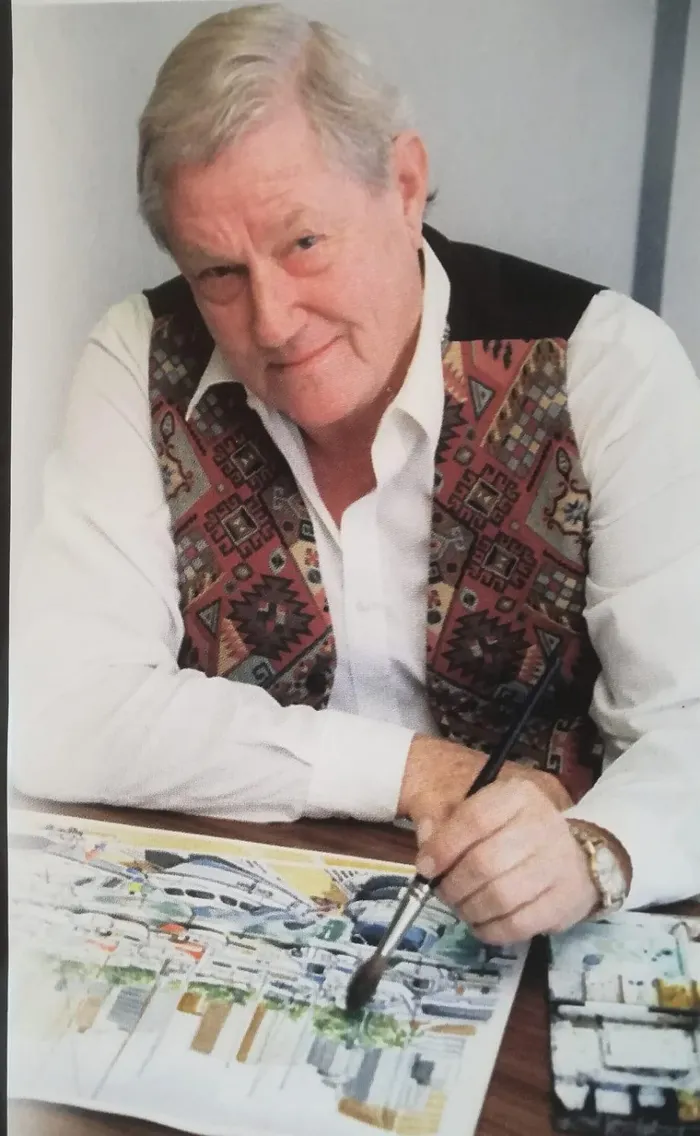
Napier Dunn in 1998 working on his sketch of the Durban Yacht Basin.
Image: Supplied
For over a decade, Napier Dunn was the cartoonist at the Mercury. In the late 1990s, he also occasionally painted depictions of historic buildings and scenes of Durban. These were published in the Mercury from time to time, to much acclaim.
In 1998, with the support of the newspaper's then editor, David Wightman, a set of 12 paintings was collected together as “Dunn’s Durban” for a 1999 calendar. The following year, with the backing of the next editor, Dennis Pather, a 2000 calendar was printed.
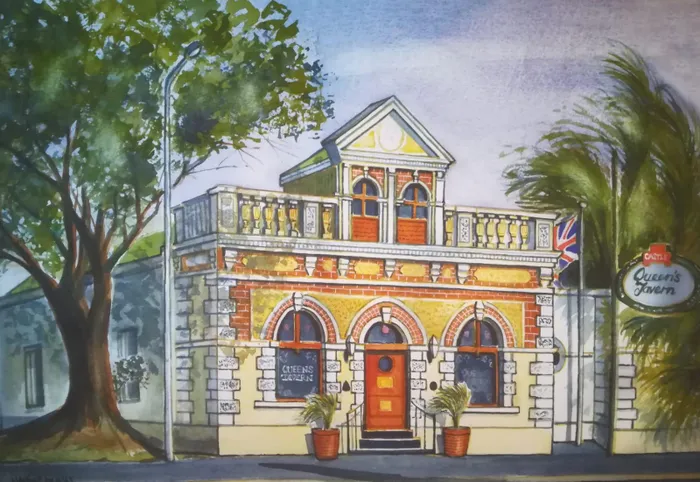
Queen's Tavern when it was still a pub and restaurant in the 1990s. Across the road from Newspaper House, it was a popular watering hole for journalists. The building is today painted grey and white.
Image: Supplied
Dunn died 20 years ago, in October 2005 aged 67, and in memory of this versatile man a sampling from those 24 paintings will surely provide as much pleasure now as they did more than 25 years ago.
Born in England in 1938, Napier was the second son of Edward Dunn, who was the musical director of the Durban Civic Orchestra from 1935 to 1954. Napier was educated at Treverton in Mooi River and briefly at Hilton Road before attending Glenwood High School where he took up the French horn.
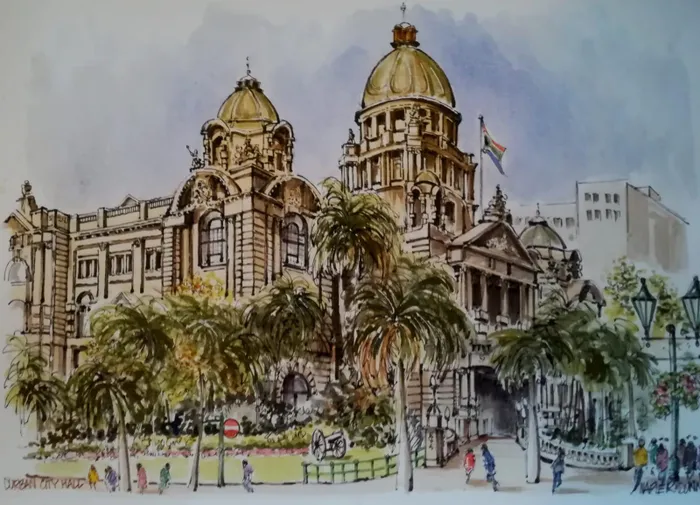
Durban's City Hall, a building well-known to Napier when as a boy he attended concerts conducted by his father Edward, and later played French horn on its stage.
Image: Supplied
He later learnt to play six instruments including, not surprisingly, the clarinet which his father had played with the Hallé Orchestra in Manchester. While still in his teens, Napier played the French horn with the Durban Civic Orchestra.
By his own admission, Napier was one of “the wild ones”, prone to unruly behaviour which his father hoped a spell with the Grenadier Guards might curb. During his three years with the Guards band, he gained a level of proficiency which so impressed London’s Royal College of music, that he was awarded a scholarship to study there.
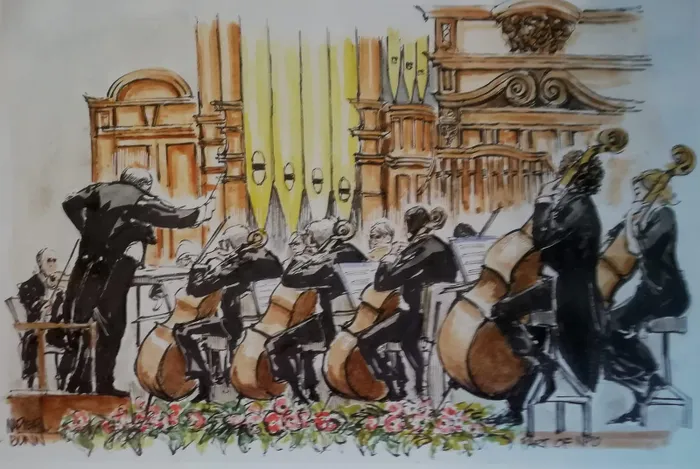
The cellos and double basses of the KZN Philharmonic Orchestra in 1998. Napier's father was the longest - serving conductor of the orchestra's predecessor.
Image: Supplied
After his studies, he returned to South Africa where he played in the National Symphony Orchestra of the SABC before making his way back to London, where he successfully auditioned for a vacant French horn post with prestigious London Philharmonic Orchestra.
During his two years there, he had time to observe his fellow musicians, observations which he turned into caricatures, usually to their delight. But he was not yet ready to turn this emerging skill into his profession.
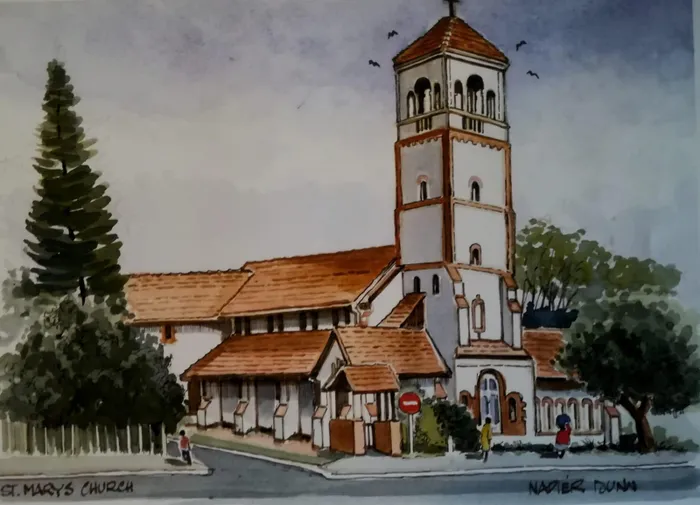
St Mary's Church, Greyville was designed by Sir Herbert Baker.
Image: Supplied
He next sailed to Australia, joining first the Queensland Symphony Orchestra in Brisbane and then the Sydney Symphony Orchestra. In between, he toured the continent with the Australian Ballet Company’s orchestra.
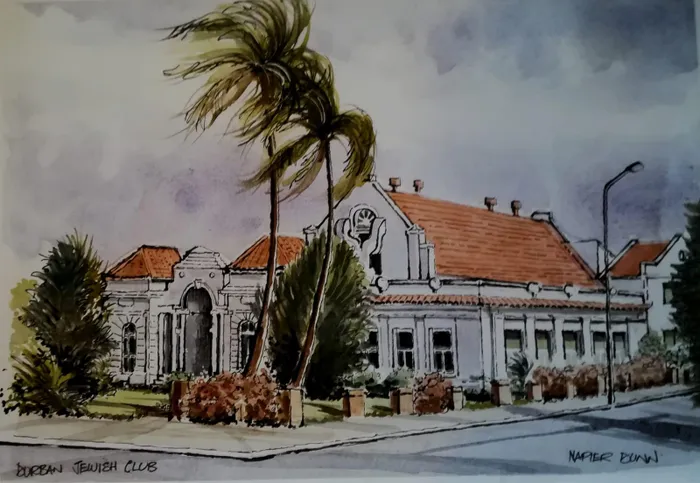
The Durban Jewish Club was opened in 1931. Sketched in the late 1990s before the lawn was paved over for parking and the erection of a security fence.
Image: Supplied
Restless by nature, Napier enjoyed plying his trade in different countries, usually immersing himself in the local culture and language. His next few years were spent in Asia; there were brief stints in Indonesia, Borneo and Singapore before a longer sojourn in Hong Kong where he had his first break as a cartoonist for the South China Morning Post. Then it was off to Japan where he again worked for a newspaper- and learnt enough Japanese to make himself understood and to teach English.
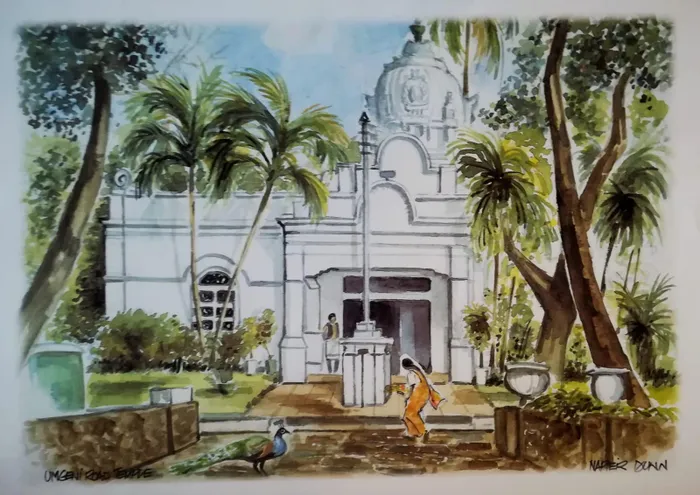
The Umgeni Road Temple, a beacon of the Hindu community. Erected in the 1880s on land donated by two wealthy jewellery manufacturers.
Image: Supplied
But he had yet to see America. Over three years he travelled across the United States in a camper van, fell for the charms of San Francisco before moving to Alaska for six less charming months, earning money by sketching in shopping centres. Missing Hong Kong, he returned there for seven years before the seven year itch struck: it was time to re-acquainted himself with his boyhood home. Working his passage on a container ship, he sailed for Durban.
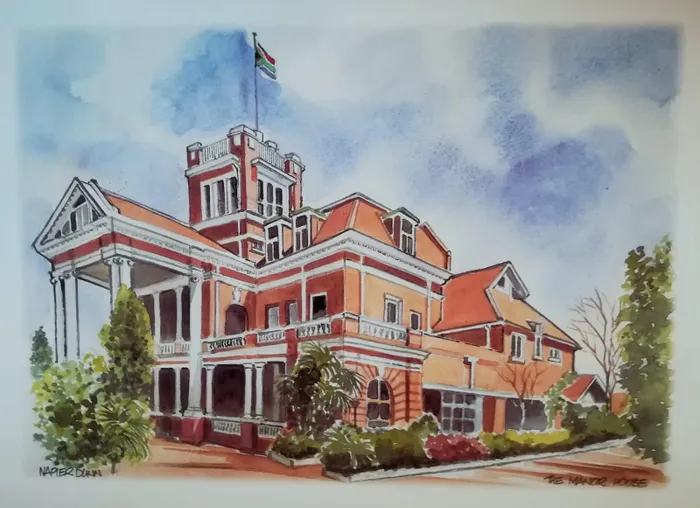
Manor House, the mansion built by Sir Liege Hulett in 1905 in Nuttall Gardens, Morningside. Today it is corporate offices.
Image: Supplied
There had been times during his wandering years when Napier had resorted to manual jobs before finding employment in an orchestra or with a newspaper. By his early 50s, he sought a more settled career which he found when he joined the Mercury in 1991 as their cartoonist. The years that followed were some of his most productive and when his employment with the paper ended, he was unhappy. He later drew occasional sports cartoons for The Sunday Tribune, gave talks and drew cartoons and caricatures on commission.
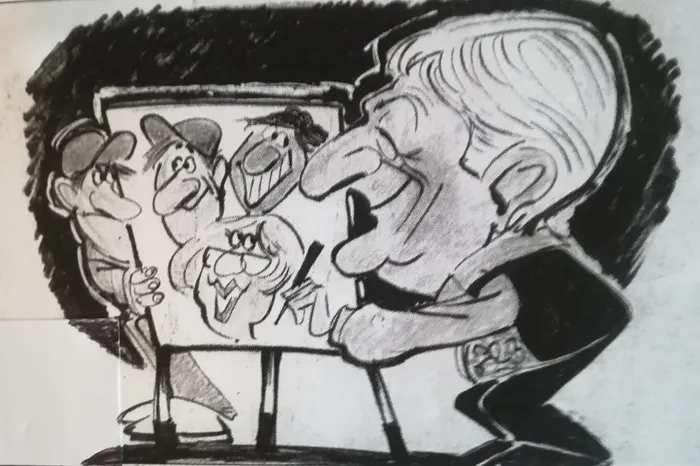
A self - penned cartoon of Napier Dunn at work.
Image: Supplied
He followed tennis avidly- and was a regular player- and was often seen at concerts given by the KZN Philharmonic Orchestra in the Durban City Hall once, rather proudly, telling a concert-goer that he had played with the old Durban Civic Orchestra on that very stage. Just before his death, he had completed a set of 12 paintings of the orchestra which he incorporated into a calendar.
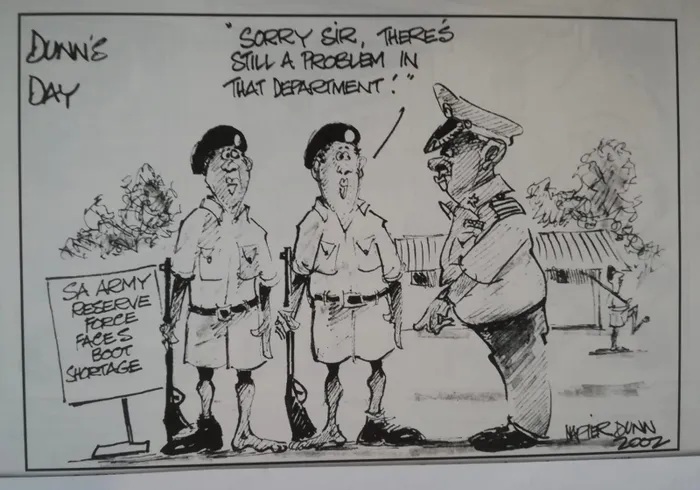
This cartoon on the lack of funding in the South African National Defence Force (SANDF) appeared in The Mercury on January 18, 2002. More than two decades later, Dunn's cartoon remains just as relevant.
Image: Supplied
His newspaper cartoons exposing the shenanigans and missteps of politicians and official-dom had a gentler tone than some of his contemporaries, but they still made their point. A colleague at The Mercury, Greg Dardagen, said that Napier had a distinctive cartoon style coupled with a dry wit.
Many cartoonists have preserved their best work in printed collections, a few publishing annually. It is a pity that there is no such edition of Napier Dunn’s work, but at least we have his depictions of Durban’s heritage and orchestra to savour.