

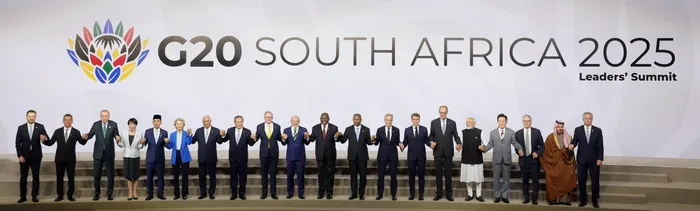
Family photo of G20 Heads of State, government; invited leaders and heads of International Organizations during the G20 Leaders’ Summit, hosted by South Africa at the Johannesburg Expo Centre, Gauteng Province.
Image: Siyabulela Duda / GCIS
G20 leaders are set to adopt a joint declaration today as the two-day summit in Johannesburg concludes, directly rebuffing US President Donald Trump’s attempt to block any consensus without Washington’s participation.
The declaration, which acknowledges the urgent debt crisis gripping many Global South countries, marks a significant diplomatic stand by attending nations and a clear rejection of Trump’s eleventh-hour demands.
Forty-two countries and institutions took part in yesterday’s sessions, despite the United States refusing to attend the summit, even as it prepares to assume the G20 presidency from South Africa.
Tensions escalated sharply this week after Trump warned South Africa not to issue any joint leaders’ declaration, insisting it would not be legitimate without US endorsement.
Then in an abrupt reversal, the US later proposed sending its embassy’s chargé d’affaires to collect the G20 presidency gavel from President Cyril Ramaphosa, a request South Africa swiftly rejected. Ramaphosa’s spokesperson, Vincent Magwenya, confirmed that no US representatives would attend, sealing Washington’s isolation from the final outcomes.
“We have made our position very clear. What they were suggesting, is a breach of protocol. You cannot have a head of state handing over the presidency and the leadership of such an important, premier forum for macro-economic issues and other related issues being handed over to a junior embassy official. It’s a breach of protocol. It has never happened before and it was never going to happen for the first time here in South Africa,” said Magwenya.
In diplomatic practice, a chargé d’affaires is the lowest-ranking head of mission, typically appointed only when a country does not have an ambassador in place. Unlike an ambassador or minister, a chargé d’affaires does not present credentials to a host head of state and is generally viewed as a temporary or junior-level representative.
South Africa considers the G20 presidency handover a high-level ceremonial event, prompting concern that the US was downgrading its participation by assigning a chargé d’affaires to lead its delegation.
International Relations Minister Ronald Lamola confirmed that Pretoria will not hand over the G20 presidency to the US at the Nasrec Expo Centre.
Speaking on the sidelines of the G20 Summit yesterday, Lamola said the US will have to collect it from the Department of International Relations and Cooperation (DIRCO) offices.
He emphasised that the summit was South Africa’s G20, highlighting that it was an opportunity to shine a spotlight on the African continent.
“No one will steal that spotlight. The African continent has made it,” Lamola said.
The statement follows the adoption of a declaration by G20 leaders, which he said was clear on issues affecting the Global South, particularly Africa.
He pointed to the framework on critical minerals, noting that 30% of the global minerals required to power artificial intelligence and green economies were found in Africa.
“South Africa has enabled the issue of beneficiation at source within this G20 framework,” Lamola added.
Lamola, on the subject of artificial intelligence in Africa, acknowledged that few African content creators have access to resources, but stressed that the G20 summit aimed to change that dynamic.
“This G20 speaks about how the African continent must not just be a consumer of artificial intelligence but a source of innovation, research, data centres, and other platforms,” he said.
“These are key issues for the continent’s young population. This G20 will revolutionise how Africa participates in the global economy.”
Lamola described the summit as a “mission accomplished,” adding that global visitors to South Africa had provided positive feedback.
“They love South Africa. They love our wine. They also know about biltong,” he said.
“It has been a good year. We are very glad that a South African government has delivered a progressive declaration that will revolutionise the African continent and how the Global South engages in the global economy.”
Lamola rejected claims that the United States had been denied access to the closing ceremony.
“We did not deny anyone access. The United States is a member of the G20. If they want to be represented, they can send someone at the appropriate level. This is a leaders’ summit,” he said, adding that, “The right level is the head of state, a special envoy appointed by the president, or a minister.”
Lamola said Ramaphosa will not hand over to the US at the summit but at the Department of International Relations and Cooperation or wherever else the US may request within South Africa’s borders.
“We remain open and cordial, and we are willing to cooperate and work with them. But the focus of this G20 summit has been on critical issues such as artificial intelligence, climate change, and the framework for critical minerals, and that’s what we must focus on,” he said.
The declaration at the G20, under the South African Presidency, plans to address global development challenges with a significant focus on Africa through a multi-faceted strategy centred on the principles of solidarity, equality, and sustainability.
Global leaders acknowledged that high levels of debt hinder inclusive growth and limit investment in development needs, particularly for low-income countries in Africa.
Member countries also acknowledged that addressing the severe energy access deficit in Africa where over 600 million Africans lack electricity and an estimated 1 billion lack clean cooking access, was a priority.
They unanimously endorsed the recommendations set out by the report of the South Africa G20 Africa Expert Panel.
Leaders said the bloc must ensure the voice of the Global South is amplified in all global institutions, acknowledge the need for growth based on shared rules and fair trade, the rethinking of how global financial institutions operate and how to relieve the debt burden on developing countries.
The report, recently handed over to Ramaphosa, demanded a shift from old development paradigms, which viewed countries in the global South as mere export centres for raw materials.
It also called for bold multilateral action to transform Africa's development path.
Italy used the meeting to commit to halving the debt owed by African countries by 50%, with Prime Minister Giorgia Meloni saying they will ensure the debt owed by low and middle income countries was halved over the next decade.
Maxim Oreshkin, the deputy head of the Russian Federation’s presidential administration said the international economic order was in crisis and did not take into account new developments.
“These days global economies are experiencing severe fragmentation which include sanctions, trade barriers and technological restriction. This destabilises global architecture and holds back global growth and undermines the (United Nation’s) SDGs (sustainable development goals).
Oreshkin said Africa needed growth to meet the needs of its young and fast growing populations.
“Weak institutions that limit the financial flows of developing countries are not enough. Africa's total debt according to the IMF (International Monetary Fund) will reach three trillion dollars this year. The World Bank has provided more aid to Ukraine in the past three years than all the African countries combined,” Oreshkin said as he called on the G20 to remain a multilateral platform.