

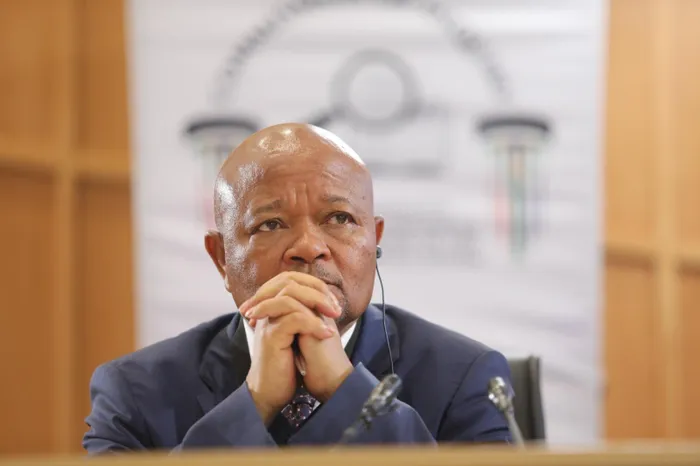
Suspended Police Minister, Senzo Mchunu said he took a decision to disband the Political Killings Task Team (PKTT) without consulting any of the police top officials.
Image: Oupa Mokoena/IOL News
SUSPENDED Police Minister Senzo Mchunu came under intense scrutiny during his testimony at the Madlanga Commission of Inquiry regarding his controversial decision to dissolve the Political Killings Task Team (PKTT).
The decision, relayed through a missive dated December 31, 2024, was described by Mchunu as a necessary move based on a work-study recommendation from 2019, which suggested that the team’s functions be absorbed into a more robust murder and robbery unit.
As Justice Mbuyiseli Madlanga and his co-commissioners interrogated the minister’s rationale, they highlighted significant concerns over the timestamps and implications of Mchunu’s directives.
When asked about his use of the term "immediately” in the letter, Mchunu attempted to clarify that it indicated the urgency of his decision-making process rather than an instantaneous dissolution.
"This immediately is not like switching off," he insisted, as Madlanga countered with a lesson in language, pointing out the grammatical context of the word.
Co-commissioner Advocate Sandile Khumalo SC said: "My reading of it is that something must be done immediately, not that you have made an immediate decision that something must happen in the future."
Madlanga pressed for clarity on the implications of this timing, questioning why Mchunu had chosen to announce such a “bombshell” on New Year's Eve, allegedly before briefing National SAPS Commissioner General Fannie Masemola.
Mchunu suggested that the decision was merely the culmination of a long-considered plan. However, the presiding commissioner found this explanation lacking, asserting it "doesn't make sense" and emphasising the importance of procedural transparency.
During the cross-examination, Mchunu maintained that his relationship with Masemola was productive, stating: “He (Masemola) supported the directive in full.”
Yet, the commission highlighted that the November 2024 meetings had not discussed the PKTT's disbandment. Mchunu thus faced further questions about the justification of this critical decision, especially given that no other task teams had been dissolved prior to this.
The minister defended the rapid disbandment as a route toward implementing decisions overdue, citing operational costs as a significant factor. Yet when pressed about the comparative budget of the PKTT against other teams, Mchunu conceded he had not conducted such an analysis before concluding that its costs were unjustified.
Part of the commission’s focus included the process for transitioning ongoing investigations previously handled by the PKTT.
A disbandment report, which was prepared post-decision, suggested that the SAPS would manage outstanding cases while an audit of pending dockets would occur to determine the future allocation. The expected timeline for the completion of these dockets could extend into late 2025, raising questions about operational effectiveness and public safety.
As the inquiry unfolds, Minister Mchunu’s testimony will resume on Friday, as the commission digs deeper into the circumstances surrounding the task team’s disbandment.