

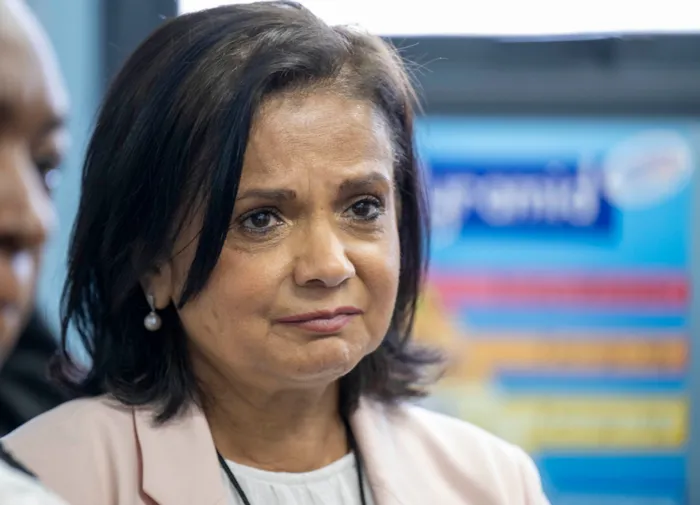
National Director of Public Prosecutions, Advocate Shamila Batohi.
Image: Henk Kruger / Independent Newspapers
THE recent conduct of the National Director of Public Prosecutions (NDPP), Advocate Shamila Batohi, at the Nkabinde Enquiry has sparked serious concerns about the integrity of the National Prosecuting Authority (NPA).
Legal analyst Bophelo Seleke said Batohi’s actions could significantly erode public confidence in an institution already under scrutiny. As the initiator of the enquiry into Advocate Andrew Chauke’s fitness to serve as South Gauteng Director of Public Prosecutions, Batohi's role is pivotal, yet her recent decisions raise questions about her commitment to accountability.
The enquiry, chaired by retired Constitution Court Judge Bess Nkabinde was established by President Cyril Ramaphosa to investigate serious allegations against Chauke, who has been suspended on full pay since July.
During the enquiry on Monday, Batohi faced intense questioning from the panel chair, Judge Nkabinde. However, she abruptly refused to continue testifying, claiming she needed to seek proper legal counsel.
When questioned about her absence after the lunch break, Batohi stated that she had decided to obtain legal advice. Nkabinde reminded her that as the enquiry’s initiator, she was in a crucial position as the key witness.
Proceedings were adjourned until January.
Seleke said Batohi’s unilateral decision to leave the enquiry without formally seeking the panel’s consent demonstrated a blatant disregard for procedural authority.
“Commissions of enquiry, particularly those established to assess the fitness of senior public prosecutors, operate under strict procedural rules. As head of the National Prosecuting Authority, she is expected to model adherence to both legal and institutional norms,” Seleke said.
He emphasised that Batohi’s request not to be cross-examined, which Nkabinde flatly declined, raised significant concerns. “Evidence, especially from a senior official, must be subjected to cross-examination to test its reliability, completeness, and truth.
"By seeking to avoid cross-examination, Batohi attempted to evade a core mechanism of legal and institutional accountability. Her eventual withdrawal and defensiveness underscore a failure to anticipate or accept this procedural reality. As the NDPP and initiator of the inquiry, her evidence was required to withstand rigorous scrutiny; avoidance undermines both the integrity of the inquiry and public confidence in the office she leads," he said.
Seleke said Batohi's stated reason to seek legal advice comes across as disingenuous.
"Given that she is leaving office, it seems likely she is concerned with defending herself against any personal challenge by Adv. Chauke and avoiding the costs or consequences that may follow. Walking out mid-testimony under these circumstances undermines the authority of the panel, sets a poor precedent for procedural compliance, and signals avoidance rather than genuine engagement with the inquiry she herself triggered," he said.
Seleke said by leaving without permission and attempting to avoid cross-examination, Batohi undermined the procedural integrity of a legally mandated process.
"Legally, her conduct raises concerns under the principles of natural justice, particularly audi alteram partem, which requires that evidence be tested through cross-examination.
"Avoiding this scrutiny is a failure not just of professional decorum, but of legal and institutional accountability. Institutionally, her conduct risks eroding public confidence in the NPA and the office of the NDPP," he said.
Xola Nqola, chairperson of the Portfolio Committee on Justice and Constitutional Development, responded to Batohi’s conduct with strong criticism. He described her abrupt departure as deeply troubling and indicative of a broader failure to respect the principles of accountability and due process.
Nqola reiterated that the enquiry served a vital constitutional function to restore public trust in the prosecuting authority. “Any attempt by a key witness, especially the head of the institution under scrutiny, to impede or disrupt its proceedings or evade cross-examination is an act of institutional disrespect that cannot be tolerated. It sends a profoundly damaging message to the public and the dedicated public servants within the NPA,” he said.
The committee plans to engage with the Minister of Justice and Constitutional Development and relevant authorities to ensure that all individuals cooperate fully with the enquiry and that the processes of constitutional accountability are not undermined.
Dr Nora Saneka, chairperson of the civil rights organisation Active Citizen Movement (ACM), suggested that it would have been more respectful for Batohi to have asked the Chair for permission to seek legal counsel. “Batohi has not refused to respond to cross-examination; she just needed to get legal counsel. She appeared before the chair to explain herself when requested and accepted the warning given,” Saneka noted.
Raksha Semnarayan, an ACM executive committee member, pointed out that there were aspects of the NDPP's testimony that could be improved. “This shows that there are serious issues in the NPA’s administrative processes, governance, and oversight that require immediate attention.
“The focus on the NDPP’s testimony, to the extent that it is being covered, removes attention from the purpose of the commission. The commission is intended to look at the conduct of Chauke and more specifically his failure to carry out his legal mandate concerning prosecuting corruption-related crimes.”
Terrence Manase, spokesperson for the Minister of Justice and Constitutional Development, stated that in keeping with the principle of institutional independence, the Minister will refrain from commenting on matters currently before the enquiry.
“The Minister will await the enquiry’s report and recommendations and will respond at the appropriate time, should this be required. She has full confidence in the enquiry panel’s capacity to manage its proceedings, address any issues arising before it, and discharge its mandate independently.”
Tiyisela Mpuzana, spokesperson for the enquiry, added that as the enquiry is ongoing and evidence is still being led, it would be inappropriate for the panel or its spokesperson to comment on issues that are before the enquiry at this stage.
“Any public commentary on matters arising during testimony or on the conduct of witnesses may compromise the integrity, fairness, and orderly conduct of the proceedings. The panel remains seized with the process and will allow the enquiry to run its course in accordance with its mandate. Once the enquiry has concluded and the process permits, appropriate communication will be considered,” Mpuzana said.