

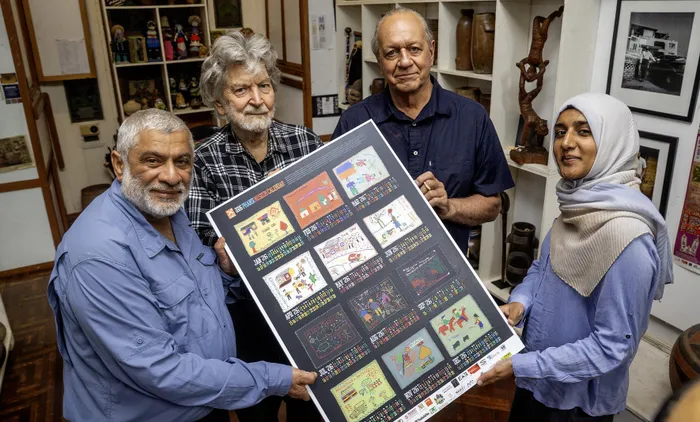
Artists and cultural custodians Yusuf Patel, Paul Mikula, Andries Botha and Fathima Paruk with the Phansi Museum’s 2026 calendar, celebrating women’s voices and living heritage.
Image: Leon Lestrade / Independent Newspapers
IT is a calendar that does more than count days. It counts voices.
Each month reflects a story that began in a different language, crossed borders through careful translation, found its way to thread and is now featured in the Phansi Museum’s calendar.
The 2026 edition, The Voices of Women, draws from a remarkable body of work gathered over more than a decade by renowned artist and sculptor Andries Botha and his team.
Nearly 3,000 stitched testimonies, either spoken or written by women across the province, form a vast archive, of which the calendar offers a tantalising glimpse. These fragments of lived experience will soon hang in some 2,000 offices, museums and schools, many of them in rural areas, doing what calendars rarely do: asking you to pause.
The stories originate in the project Amazwi Abesifazane—The Voices of Women—an initiative Botha launched after attending the Truth and Reconciliation Commission hearings. Sitting in those rooms, he noticed something others may have overlooked.
“Most of the people appearing were women,” he recalls. “They were there because the men were scattered: for social, cultural and political reasons, while the women stayed at home. They witnessed everything.”
What struck him even more was how history is usually told. “All the stories about our existence are always told by men,” he says. “I wanted to hear what women had to say.”
To do this properly, Botha established the NGO Create Africa South and trained a team of eight fieldworkers through partnerships with other organisations. Working with groups such as the Self-Employed Women’s Association (SEWA), the ANC Women’s League and structures of the IFP, the team travelled to the furthest reaches of KwaZulu-Natal, deliberately avoiding a single political or cultural viewpoint.
The women they met were asked just one question: What was the most important day of your life?
Often, they were asked in groups of about 20, women who knew one another, who felt safe enough to speak. For many, it was the first time anyone had asked, or listened.
“Over ten or twelve years, we extracted more than 3,000 embroideries,” says Botha. Each story was translated, illustrated, stitched, archived and eventually reproduced on paper. “We discovered many of the women simply wanted to tell their story because someone cared enough to hear it,”he says.
That this work finds a home in the Phansi Museum feels inevitable. Botha’s association with celebrated architect and Phansi founder Paul Mikula spans more than three decades, a relationship rooted in shared passions for beauty, creativity and the cultural life of KwaZulu-Natal.
Mikula opened Phansi Museum in Glenwood after relocating from the BAT Centre, setting it up in the former home of Esther Roberts. Much of what fills the museum - beaded panels, engagement waistcoats, amabaxha mats, beer pots, telephone-wire plates, leather armwear and Zulu dolls—comes from his personal collection. These artefacts have long found their way into Phansi’s annual calendars, which the museum has produced since 1994.
“This is our 31st Phansi Calendar,” says Mikula, now in his 80s. “Each edition highlights a different community or collection.”
Distributed through a dedicated network of runners, the calendars reach schools and public institutions across the province. Over time, they have become collectors’ items, small, beautifully produced ambassadors of a much larger cultural project.
For Mikula, the calendar is about more than visibility. “It’s a way of getting people to love the museum,” he says. “The museum is about culture, about Ubuntu art, it’s for the people. People couldn’t read or write, but they could do beadwork. When sewn together, it tells a story.”
Around 2,000 calendars are distributed to schools each year, where they quietly create awareness of a heritage many learners might never otherwise encounter.
“Unless you visit the museum, you don’t really get exposure to it,” says Phansi trustee Yusuf Patel. “By putting these images into print and into schools, we’re connecting students to this incredible heritage and hopefully encouraging them to come and see it for themselves.”
By December, the calendar has developed a following. Runners arrive eagerly to collect their bundles, transporting them to rural distribution points where the calendars take on a second life as teaching tools, conversation starters and objects of pride.
It is, as Patel puts it, a collective effort: a network bound by a shared commitment to art and culture.
For Botha, the significance runs deeper still. “Culture is important because it never suffers from amnesia,” he says. “It records things into eternity for those who know how to look, to find, and to learn who they actually are.”
In that sense, this calendar is not merely marking time. It is preserving memory.