

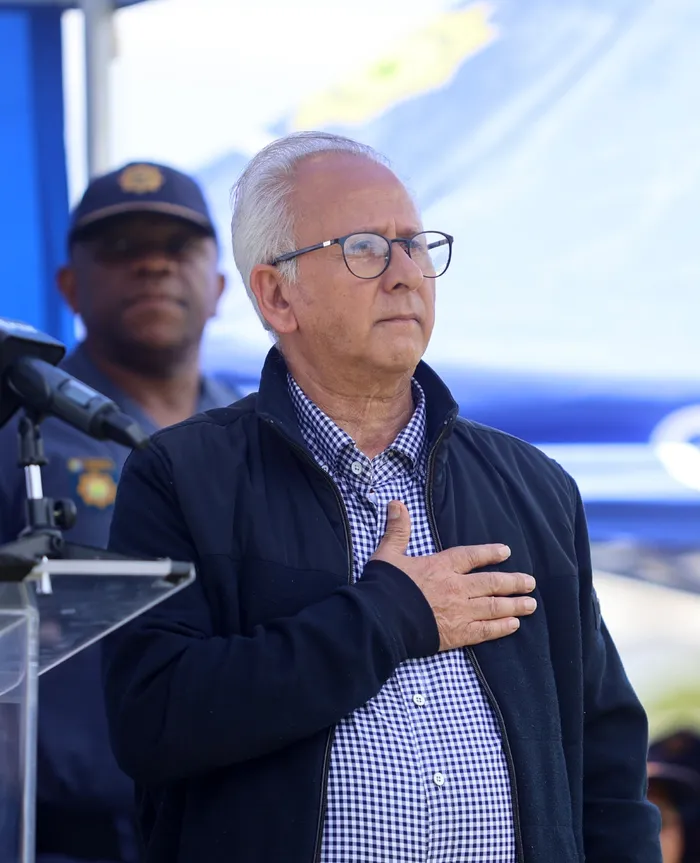
Acting Police Minister Firoz Cachalia
Image: Tumi Pakkies/ Independent Newspapers
Acting Police Minister Firoz Cachalia has dismissed calls for increased legislative oversight of the Presidential Protection Services (PPS), asserting that existing laws are sufficient to ensure accountability for misconduct within the unit.
His stance comes in response to inquiries from Democratic Alliance (DA) MP Ian Cameron, who requested clarity on whether the minister would amend legislation to strengthen oversight mechanisms for the PPS.
During a recent parliamentary session, Cachalia stated unequivocally that he has no intention of introducing amendments to the South African Police Service Act (SAPS Act) or the Independent Police Investigative Directorate Act (IPID Act) that would establish a statutory obligation for PPS members to report misconduct directly to IPID.
“The Minister of Police will not introduce legislative amendments to the South African Police Service Act, 1995 to create a statutory obligation for Presidential Protection Services misconduct to be reported directly to the Independent Police Investigative Directorate,” he clarified.
Cachalia further explained that the PPS, a specialised unit within the South African Police Service (SAPS), operates under the same legal framework that governs all police members. He emphasised that under the existing IPID Act, any incident of misconduct involving PPS personnel is mandated to be reported to IPID in compliance with Section 29(1).
“As Presidential Protection Services employees are members of the SAPS, the oversight of Presidential Protection Services’ operational deployment protocols is subject to the same oversight mechanisms as all other members of SAPS,” Cachalia reiterated.
In his exchange with Cameron, the issue of external oversight on PPS protocols and annual reporting to Parliament on integrity incidents was also raised.
Cachalia noted that the executive director of IPID is obliged to report on the activities and recommendations of the agency whenever requested by the minister or Parliament—a provision that also encompasses incidents within the PPS.
When pressed about whether he would advocate for policy reforms to address what appears to be a trend of protection units evolving into semi-autonomous entities, Cachalia reaffirmed that all members of SAPS, including those in protection units, are subject to a stringent legal framework.
“A need for review of policies and directives dealing with discipline in the SAPS has been identified as a priority to be addressed with the national commissioner,” he said.