

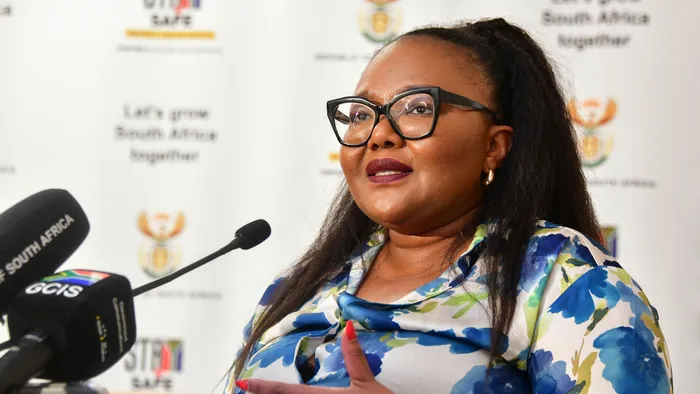
Basic Education Minister Siviwe Gwarube
Image: GCIS
A staggering R7.1 billion has been spent by the provincial education departments from their Equitable Share allocations on information and communication technology (ICT) for education over the past three years.
A total of R2.65 billion was spent in the 2022/23 financial year, followed by R2.62 billion in 2023/24, and R1.8 billion earmarked for the current financial year, 2024/25.
This significant investment marks a crucial step towards modernising education in South Africa and highlights the government's commitment to integrating technology in learning.
This revelation came from Basic Education Minister Siviwe Gwarube during a parliamentary session where she responded to questions posed by Economic Freedom Fighters (EFF) MP Vuyani Pambo regarding provincial expenditures.
Pambo inquired about how the Basic Education Department monitors these expenditures centrally and holds provincial bodies accountable for any underspending or misallocation of ICT funds.
Minister Gwarube explained that the Basic Education Department employs a comprehensive national oversight framework to track provincial ICT expenditures. This framework includes collaboration with the National Treasury to analyse spending patterns and the Auditor-General of South Africa's independent verification of the expenditures through annual audits. This is aimed at ensuring transparency and accountability in the allocation of educational resources.
Gwarube emphasised the internal monitoring systems in play, which involve the Chief Financial Officer (CFO) reviewing quarterly and annual financial performance reports from provinces. An internal audit is also conducted to assess the effectiveness of internal controls associated with ICT spending while identifying any potential risks involved.
Additionally, a supply chain management system is in place to ensure compliance with procurement and adherence to contractual obligations regarding ICT goods and services purchased by provinces. “Although provinces administer their own equitable share budgets, this national oversight system enables the Department of Basic Education to track expenditure trends, highlight concerns, and guide corrective action where necessary,” Gwarube stated.
The minister highlighted that provincial bodies are held accountable for underspending or misallocating ICT funds through a series of quarterly and annual performance reviews, meetings of the Council of Education Ministers, and the Head of Education Departments Committee.
Findings from the Auditor-General’s audits are crucial in holding provinces accountable for any irregularities, weaknesses in financial management, or failures in procurement controls.
Whenever non-compliance or persistent underperformance is detected at a provincial level, the Department of Basic Education advises on corrective actions, which can include formal written directives requiring the implementation of measures within a specified timeframe.
Gwarube further explained that in collaboration with the National Treasury, fiscal interventions can be enacted, including halting a portion of an allocation or reallocating it to another province if a province consistently mismanages funds. For initiatives under conditional grants, the department may withhold or delay future fund releases, impose stricter reporting requirements, or request revised implementation plans.
“These interventions are designed to safeguard the integrity of the national ICT in education programme while recognising the constitutional autonomy of provinces in managing their equitable share allocations.”
The overall objective, as reiterated by Gwarube, is to enhance digital access and governance across the education sector, ensuring that ICT investments effectively support teaching and learning processes while ultimately improving learner outcomes.
As a part of this initiative, Pambo also referenced the digital devices commitment made by President Cyril Ramaphosa during the 2019 State of the Nation Address.
Gwarube responded that, between 2022/23 and 2024/25, the government has procured a total of 545,938 learner ICT devices and 30,818 devices for teachers. Furthermore, 10,588 classrooms have been equipped with essential ICT resources to facilitate modern teaching and learning.
The commitment to advancing digital learning remains steadfast, with the department focusing on modernising the delivery of Learner Teacher Support Material and ensuring equitable access to technology-enhanced education.
“Progress will continue to depend on available provincial budgets, improvements in supply chains, strengthened partnerships, and the broader fiscal environment,” said Gwarube.