

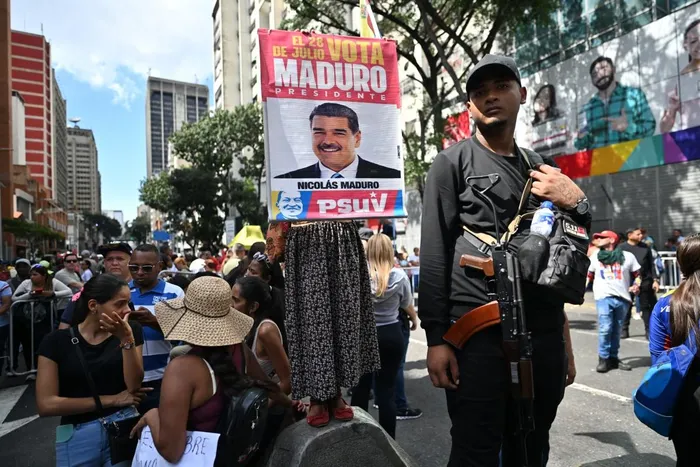
Political economist and social commentator Nco Dube examines how America's actions in Venezuela, Nigeria, and the DRC demonstrate a consistent pattern of prioritising control over strategic resources above international law, sovereignty, and the 'rules-based order' it claims to champion. An armed supporter of ousted Venezuela's President Nicolas Maduro stands next to another one holding a poster of him during a demonstration in Caracas on January 4, 2026, a day after he was captured in a US strike. The Venezuelan military recognised Delcy Rodriguez, Maduro's Vice President, as acting president on Sunday.
Image: Juan Barreto / AFP
The Displacement of Maduro and the Death of Pretenses
The reported capture of Venezuelan President Nicolás Maduro by U.S. forces, his removal to a U.S. warship, and the announcement of his indictment in New York mark a watershed moment in the history of American interventionism. Unlike previous episodes of covert destabilisation, proxy wars, or legalistic maneuvering through multilateral institutions, this intervention was overt, theatrical, and unapologetically imperial. Donald Trump’s press conference, in which he confirmed not only Maduro’s capture but also the effective annexation of Venezuela under indefinite U.S. colonial rule, stripped away the last vestiges of the “rules-based international order.” What remains is the raw assertion of power: the United States does what it wants, when it wants, and dares the world to stop it.
This episode is not an aberration but the culmination of decades of U.S. behaviour in Latin America, Africa, and beyond. It is the logical extension of a system in which oil, minerals, and strategic resources dictate foreign policy, and where sovereignty is expendable if it interferes with American corporate and geopolitical interests.
To understand the gravity of this moment, one must situate Venezuela’s annexation alongside two other resource-driven interventions: the U.S. role in Nigeria’s oil politics and the manipulation of the DRC/Rwanda peace process. Together, these cases reveal a consistent pattern: the United States cloaks its imperial ambitions in the language of democracy, stability, and justice, but the underlying driver is always resource control.
Venezuela: Annexation in the Age of Petrodollar Decline
Venezuela’s significance lies not only in its possession of the world’s largest proven oil reserves, 18% of the global total, but also in its defiance of the petrodollar system. Since Hugo Chávez’s nationalisation of oil resources in 1998, Venezuela has been a thorn in Washington’s side.
The adoption of the petroyuan in 2017, following U.S. sanctions, was a direct challenge to America’s financial hegemony. For Washington, this was intolerable: the petrodollar is the backbone of U.S. global power, ensuring demand for the dollar and underwriting its ability to finance deficits through global oil trade.
Trump’s rhetoric about “fixing Venezuela’s collapsing oil infrastructure” with U.S. companies is not about humanitarian concern or economic development. It is about reasserting control over a resource base that is strategically indispensable in the contest with China. By annexing Venezuela, the U.S. sends a blunt message: attempts to de-dollarise oil trade will be met not with negotiation but with military force. This is imperialism in its purest form, unmediated by diplomacy or legality.
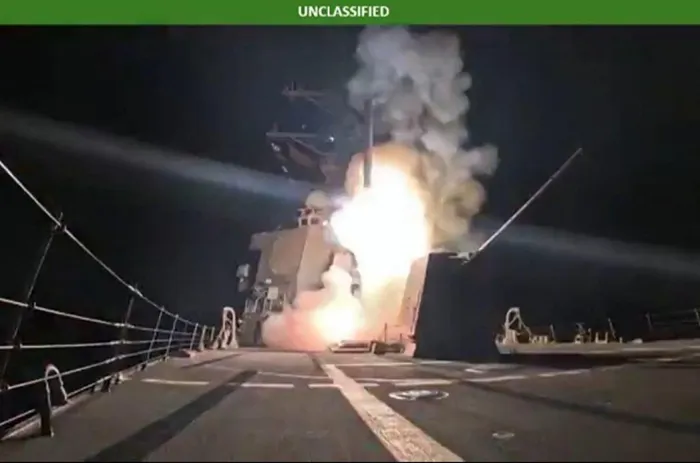
This screen grab from a video posted by the US Department of Defense on their X account on December 25, 2025, shows a missile launch from a naval vessel as President Donald Trump says US forces conducted "powerful and deadly" strikes against Islamic State militants in northwestern Nigeria on December 25, 2025, weeks after he warned against any systemic assault on Christians in the country.
Image: AFP
Nigeria: Intervention Behind the Veil of Stability
The recent U.S. strikes in Nigeria, justified publicly as measures to protect Christian communities from Islamist violence, illustrate how humanitarian rhetoric can be repurposed to legitimate force.
There is no doubt that communities in Nigeria face real and grievous threats; the question is whether external military action, conducted without clear multilateral mandate or transparent legal basis, is the appropriate response. Too often, such interventions produce short‑term tactical gains while exacerbating long‑term instability.
When protection is offered selectively, or when it coincides with strategic interests in resource security, the humanitarian rationale becomes suspect. The optics of “protecting Christians” can be mobilised to secure domestic political support in the intervening country while obscuring the broader geopolitical calculus. In Nigeria’s case, the presence of oil and the fragility of export infrastructure make the country a strategic concern for external powers. The risk is that protection becomes a pretext for securing access and influence, rather than a genuine effort to address root causes.
The parallel with Venezuela is striking. In both cases, the U.S. intervenes when resource nationalism threatens its interests. In Nigeria, the threat was internal instability that could disrupt oil exports. In Venezuela, the threat was external alignment with China’s petroyuan. The methods differ slightly but the underlying logic is identical: oil sovereignty is unacceptable when it conflicts with U.S. hegemony.
DRC/Rwanda: Minerals, Peace Deals, and Manufactured Stability
The Democratic Republic of Congo (DRC) and Rwanda present another case study in resource imperialism. The DRC is home to vast reserves of cobalt, coltan, and other minerals essential for modern technology, particularly batteries and electronics.
Rwanda, though resource-poor itself, has played a pivotal role in the extraction and export of Congolese minerals, often through illicit channels. The U.S. has positioned itself as a mediator in the DRC/Rwanda peace process, presenting itself as a guarantor of stability in the Great Lakes region.
Yet the recent peace deal brokered under U.S. influence was less about genuine reconciliation than about securing access to mineral flows. By stabilising Rwanda’s role as a conduit for Congolese minerals, Washington ensured that global supply chains dominated by Western corporations, remained intact.
The rhetoric of peace masked the reality of resource control. Congolese sovereignty was subordinated to the demands of multinational corporations, with U.S. diplomacy serving as the lubricant for exploitation.
The Venezuelan annexation must be read against this backdrop. Just as the DRC/Rwanda peace process was manipulated to secure mineral flows, Venezuela’s annexation is designed to secure oil flows. In both cases, the U.S. presents itself as a stabiliser while in reality destabilising sovereignty and subordinating local populations to resource extraction.
The Naked Politics of Power
What makes the Venezuelan episode distinct is its visibility. In Nigeria and the DRC, U.S. interventions were cloaked in the language of democracy, counterterrorism, or peace. In Venezuela, Trump dispensed with the pretense. His press conference was a declaration of imperial power: the U.S. is militarily strong enough to do what it wants, and anyone who objects is free to challenge it. This is not diplomacy; it is intimidation. It is the politics of the mafia, scaled up to the level of international relations.
The implications are profound. By annexing Venezuela without multilateral authorisation, the U.S. undermines the very system it claims to uphold. The “rules-based international order” becomes a hollow phrase when the most powerful state openly disregards it. This accelerates global skepticism toward American leadership and deepens regional distrust, particularly in Latin America, where memories of U.S. interventions are long and bitter.
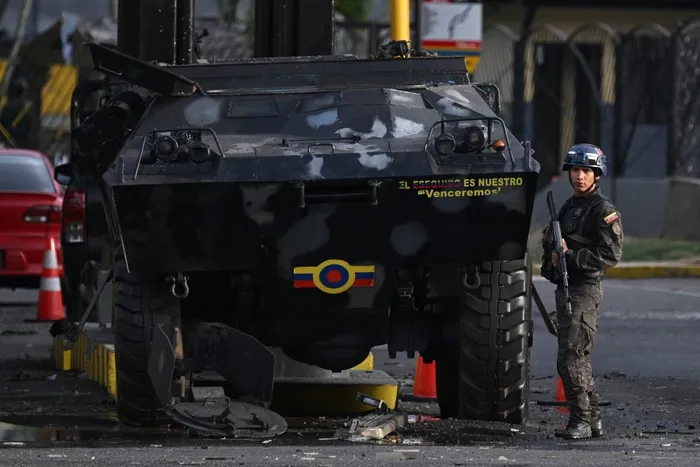
A member of the National Guard stands guard at Fuerte Tiuna, Venezuela's largest military complex, in Caracas on January 3, 2026, after US forces captured Venezuelan leader Nicolas Maduro after launching a "large scale strike" on the South American country.
Image: Federico Parra / AFP
Global Opposition: A Fracturing World
The opposition to the U.S. attack on Venezuela is broad and significant. From South Africa in Africa to Brazil, Mexico, and Colombia in Latin America, to France in Europe, to China and Russia in Eurasia, the dissent spans continents and political systems.
This is not a fringe coalition but a substantial bloc of states representing diverse interests. Their opposition signals a growing consensus: U.S. unilateralism is a threat to global stability.
China and Russia, in particular, will interpret the annexation as a direct assault on their strategic interests. China’s petroyuan experiment is undermined, and Russia’s investments in Venezuelan oil are jeopardised. Both states are likely to respond with countermeasures, whether economic, diplomatic, or strategic. The annexation thus risks escalating into a broader geopolitical confrontation, with Venezuela as the flashpoint.
The Colonial Continuum
The annexation of Venezuela is not an isolated event but part of a colonial continuum. From Nigeria’s oil to Congo’s minerals to Venezuela’s reserves, the pattern is consistent: resource-rich states are denied sovereignty when their policies conflict with U.S. interests.
The methods vary: covert manipulation, economic pressure, peace deals, military annexation. But the outcome is the same: resources flow to the U.S. and its corporations, while local populations bear the costs of instability, exploitation, and subjugation.
This continuum exposes the hollowness of U.S. rhetoric about democracy and human rights. When sovereignty aligns with U.S. interests, it is respected. When it does not, it is discarded. The principle is not law but power, not justice but extraction.
What this means for the international order
The cumulative effect of these episodes is to accelerate a shift away from a rules‑based order toward a balance‑of‑power world in which coercion is normalised. That shift is not inevitable, but it is now more likely.
The erosion of norms invites counter‑measures: economic blocs, alternative financial architectures, and military alignments that mirror the logic of the intervening power. The result is a more fragmented, more volatile international system, precisely the opposite of the stability that proponents of unilateral action claim to seek.
For South Africa and other middle powers, the strategic imperative is clear. We must defend the institutions and norms that protect sovereign equality and multilateral dispute resolution. We must also be realistic about the limits of moral suasion. Defence of principle must be paired with diplomatic coalition‑building, legal preparedness, and economic hedging.
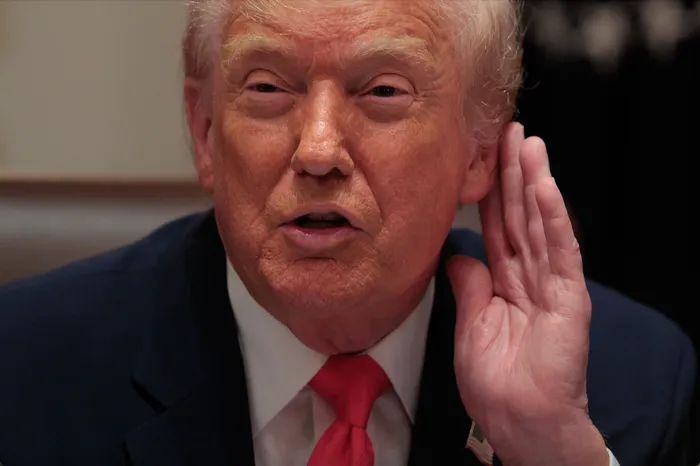
Political economist and social commentator Nco Dube argues that US President Donald Trump's unprecedented annexation of Venezuela represents a watershed moment in U.S. foreign policy, stripping away diplomatic pretense to reveal raw resource imperialism
Image: CHIP SOMODEVILLA / GETTY IMAGES
The End of Pretenses
The capture of Maduro and the annexation of Venezuela mark the end of pretenses. The U.S. no longer bothers to cloak its imperial ambitions in the language of law or multilateralism.
Trump’s declaration was clear: the world is ruled by power, and the U.S. has the power to do what it wants. This is a dangerous moment, not only for Venezuela but for the global order. It signals the erosion of whatever was left of international law, the collapse of multilateralism, and the rise of naked imperialism.
Against this backdrop, the parallels with Nigeria and the DRC/Rwanda peace process are instructive. In all cases, resources dictated policy, sovereignty was subordinated, and populations were sacrificed. The difference is that in Venezuela, the mask has been removed. The world now sees imperialism in its raw form, unmediated by diplomacy or legality.
The question is whether the global opposition of South Africa, Brazil, Mexico, France, China, Russia, and others; will translate dissent into action. If they do not, the annexation of Venezuela will set a precedent for future interventions. If they do, the world may yet see the emergence of a counter-hegemonic order.
Either way, the Venezuelan episode is a turning point. It is the moment when the U.S. reminded the world, in no uncertain terms, that the world is ruled by might, not diplomacy. And that shall remain, as long as we have a madman in the White House.
(Dube is a noted Political Economist, Businessperson, and Social Commentator on Ukhozi FM. His views don't necessarily reflect those of the Sunday Tribune or IOL. For further reading and perspectives, visit: http://www.ncodube.blog)

Nco Dube, a political economist, businessman and social commentator
Image: Supplied