

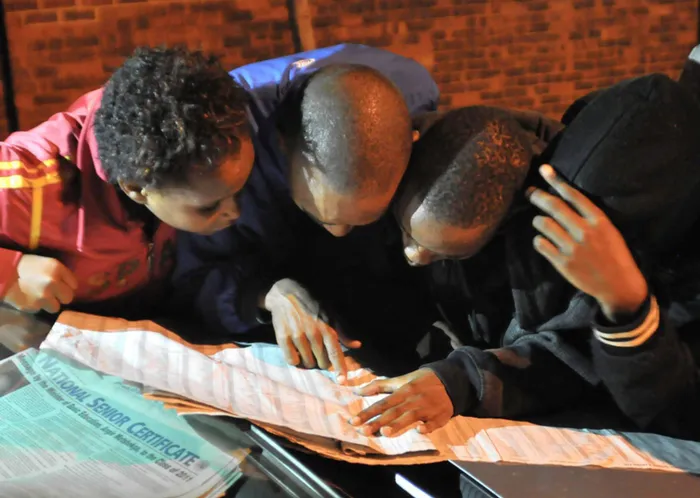
The Information Regulator of South Africa has filed an application to appeal a Pretoria High Court’s ruling that favoured the Department of Basic Education on December 12. The appeal opposes the publishing of matriculants' examination numbers in newspapers.
Image: File
As close to a million learners who sat for the 2025 Grade 12 final examinations await their results, a legal battle over the publication of matric results in newspapers is far from settled.
Basic Education Minister Siviwe Gwarube is expected to announce the national results on January 12, including the overall pass rate, top achievers and provincial performance. Traditionally, newspapers publish the exam numbers of successful candidates the following day.
However, the Information Regulator (IR) has moved to challenge a December 2025 Pretoria High Court ruling that favoured the Department of Basic Education (DBE), allowing the continued publication of matric results. The Regulator argues that publishing exam numbers violates learners’ right to privacy and contravenes the Protection of Personal Information Act (POPIA).
IR spokesperson Nomzamo Zondi confirmed that the Regulator has filed an application with the Supreme Court of Appeal to overturn the High Court decision.
“The Regulator has lodged an application for leave to appeal against the judgment, as we believe the ruling failed to adequately address the privacy risks involved,” Zondi said.
The dispute stems from an investigation launched by the IR into how the DBE handles learners’ personal information during the matric examination process. The Regulator maintains that learners should access their results at schools, as is the case with other grades, rather than through public platforms such as newspapers.
POPIA, which came fully into effect in 2021, seeks to protect personal information, including names, identity numbers and other identifying data, from being disclosed without consent or lawful justification.
The DBE, however, has argued that examination numbers on their own do not constitute personal information under POPIA, as they cannot identify an individual without additional details. The department has also maintained that newspaper publication is necessary because many learners are not in their home provinces when results are released, and newspapers provide same-day, wide access.
Following the High Court ruling, the department believed it could continue with the long-standing practice. But Zondi said the Regulator’s appeal has the effect of making its Enforcement and Infringement Notices operative once again, which would prohibit the publication of matric results in newspapers unless the DBE obtains a court order allowing it to proceed pending the outcome of the appeal.
“The Regulator has sent correspondence to the DBE outlining the impact of the application for leave to appeal,” Zondi said.
DBE spokesperson Lukhanyo Vangqa confirmed the department is aware of the appeal. “We are studying the papers and consulting with legal counsel,” he said.
In its court papers, the Regulator argues that the High Court introduced a concept of “personally identifiable information” not explicitly provided for in POPIA and failed to properly consider the potential risks to learners’ privacy.
There were 766 543 full-time learners and 137 018 part-time candidates who sat for the 2025 final exams, bringing the total number to 903 561.
Should the appeal succeed, it could reinstate the ban on publishing matric results in newspapers, disrupting a practice that has been in place for decades. Civil society groups such as AfriForum have backed the public release of results via newspapers, arguing that it serves learners, families and communities, and strikes a reasonable balance between access to information and privacy rights.-Additional reporting by Manyane Manyane
SUNDAY TRIBUNE