
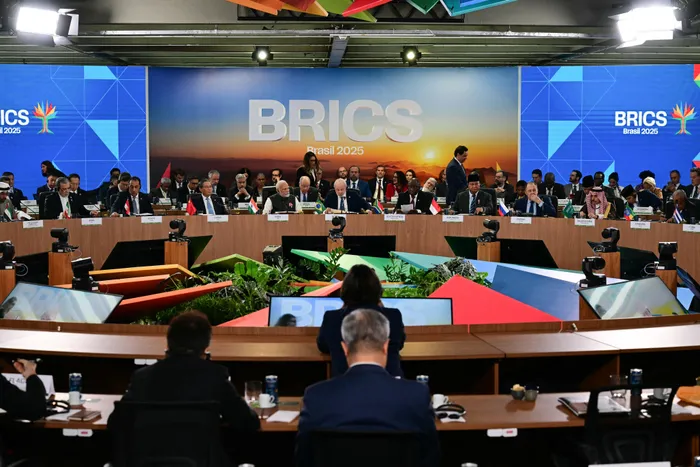
In today's complex global landscape, major powers like the US, China, and Russia aren't fighting ideological battles but striking pragmatic deals. Using Venezuela's political crisis as a case study, the writer reveals how 'transactional realism' is replacing traditional bloc politics with price-based exchanges and conditional commitments despite the establishment of bloc organisations like BRICS.
Image: Pablo Porciuncula / AFP
In their analysis of geopolitical developments, International Relations scholars perpetuate a binary fallacy that portrays the world as swiftly transforming into a battleground between opposing poles. The binary mode of thinking originates in ‘the blob’ (the North Atlantic foreign policy establishment), which continues to grapple with a Manichean psychology shaped during the long US-Soviet rivalry. Generally, that mindset assumes a world divided clearly into friends and enemies, virtue and vice, order and chaos. However, contemporary geopolitics no longer fits such moral simplicity. Today’s power dynamics are much more complex, with transactional realism increasingly the focus for the three leading powers: China, Russia and the United States.
The issue with binary thinking isn’t that it’s entirely incorrect, but that it has become overly simplistic. It views international politics as a moral theatre rather than a forum for negotiation. It also fails to account for instances of high-stakes coordination between ‘enemies,’ such as the 3 January 2026 events in Venezuela, where adversarial powers executed regime change with remarkable efficiency and minimal escalation. Binary logic presumes ideological cohesion where fragmentation exists, loyalty where hedging prevails and confrontation where quiet coordination is common. Above all, it assumes rivalry rules out deal-making. Modern statecraft shows the opposite.
From Binary Blocs to Priced Commitments
Transactional realism redefines power as bargaining rather than bloc loyalty. It views foreign policy as a series of price-based exchanges in which commitments are conditional, reciprocity is carefully balanced, and informal arrangements often override institutional rules. It conceptualises foreign policy as a sequence of explicit bargains in which commitments are valued, reciprocity is conditional and institutional rules give way to performative deal-making. This is an interpretive lens and an observable governing practice, where credibility is supplanted by leverage and alliances resemble contracts. According to Lucian Bălănuță, three mechanisms anchor this shift: the pricing of commitments, conditional reciprocity enforced by revocability and performative sequencing, in which timing, spectacle and staged diplomacy become instruments of power.
This approach clarifies the Syrian ‘soft coup’ of 2024, when Russia allowed its longstanding client to fail in defending its Mediterranean military presence. It also highlights the nearly identical strategy currently unfolding in Caracas. Norms do not disappear under transactional realism; they are manipulated, exploited when advantageous, diluted when burdensome and traded when beneficial. In this context, even strategic rivals might collaborate on outcomes, not out of trust, but because interests can temporarily align.
This helps explain why today’s geopolitical power dynamics are more sophisticated than the Manichean narratives inherited from the Cold War. When control over escalation, access to resources and systemic stability become the main currencies of power, the incentive shifts from seeking permanent alignment to engaging in compartmentalised bargaining. Crises serve as leverage, where public displays of rigidity mask private flexibility. Moral language offers cover for outcomes driven by material interests. The ultimate aim is not ideological victory but extracting value and consolidating strategic positions: oil, buffer zones, debt recovery and security control.
It is within this framework that Venezuela must be understood. The claim that a Chinese envoy Qiu Xiaoqi went to “negotiate sense” into Nicolás Maduro’s head to avert a US attack captures the essence of transactional diplomacy. This was not a rescue mission for an ideological ally, but a final audit of exposure. Maduro’s cooperation under duress reflected the collapse of credible external protection and the certainty of overwhelming US force. Beijing’s intervention was not designed to block action but to manage its consequences, ensuring that China’s debts, oil contracts and commercial stakes survived the transition.
At the heart of this management lies an emerging “oil-for-neutrality” framework connecting Washington and Beijing. Under this arrangement, US authorities guarantee that China’s outstanding oil-backed debt will be honoured by the upcoming Venezuelan transitional authority. At the same time, Beijing accepts the new order passively and avoids challenging US maritime dominance. By publicly affirming that “China will get the oil,” the US also supports its companies in rebuilding Venezuela’s energy infrastructure, transforming a potential flashpoint into a shared effort to stabilise a supposedly failing asset. This is the pricing of commitment translated into energy governance: de-escalation is bought through the continuity of flows.
Viewed through this perspective, the US intervention seems less like ideological regime change and more like calculated enforcement. It was the decisive action of a regional enforcer reaffirming hemispheric dominance under the logic of a “transactional Yalta.” Force was combined with swift signalling, escalation management and a strong focus on stability. In this context, Washington does not need universal legitimacy; it needs controllable repercussions. Venezuela becomes less of a moral battleground and more of a carefully managed asset transfer within the US sphere of influence.
Russia’s stance follows a similar thinking. Moscow’s strategic centre of gravity is not in the Caribbean but in neighbouring states and the European security framework. Its silence during the Caracas operation served as a quid pro quo for US tolerance of Russia’s territorial gains in Eastern Ukraine. Transactional realism makes distant footholds negotiable when core interests are protected elsewhere. “Russia keeping Ukraine” is a shorthand for a hierarchy of priorities that allows other commitments to be flexible.
The pattern becomes clearer when Venezuela is compared with Syria’s ‘soft coup.’ Turkey’s role in Syria illustrates how transactional realism operates through intermediaries. Acting as a middleman, Ankara legitimised a rebel coalition for Western approval while protecting Russian strategic interests. China now assumes a similar role in Venezuela, not as a security broker, but as a commercial guarantor. Regional or functional intermediaries allow major powers to reposition themselves without assuming complete control of transitions.
The emerging ‘Group’ in Caracas is said to be already adopting the Syrian model of selective amnesty through service-continuity arrangements for PDVSA’s technical core. Mid-level engineers and refinery managers, many connected to the previous regime, are protected from prosecution in exchange for maintaining production and servicing CNPC-linked joint ventures. Selective amnesty and technocratic retention prevent fragmentation, preserve operational capacity and keep the system functioning. In transactional realism, amnesty is not forgiveness but insurance.
This is where the binary fallacy causes the most significant analytical harm. It presents selective continuity as hypocrisy rather than stabilisation logic. It confuses a negotiated end to a failing regime with a moral victory of one side over the other. It forces the public to choose between heroic liberation and imperial crime, when many transitions are neither. They are reallocations of control over oil, borders, security services and revenue streams, over the infrastructure of power rather than the symbolism of leadership.
Managed Transitions and the Return of Spheres of Influence
There now appears to be more than a faint indication of a broader deal developing, one in which the US quietly reconsiders its traditional rejection of spheres of influence. The underlying logic is straightforward: Ukraine is seen as negotiable territory within Europe’s security framework; East Asian deterrence is considered conditional rather than absolute; and removing an external sponsor’s client regime in Venezuela is regarded as a price worth paying for non-interference in other areas. Under such an arrangement, the US seeks uncontested dominance in the Western Hemisphere, while Russia and China bolster their respective spheres, mostly unrestrained by norms of democracy, self-determination, genuine alliances or sovereign equality.
The idea that the world could be divided into three spheres of influence has persisted for years. What has shifted is its growing plausibility as a genuine guiding principle rather than just a theoretical risk. And it is perilous as it poses a threat to the US due to the likely backlash in Latin America, Europe and across the Global South. It is particularly dangerous for Europe, which has been downgraded from a strategic actor to a negotiable object.
It is also critically dangerous for America’s allies in Asia, including Taiwan, Japan and South Korea, who will need to adjust how they secure their survival in a world of conditional guarantees. Most importantly, it risks normalising a global order where violence becomes routine and the use of military force by large states against smaller ones is no longer exceptional. The economic repercussions of such a system would not remain distant; they would eventually affect all Americans.
Today’s geopolitical landscape is no longer organised around blocs, but around deals. The major powers remain rivals, yet they increasingly act like traders balancing a global ledger of assets and liabilities. Transactional realism marks a turning point because it explains how adversaries can publicly condemn each other, coordinate indirectly and accept outcomes that the binary fallacy insists should be impossible.
The new thinking informs calls for a leaner but financially starved UN, and a weakened Security Council replaced by a “Core Five” comprising the US, China, India, Japan and Russia, and a complete exclusion of ‘weak’ Europe.
The era of the bloc is ending, and a new one has already begun: Russia keeps Donbas and gets readmission to international sports, the G8 and the global economy.
(Hadebe is an independent commentator based in Geneva on socio-economic, political and global matters. His views don't necessarily reflect those of the Sunday Tribune, Independent Media or IOL)