

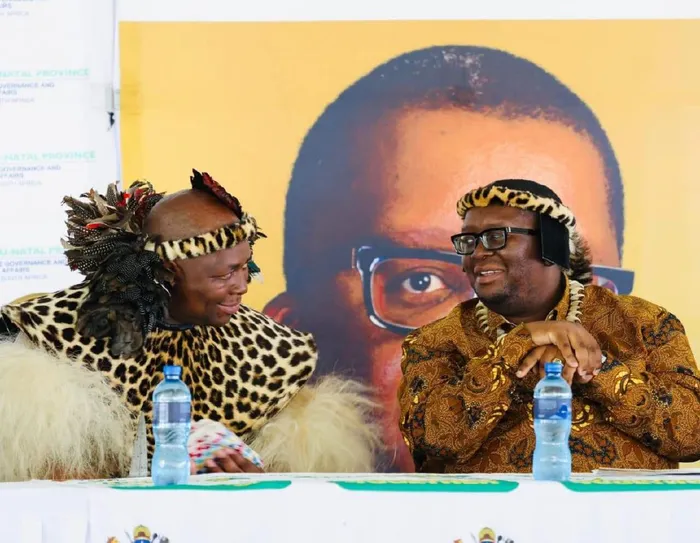
XOLANI Zulu with KwaZulu-Natal MEC of Cooperative Governance and Traditional Affairs Thulasizwe Buthelezi on the day that Zuu was introduced to the people of Mfulamhle in uMzimkhulu, southern KwaZulu-Natal. The MEC is accused of stoking ethnic tensions, political meddling and causing divisions among amaBhaca ethnic group.
Image: Independent Newspapers Archives
THE amaBhaca ethnic group, largely concentrated in the uMzimkhulu area, are on tenterhooks over the looming installation of a new Inkosi, despite the presence of a sitting traditional leader already occupying the throne.
The amaBhaca, who fall under the broader Nguni ethnic group, have accused KwaZulu-Natal MEC for Cooperative Governance and Traditional Affairs (CoGTA), Thulasizwe Buthelezi, of interfering in their internal affairs, a move they say has the potential to plunge the ethnic group into a civil war over a contested traditional leadership succession.
On December 30, a well-attended traditional imbizo was held at which the KwaZulu-Natal CoGTA formally introduced Xolani Zulu as Inkosi of Mfulamhle, an area that falls under uMzimkhulu.
The imbizo went ahead despite repeated and emphatic objections from the amaBhaca community, who have on several occasions stated that they reject Zulu as their Inkosi.
At a media briefing convened by the amaBhaca traditional leader in uMzimkhulu, Inkosi Ntobeko Msingaphantsi expressed deep disappointment and frustration over the impending installation of Zulu as Inkosi of eMfulamhle.
Msingaphantsi placed the blame squarely at MEC Buthelezi’s door, describing Zulu’s impending installation as a fallacy and accusing the MEC of deliberately sowing divisions within the amaBhaca community.
The KwaZulu-Natal CoGTA, through its spokesperson Senzelwe Mzila, rejected the accusations but acknowledged that it was aware of an ongoing traditional leadership dispute in Mfulamhle.
Deliberate sowing of divisions
Despite the rejection of the installation by sections of the community, the department proceeded with formally introducing Zulu to the local community, a move that has fuelled outrage and reinforced accusations that CoGTA is attempting to wrest control of amaBhaca traditional leadership away from the ethnic group.
Speaking to Independent Media this week, Inkosi Msingaphantsi vowed that he would rather pay the ultimate price with his life than allow the Department of CoGTA to divide his people and potentially plunge the amaBhaca into violent conflict.
The traditional leader said that if he allowed the installation to proceed unchallenged, his subjects would one day ask him what he did to defend them against what he described as the deliberate fragmentation of the amaBhaca of uMzimkhulu, allegedly engineered by CoGTA under Buthelezi’s leadership.
“It is painful that the amaBhaca are being pitted against each other by someone in government. The problem is that he (Buthelezi) will incite a war and then walk away, leaving behind bloodshed,” said Inkosi Msingaphantsi.
He said it was perplexing that Zulu would be installed in an area that already has a recognised traditional leader, particularly given that Zulu is not indigenous to the area and hails from KwaNokweja in Xobho.
“I have never seen anything like this. Whenever it is discussed, tempers flare because it is extremely infuriating. What angers me the most is that Buthelezi called us to inform us about Zulu, we rejected him, yet he continues to push forward because he has his own agenda,” Inkosi Msingaphantsi said.
Potential bloodshed averted
He further revealed that on the day Zulu was introduced to the community, it was he who intervened to prevent an escalation of tensions after angry amaBhaca regiments threatened to storm the imbizo.
“I am the one who stopped them and ordered the regiments to stand down. Had I not done so, tell me what would have happened? Would blood not have flowed?” asked Inkosi Msingaphantsi.
Inkosi Msingaphantsi also questioned the reasoning provided by Buthelezi, who reportedly told the community that Zulu had to be installed as a traditional leader because he was a close friend of the late King Goodwill Zwelithini kaBhekuzulu.
“We are hearing for the first time that a person can be installed as a traditional leader simply because their father was a friend of the King. What kind of nonsense is that?” he asked.
The Inkosi further claimed that CoGTA KZN deliberately misled the community by advertising the event at which Zulu was introduced as an elders’ Christmas lunch.
“It is quite clear that Buthelezi knew exactly what he was doing at Mfulamhle,” said Inkosi Msingaphantsi.
Addressing the gathering on the day of the event, MEC Buthelezi said: “Today we are here to observe a tradition as your traditional leader who went to the Zulu royal family for the ukuthela amanzi ritual (a cleansing rite that solemnised a traditional leader’s rule over his subjects, endorsed by the reigning king), on his father’s throne, accompanied by family members.
Zulu royal family endorsement
“The traditional leader was not alone when this ritual took place. There were five traditional leaders present. This ritual is not performed by just anyone; it confirms that the king has accepted the traditional leader, entered the kraal, and had gallbladder bile sprinkled over him. This is the ritual of introducing a person to the ancestors and certifying him for a specific position,” said Buthelezi.
Prince Thulani Zulu, spokesperson for King Misuzulu kaZwelithini, also addressed the gathering and endorsed Zulu’s installation.
Prince Thulani said Inkosi Zulu’s father played a pivotal role in restoring relations between the Zulu royal family and the amaBhaca, even before uMzimkhulu was reincorporated into KwaZulu-Natal.
“The traditional leadership of Mfulamhle is complete. It lacks nothing, as it was able to conduct its own Festival of First Fruits. Since Inkosi Xolani has undergone the ukuthelwa ngamanzi ritual, it means the traditional leadership here is complete,” said Prince Thulani.
Approached for comment, CoGTA spokesperson Mzila reiterated that the department stands by its earlier position that there is nothing improper or irregular about the installation of Zulu.
This is not the first time that MEC Buthelezi has been accused of political interference in traditional leadership as earlier last year, members of the KwaMashabane Tribal Authority, in KwaMhlabuyalingana, questioned CoGTA's reinstatement of a centenarian traditional leader, Inkosi Sizabantu Gumede, 106, who had abdicated his throne in 2015. His son, Inkosi Sipho Gumede (56), then took over the throne, only for Gumede senior to make a u-turn.
Two years ago, there were some Izinduna who accused his department of unfairly targeting them in their investigations of illegal land sale allegations.
KZN Cogta, however, disputed these allegations and said they have an obligation to probe reports of misconduct against those implicated.
Who are the amaBhaca?
The amaBhaca are a distinct South African Nguni ethnic group, originally part of the abaMbo people, known for their unique language, isiBhaca, and rich cultural heritage. They are predominantly found in the Eastern Cape, particularly in KwaBhaca, and in KwaZulu-Natal, especially in the uMzimkhulu area.
The amaBhaca trace their lineage to Inkosi Zelemu and were later led by prominent historical figures such as Madzikane kaKhalimeshe. Their culture was shaped by migration and historical interactions with both Xhosa and Zulu communities.
Despite sharing linguistic and cultural similarities with other Nguni groups, the amaBhaca strongly assert their distinct identity, rejecting perceptions that they are simply Zulu or Xhosa. IsiBhaca, while mutually intelligible with other Nguni languages, is regarded by its speakers as a key marker of amaBhaca identity.
Historically, the amaBhaca are believed to have migrated southwards from KwaZulu during the Mfecane period. They share ancestral links with the Zulu through Inkosi Zelemu, an ancestor of Zulu kaNtombela, the grandfather of King Shaka Zulu kaSenzangakhona. However, the amaBhaca maintain that they are neither Zulu nor Xhosa, although they share certain cultural practices with the Zulu, including umhlonyane, a traditional rite of passage for girls into womanhood.
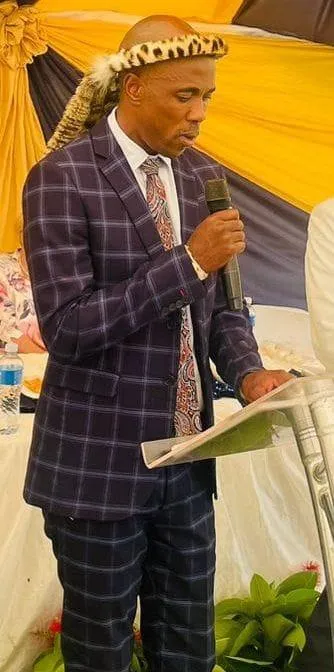
AMABHACA traditional leader Inkosi Ntobeki Msingaphantsi has vowed to 'pay the ultimate price' than allow KwaZulu-Natal Cooperative Governance and Traditional Affairs Department to install a new traditonal leader of amaBhaca of Mfulamhle in uMzimkhulu who is not from the area. Inkosi says the move has the potential to escalated into war and ethnic tensions that will divide amaBhaca.
Image: SUPPLIED