
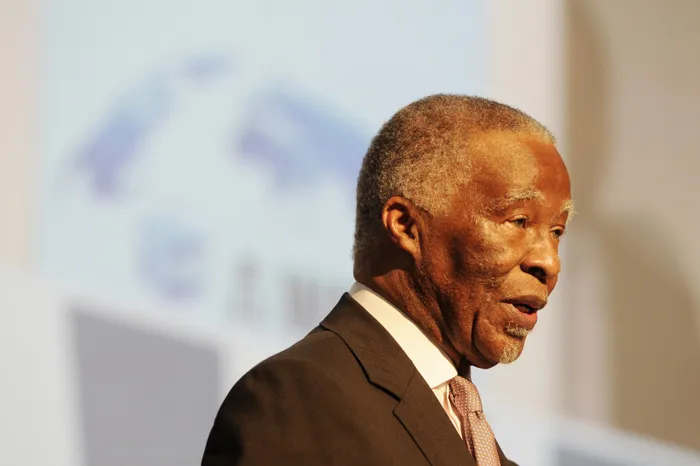
FORMER president Thabo Mbeki who has been instructed by the uMkhonto weSizwe Party (MKP) to withdraw and apologise for his remarks that they deem tribalistic and an incitement of violence towards MKP supporters by linking them to apartheid security agents.
Image: ARMAND HOUGH Independent Newspapers
The uMkhonto weSizwe Party (MK Party) has called on former president Thabo Mbeki to issue an unconditional apology to the people of KwaZulu-Natal, accusing him of making tribalistic statements that delegitimise voters and incite violence.
Mbeki has come under fire following remarks in which he alleged that the MK Party supporters were controlled by former apartheid-era state security structures that infiltrated the liberation movement. He made the comments while addressing a conference of Umkhonto weSizwe Liberation War Veterans, the now-disbanded armed wing of the ANC.
During his address, Mbeki questioned why the MK Party performed strongly in KwaZulu-Natal and in hostel communities in Gauteng.
“The security agent cells have never been disbanded to this day. I have said this many times,” Mbeki said.
He further claimed that hostel residents who previously supported the Inkatha Freedom Party (IFP) during periods of political violence were now voting for the MK Party because they were allegedly being controlled by agents linked to the party.
“The reason why they are voting for the MK Party now is because they are controlled by agents that are controlling the MK Party,” Mbeki said.
Addressing the ANC’s poor performance in the 2024 national and provincial elections, Mbeki argued that the party’s losses were not the result of dissatisfaction with its leadership.
“It was not because people were unhappy with the ANC leadership. It was the activation of that national security management system which produced that result,” he said.
Mbeki also rejected the view that the July 2021 unrest was driven by public anger over the incarceration of former president Jacob Zuma at Estcourt Prison on a contempt of court charge linked to the Zondo Commission. Instead, he described the unrest as a deliberate “counter-revolutionary” intervention aimed at testing whether South Africa could be destabilised and paralysed.
MK Party spokesperson Nhlamulo Ndhlela condemned Mbeki’s comments, describing them as reckless and dangerous.
“The MK Party rejects, as politically reckless, socially dangerous and intellectually dishonest, the narrative advanced by former President Thabo Mbeki,” Ndhlela said.
He accused Mbeki of attempting to delegitimise the democratic choices of millions of voters who had withdrawn their support from the ANC.
“Mbeki is avoiding confronting the political reality that millions of South Africans have consciously withdrawn consent from the ANC and placed it elsewhere,” he said.
Ndhlela said the remarks criminalised and stigmatised entire communities, particularly in KwaZulu-Natal.
“It amounts to an attempt to explain away the democratic will of the people of KwaZulu-Natal by casting suspicion on their identity, culture and political choices,” he said.
He also accused Mbeki of hypocrisy, noting that long-standing electoral victories by the Democratic Alliance in the Western Cape had never been described as counter-revolutionary.
“When communities vote against the ANC, their choices are delegitimised; when others do so, their choices are respected. This is not principle. It is prejudice,” Ndhlela said.
Ndhlela warned that Mbeki’s remarks bordered on incitement by portraying MK Party support as illegitimate and externally orchestrated.
“This reckless language places lives at risk,” he said.
He called on Mbeki to withdraw the statements unconditionally and apologise to the people of KwaZulu-Natal, hostel communities and MK Party supporters.
Ndhlela also questioned Mbeki’s moral authority, citing his handling of HIV and AIDS policy during his presidency, when he kept questioning the link between the virus and the syndrome.
“South Africans have seen before assertion without proof, delivered with moral authority, with catastrophic consequences,” he said, referring to research estimates that more than 330 000 people died prematurely due to delayed access to antiretroviral treatment.