

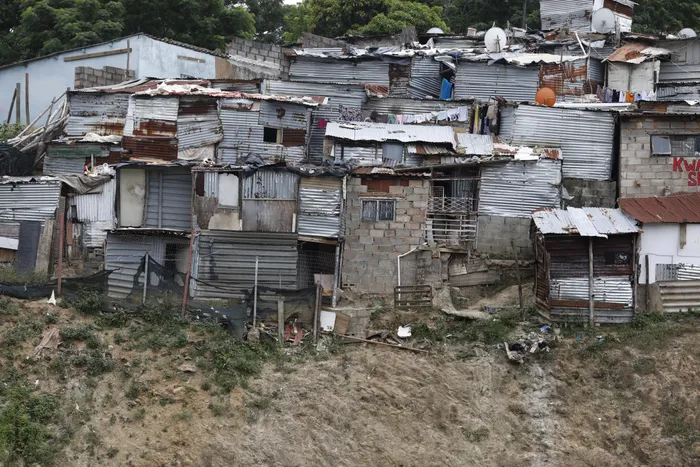
UNEMPLOYMENT and desperation has driven hundreds of South Africans to place themselves in harm's way in a precarious informal settlement on a steep Springfield hillside along Alpine Road, Durban. Residents face daily threats from illegal electricity connections, treacherous terrain, and extreme weather.
Image: DOCTOR NGCOBO Independent Newspapers
IT never rains but pours for residents of an informal settlement perched precariously on a hill along Alpine Road in Springfield, Durban, where poverty and unemployment have pushed families into life-threatening living conditions.
During a visit to the area, Isolezwe, sister publication of the Sunday Tribune, found that many residents knowingly risk their lives by erecting makeshift shacks on the steep terrain, saying they have no alternative as they continue searching for work.
‘We are here because we have nowhere else to go’
Mlungisi Chiliza, originally from Mkhomazi on the South Coast, has lived in the settlement for six years. He describes the area as a poverty-stricken squalor.
“Nothing is going right here. We are only here because we have nowhere else to go. It’s really bad, my brother. We can’t find work so that we can move into better, more habitable rental places,” said Chiliza.
Illegal electricity connections turn deadly
Among the most serious dangers residents face are illegal electricity connections, commonly known as izinyokanyoka. Chiliza said several people have been injured or killed as a result.
“Just last year, a small child was electrocuted by these illegal connections. Another person also died the same way. It’s a very difficult situation,” he said.
Chiliza said he left his hometown in search of a better life in Durban, but instead endures frequent nights without food.
Children live under constant threat
Thobekile Mthembu, who has lived in the settlement for four years with her two children, an infant and a 10-year-old, said daily life is filled with fear.
“I always have to make sure my 10-year-old doesn’t wander too far outside. One wrong step and she could fall down the cliff,” said Mthembu.
Like many others, she is fully aware of the dangers but says unemployment has left her with no alternatives.
Accidents and injuries are common
Senzo Mncwabe, another resident who has lived there for four years, survives on occasional piece jobs. He says accidents are common.
“There was someone who fell off the cliff and broke their leg. We really wish we could get help,” he said.
‘This is not a place for people to live’
Kwanele Nsundwane, from Lusikisiki in the Eastern Cape, has also lived in the settlement for several years. He described the heat inside the shacks as unbearable.
“I have never experienced such heat in my life. This is not a place for human beings to live. We endure these conditions because we don’t have jobs. No one who is employed would choose to live here,” he said, fighting back tears.
Hunger, poor sanitation and no water
Nsundwane also decried the poor state of sanitation and lack of basic services.
“Brother, write and tell people that we are suffering. We go to bed hungry and we have no jobs,” he pleaded.
Residents have no access to running water and must fetch it from a distance, a task made even more difficult by the steep and uneven terrain. Alcohol-fuelled fights are common, and the ageing shacks are highly vulnerable to strong winds and heavy rainfall.
Fires, evictions and sleepless nights
The community estimates it has about 500 residents, with only around 100 with casual jobs. Many rely on begging for food from neighbours, and every afternoon dozens queue nearby for free loaves of bread.
Heavy rains often bring sleepless nights, and in 2021 a fire destroyed several shacks, though residents later rebuilt. They have also faced eviction attempts by an undisclosed landowner but refuse to leave, saying they have nowhere else to go.
A broader crisis of unemployment and informal housing
Most residents are not originally from Durban, having migrated in search of work, a dream that has remained elusive as South Africa’s economy has struggled to grow beyond 2% over the past two decades.
The rapid mushrooming of informal settlements places additional strain on municipalities, which are eventually forced to provide services, perpetuating a cycle that keeps informal housing a persistent reality, despite eThekwini Municipality’s stated goal of eradicating informal settlements by 2030.