

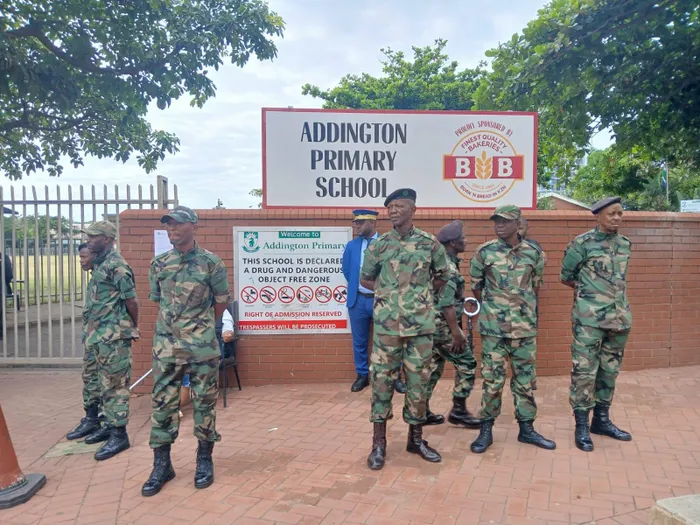
Protests erupt at Addington Primary School over the admission of foreign learners.
Image: Doctor Ngcobo/ Independent Newspapers
CIVIL rights and education experts have warned that South African citizens have no legal right to pressure school principals to deny admission to children of foreign nationals, regardless of their immigration status.
The warning follows two weeks of protests at Addington Primary School in Durban, where organisations including the March and March (MAM) and Operation Dudula joined local residents calling for South African children to be prioritised over foreign learners.
Professor Mary Metcalfe said the Department of Basic Education operates under the 2021 and 2025 school admission regulations, which state that: “The right to education extends to everyone within the boundaries of South Africa, the nationality and immigration status is immaterial”.
“Principals cannot be put under pressure by parents to defy departmental instructions,” said Metcalfe.
She said opposition to the policy should be pursued through lawful channels, warning that schools could not discriminate on the basis of nationality.
“The obligatory legal framework that guides principals and department officials is that all public schools are required to admit all learners and serve their education requirements,” said Metcalfe.
While acknowledging challenges related to school capacity, Metcalfe said education authorities had a duty to manage admissions fairly and prevent social conflict and to ensure that there are sufficient places in all public schools to accommodate all learners of compulsory school age.
“The principle and practice of admission of all learners to public schools regardless of their nationality and immigration status is well established and is a legal requirement of all public schools,” she said.
Tensions escalated into violence this week outside the school, which is located near Durban’s Point area, a neighbourhood largely populated by foreign nationals. Clashes began after local parents, alleging their children were being sidelined, attempted to conduct a headcount of foreign learners.
Officers from the eThekwini Metro Police and the South African Police Service intervened to disperse the crowd.
Systems-oriented social justice activist Tracey Malawana blamed the unrest on the government’s failure to provide sufficient schools and classrooms, saying many parents struggle annually to secure placements for their children.
She cautioned residents that Section 29 of the South African Schools Act guarantees the right to basic education to everyone in the country.
“Children of foreign nationals, whether documented or undocumented, cannot lawfully be excluded from public schools.
“Schools are not immigration enforcement sites, and denying a child access to education because of their nationality or lack of papers would amount to unfair discrimination and a violation of their rights. At the same time, it is important to be equally clear that the law does not permit schools to prioritise foreign learners over South African learners,” said Malawana.
Parents Association of KwaZulu-Natal chairperson Vee Gani criticised the protesters, accusing them of xenophobia.
Gani said there was no evidence that Addington Primary had prioritised foreign learners.
“From the report that I have seen, the department confirms that it is not the case and that there are more South African children in the school,” he said.
He added that some parents had missed last year’s application deadlines.
“If the school already has its number, what is the school going to do?” he said.
MAM leader Jacinta Ngobese-Zuma rejected claims that the protests traumatised children, saying the real harm was experienced by South African learners denied access to schooling.
“If they have not built more schools, they must prioritise South African children first,” she said.