

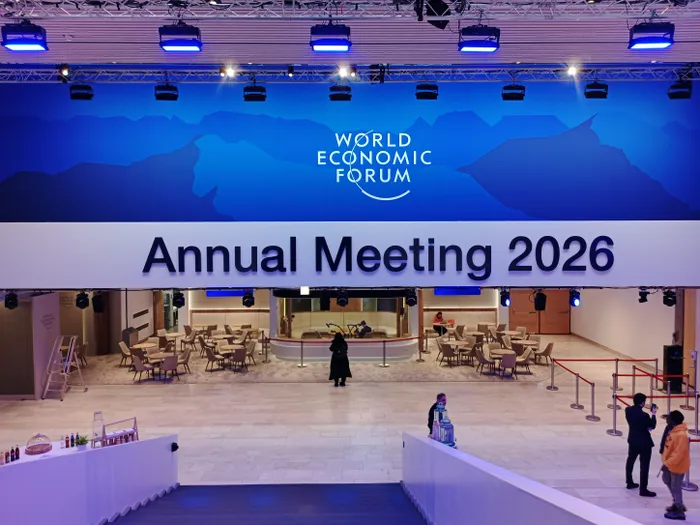
While geopolitical tensions including US posturing over Greenland and the global race for critical minerals dominated debate at the World Economic Forum in Davos, questions persisted about Africa’s readiness to assert itself in this evolving order.
Image: Siphelele Dludla / Independent Newspapers
AS the curtain fell on the World Economic Forum (WEF) Annual Meeting in Davos on Friday, lingering questions remained about the influence of the Global South — and Africa in particular — on the global stage.
With no major African keynote voices featured on the main stage this year, many delegates left private dinners and side events with the impression that discussions were largely driven by American and European priorities.
Canadian Prime Minister Mark Carney, in a forceful address, said his country would not be bullied and would assert itself as an energy superpower with vast critical mineral reserves. He signalled that Canada would engage the world “as it is”, rather than waiting for a more favourable global order.
Against that backdrop, the question arose: is Africa prepared to claim its seat at the table as the global scramble for critical minerals intensifies?
Geopolitical tensions elsewhere also dominated conversation. Greenland unexpectedly became a focal point, as leaders speculated about US President Donald Trump’s next move after threatening tariffs if the United States failed to gain greater control over the Arctic territory from Denmark.
“It was completely dominated by the US and overlooked the crises in the Middle East and issues in South America,” said one Europe-based journalist at the media’s closing dinner. “This was the largest American government delegation abroad in many, many years. Africa did not feature on the main stage.”
Despite perceptions that Africa was still fighting for recognition, the Forum pressed ahead under its theme of the “Spirit of Dialogue” amid one of the most complex geopolitical backdrops in decades. Leaders debated global growth, climate change and artificial intelligence — sectors many believe could drive future job creation.
Larry Fink, interim co-chair of the WEF and CEO of BlackRock, summed up his impression of the global economic order and the Forum's place in shaping this conversation.
“We believe economic progress should be shared. We believe prosperity should reach further than it has, and we believe institutions like the World Economic Forum still matter in making that happen,” Fink said on Friday.

Dr Iqbal Survé, Chairperson of Sekunjalo Group has echoed the importance of Davos.
Image: Supplied
Nearly 3 000 leaders from government, business, civil society and academia attended, seeking common ground on challenges ranging from peace and security to technology, growth, people and the planet. The meeting drew about 400 top political leaders, including nearly 65 heads of state and government, with a strong presence from G7 countries across more than 200 sessions.
Finance Minister Enoch Godongwana maintained that the country made a compelling case for investment and should continue participating in the platform.
“This place has 3 000 leaders of business and governments from various jurisdictions. We would have visited each of those countries one by one and the cost of travelling to them is enormous. You save the costs by meeting all of them in one venue and arranging bilateral meetings,” Godongwana said.
“It would be a mistake for South Africa not to be part of such an important event, where you meet all these leaders, continue to interact and send a positive message about South Africa as a nation.”
South Africa is set to take centre stage when it hosts the WEF Spring Summit next year.
Dr Iqbal Survé, chairperson of Sekunjalo Group, echoed the importance of Davos, while acknowledging frustration among African countries that have struggled to translate attendance into investment.
“Not everything happens all at once. I do hope sometimes that things can go a little bit faster,” Survé said. “I'd like to see a much broader representation of Africa at Davos. It would have been nice to have our president here as well. But Minister Godongwana has led the delegation well, and our Reserve Bank governor has carried South Africa forward on the stage in quite a big way.”
On whether Africa was finally being heard, Survé offered a pragmatic view.
“Davos is not the place where you get the investment. Davos is where you build the network and the relationship. It's like speed dating. Then you do the hard work afterwards, and you send your teams in to actually do the hard work.”