

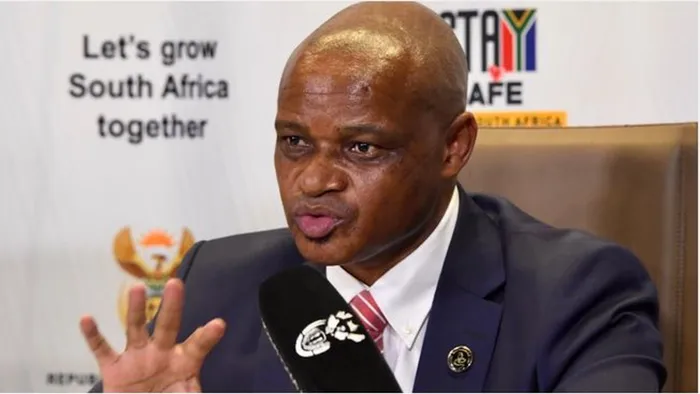
Advocate Barnabas Xulu and his law firm, B Xulu and Partners Incorporated, are set to challenge the appointment of Andy Mothibi (pictured) as the National Director of Public Prosecutions (NDPP).
Image: Supplied
ADVOCATE Barnabas Xulu has filed an application to challenge the appointment of Andy Mothibi as the National Director of Public Prosecutions (NDPP).
He asserts that the appointment is unlawful, as Mothibi did not participate in a formal interview process. Xulu has accused President Cyril Ramaphosa of lacking transparency in the appointment.
Mothibi, who is set to take over from Advocate Shamila Batohi on February 1, was the subject of an urgent court application filed by Xulu and his law firm, B Xulu and Partners Incorporated, in December 2025. They sought to prevent Ramaphosa from appointing Mothibi as the new NDPP.
In his application, Xulu argued that the interview process was flawed, biased, and unlawful. His objections targeted candidate Advocate Hermione Cronje, whom he accused of “unlawful information peddling.”
He claimed that the advisory panel failed to adequately address his objections during her interview, while other candidates faced scrutiny for similar objections. Moreover, Xulu alleged that Cronje received preferential treatment.
Although he later withdrew the urgent interdict, Xulu continued to pursue a review of the advisory panel’s report. Following Ramaphosa’s appointment of Mothibi, Xulu filed a second urgent application to block the appointment, labelling the process as “politically deliberate.”
“I will amend the court papers to challenge the appointment of Mothibi. The appointment is unlawful and should be set aside,” says Xulu
He emphasised that Ramaphosa continues to refer to the interview process, despite Mothibi's absence from it.
“He (Ramaphosa) kept referring to that tainted process as if it was lawful. Why is he referring to that thing when Mothibi was not part of the process?” Xulu added.
In response, Ramaphosa’s spokesperson, Vincent Magwenya, indicated that the Presidency would respond to the court papers once Xulu decides to proceed with the action he is considering. Justice Department Minister Mmamoloko Kubayi, through her spokesperson, Terrence Manase, stated that any court application would be rigorously opposed, as it would lack substance, rationale, and legal basis.
“The Minister views the continuous litigation by Advocate Xulu to be malicious and not in the interest of this country and fighting crime and corruption in this country,” says Kubayi
She added that the appointment of the NDPP is a constitutional prerogative of the President, exercised in accordance with Section 179 of the Constitution and the applicable provisions of the National Prosecuting Authority Act.
Concerns have also been raised that Mothibi's appointment could be a strategic move to shield Ramaphosa’s associate and alleged relative, Hangwani Maumela, from prosecution in the R2 billion Tembisa Hospital tender scandal.
This prompted the Democratic Alliance (DA) to apply for the Promotion of Access to Information Act (PAIA) to compel the Presidency to release the advisory panel's report.
Kaizer Kganyago, spokesperson for the Special Investigating Unit (SIU), stated that Mothibi would not comment on his appointment but assured that the work under Leonard Lekgetho, the acting head of the SIU, would remain unaffected.
Kganyago noted that Mothibi instructed the team investigating the Tembisa Hospital to conclude their investigation in 2026, and this would continue as planned.
“It is worth highlighting that the SIU made the decision to share the interim report with the public and has already acted on some of the outcomes that have been determined,” he said.
Political analyst Zakhele Ndlovu supported Xulu’s actions, asserting that Mothibi’s lack of participation in the interview process renders his appointment unlawful. Politician and lawyer Zwelethu “Mighty” Madasa echoed this sentiment, stating that Mothibi’s appointment was not “objective and fair.”
Madasa pointed out that other shortlisted candidates were ignored without explanation, while Mothibi was not subjected to the same process as others.
“Lastly, the resources expended in the recruitment process were not effectively and economically used as stipulated in Section 195 (b) of the Constitution,” he added.