

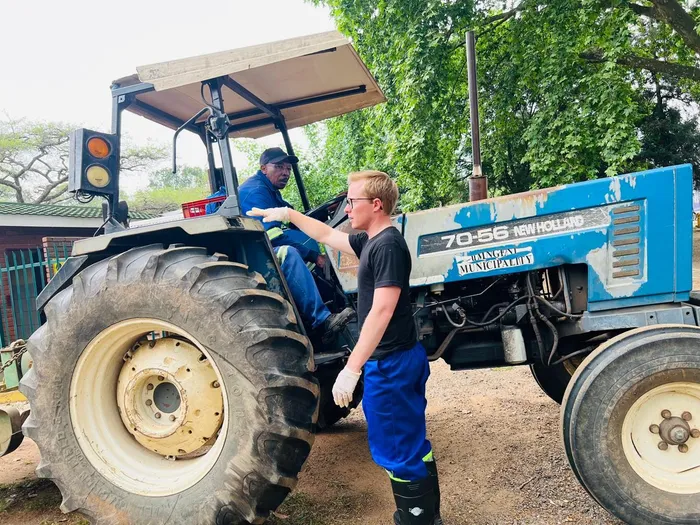
Mayor Chris Pappas says the Umngeni Municipality has provided tractors to fight poverty by supporting small-scale farmers.
Image: Supplied Umngeni Municipality
In a significant move to combat poverty, the Democratic Alliance (DA)-run Umngeni Municipality, outside Pietermaritzburg, has announced the write-off of R10 million in debt owed by impoverished households.
Mayor Chris Pappas shared that this initiative is set to benefit approximately 3,190 families.
As part of this initiative, these households will receive free electricity, and their children will be offered assistance with short-term employment opportunities.
Pappas explained that the debts owed by families vary widely; some owe as little as R61, while others face overwhelming debts of up to R90,000, which they struggle to settle.
According to the municipality's 2025-2026 Integrated Development Plan, youth unemployment among individuals aged 25 to 34 stands at a staggering 36.2%.
“It depends on what people have not been paying, but that has now been written off,” Pappas said.
He added that families classified as indigents carry the largest debts.
To ensure that the right families receive assistance, the municipality encourages those in adverse situations to verify their status.
“We then ask them to go (to the municipality) to verify if they are, in fact, in an adverse situation; we curate their details, and we give them free basic electricity. We give people 200 kilowatt-hours,” he said.
Pappas emphasised that providing free basic services has proven effective in helping deserving families escape the cycle of poverty. The municipality has been actively monitoring poverty levels and identifying those in genuine need of support.
He highlighted the plight of elderly men who often find themselves without family support. “One of the common things that we see is elderly gentlemen who have no one to look after them as they have no grandchildren, no wives, or anyone,” said Pappas.
The areas benefiting from the debt write-offs include Mpophomeni Township.
Pappas said elderly men represent a particularly vulnerable group, often overlooked in terms of assistance.
“They are sort of repeating on our system, and when we identify those people, we make sure to assist them by ensuring that they are not accumulating debts, not getting blacklisted, and that they are not followed by debt collectors or having their electricity cut off,” he said.
The municipality is also working to identify the underlying causes of poverty.
“We don’t want people to get free basic services forever, but we want people to get to a situation where they are no longer poor,” Pappas said.
Families who have relied on free basic services for an extended period are being prioritised for short-term assistance through the Expanded Public Works Programme (EPWP). This includes projects focused on road repairs, electricity maintenance, community security programmes, and the upkeep of tourism sites.
“We are excited that over the last three years, youth unemployment has decreased by seven percent, meaning that there is something we are doing right,” he added.
“Those young people who are being employed support their households. It is not necessarily a good thing that people have free basic services, but it just means that we have a high level of poverty. So we want to have a low level of poverty.”
Another strategy in the fight against poverty involves promoting agriculture and fostering a mindset among small-scale farmers that they are, in fact, businesspeople.
“We partner with them to make sure that their businesses are successful as opposed to just dependent on government,” Pappas noted.
In addition to making tractors available to small-scale farmers, recently purchased at a cost of R1.2 million, the municipality is also educating farmers on managing foot and mouth disease, which has affected many regions of the country.
“A lot of it is about education, and making sure that people understand animal health and the legislation. Local people don’t brand their cattle anymore, and there is no animal identification, which makes it hard to sell them at market. Those are basic things to show that small-scale farmers are actually business people, and they can be treated like that in a formal economy,” he said.
Pappas clarified that tractors are stored at the municipality's facility and are provided to farmers upon request. When questioned about whether these programmes are part of the DA’s campaign for the upcoming local government elections, he insisted that the debt write-offs have been occurring for the past three years.
“It is just that the biggest write-off was this year because we managed to improve the system of identifying poor households. The closer we get to the local government elections, the more people will say we are only doing things for elections. We are not going to stop working because the elections are coming, and there will be more programmes that we will roll out because the elections will come and go,” Pappas said.
The ANC in the Moses Mabhida Region, which includes the Umngeni Municipality, expressed surprise at the DA's positive initiative to assist the poor. ANC regional coordinator Zet Luzipho acknowledged the move.
“Let us give credit where it is due because, whether it is for electioneering or not, they are allowed to do so.”
However, he also noted that the debt write-off is atypical for the DA, which traditionally has not prioritised policies that support indigents.
“Everyone in South Africa knows that the indigent policy is an ANC policy. The DA has a principle of user pays, and they don't have a principle that says you can get free services, as they are a liberal party, of which liberalism does not allow people to get something for free. They are doing this for elections, although I know that they will deny it,” he said.
Luzipho further argued that if the municipality is serious about supporting small-scale farmers, it must first address property ownership issues.
“How do you give tractors to small-scale farmers without defining who they are? Have they allowed farm tenants, dwellers, and workers to become permanent residents on those farms?” he said