

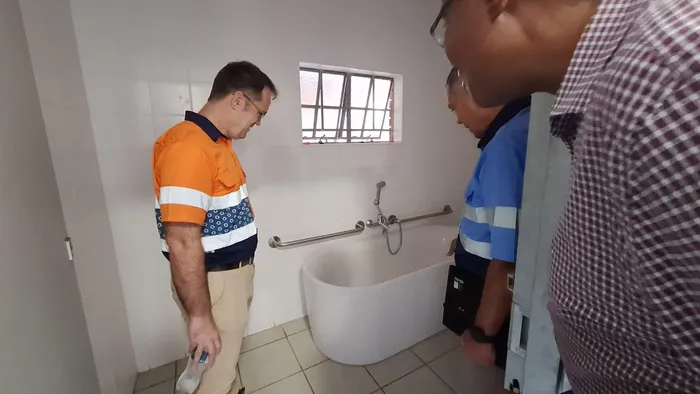
Leaks and moisture are some of the infrastructure issues identified at YWCA Special School.
Image: Facebook / KwaZulu-Natal Department of Public Works
THE KwaZulu-Natal Department of Public Works and Infrastructure has raised serious concerns regarding substandard infrastructure at special schools across the province.
MEC Martin Meyer has attributed these quality issues directly to the involvement of implementing agents other than the Department of Public Works and Infrastructure, following recent oversight visits.
The department's assessment focused on infrastructure readiness for the 2026 academic year. During visits in the Amajuba District, Meyer highlighted several concerning issues.
“Infrastructure not being done properly. And I’m very concerned that other implementing agents are being used instead of Public Works and Infrastructure, and we see the work is not being done properly,” Meyer stated.
“I’ll engage with my colleagues in the executive and make sure that what we’ve given to our kids is right. We give our educators the right support, and we build special schools for our special children because they are all our children in this province,” he added.
KZN Public Works and Infrastructure spokesperson Steve Bhengu noted that the oversight spanned two days, January 29 and 30, and focused on schools catering to children with special needs.
Meyer was fulfilling his role as a member of the provincial legislature, district champion, and custodian of KZN Public Works and Infrastructure.
“During the visit, the MEC observed a number of existing challenges. These include roof leakages, excessive mould, infrastructure built out of spec for persons living with disabilities, poor demarcation, and a high number of classroom shortages,” Bhengu said.
Bhengu expressed serious concerns about the build quality, materials, and workmanship evident in one of the schools, despite the building being only three years old. A high level of moisture was clearly visible on the exterior walls, indicating significant underlying issues that should not be present in such a new building.
He reiterated that some schools had utilised implementing agents other than KZN Public Works and Infrastructure for their projects.
“Client departments are permitted to decide on the implementing agent of their choice. However, the problem that tends to emerge is that at times, these agents deliver substandard workmanship. This then creates problems in the long run, as issues later emerge that have to be addressed.”
“There is no policy that prevents the client department, for example, the Education Department in this context, from going with another implementing agent. It is the full prerogative of the department who they wish to appoint. It is a standard practice,” Bhengu added.
The department remains concerned about the substandard work delivered by some private implementing agents, with some not being from KZN.
“In this regard, the department is considering what regulatory steps could be taken to ensure that KZN Public Works and Infrastructure is best positioned to be the implementing agent of choice. Doing this would prevent these ongoing issues that we continue to see.”
At YWCA Special School, the department identified serious structural issues, including leaks and moisture, resulting from poor delivery by an outside implementing agent. Meanwhile, at Bumbisizwe Special School, critical infrastructure gaps were discovered, including an inconsistent water supply and unsafe power connections.
The department is stepping in to rectify these issues to ensure that learners with special needs have the safe, dignified environment they deserve.