

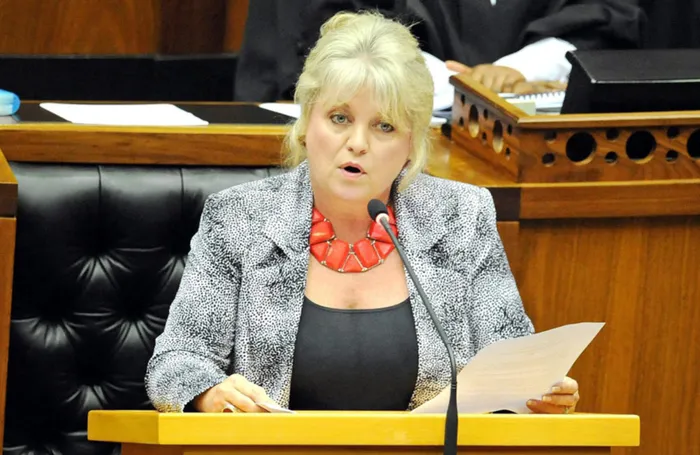
DA MP Dianne Kohler-Barnard testifies before the Ad Hoc Committee, refuting allegations made by KZN Police Commissioner Nhlanhla Mkhwanazi regarding classified information leaks, asserting that her communications were based on publicly available information prior to her JSCI membership.
Image: David Ritchie / Independent Newspapers
DA MP Dianne Kohler-Barnard addressed allegations made against her by KwaZulu-Natal Police Commissioner Nhlanhla Mkhwanazi, asserting that they stem from a misunderstanding regarding her timeline of membership with the Joint Standing Committee on Intelligence (JSCI).
She clarified that her communications occurred before her appointment to the JSCI and involved information that was already publicly available.
“All of the communications by me, at which I understand Lieutenant-General Mkhwanazi’s allegation to be leveled, occurred prior to my membership of the Joint Standing Committee on Intelligence (JSCI),” says Kohler-Barnard.
She was giving evidence before the Ad Hoc Committee, which is investigating the allegations Mkhwanazi made during a press conference in July 2025.
During the Madlanga Commission of Inquiry and in front of the Ad Hoc Committee, Mkhwanazi accused Kohler-Barnard of discussing matters that should have been addressed within the confines of the JSCI, instead raising them in an open committee like the Police Portfolio Committee.
He highlighted specific questions she posed as a member of the Police Portfolio Committee, including inquiries related to an investigative report by the Inspector-General of Intelligence concerning the procurement of luxurious hotels.
“I don’t want to say the report ended being spoken by News24,” he said.
In her affidavit, Kohler-Barnard noted that Mkhwanazi had previously accused her of being part of a criminal syndicate during his televised press conference, and similar allegations were reported at the Madlanga Commission.
While Mkhwanazi did not repeat these allegations at the Ad Hoc Committee, he claimed that she should not have commented on the information in question, despite it being already in the public domain.
“This amounted to a dilution of the earlier allegations,” she said.
Kohler-Barnard also mentioned a news report about extravagant spending on luxury hotels by Crime Intelligence, which surfaced on January 13, 2025.
“That was the first I heard of this,” she stated, emphasising that the report regarding the Crime Intelligence properties occurred before the formation of the JSCI.
“The JSCI did not exist at that stage. It was put together on April 1. All of this happened way before. I have no idea how the information about the hotels came to be in the newspapers,” she explained.
“There is no merit to Lieutenant-General Mkhwanazi’s allegations that I obtained knowledge of the property purchases as a result of my position on the current JSCI, or that I leaked classified information relating to the two properties in my press statements. It would have been impossible for me to do so,” she further stated
Kohler-Barnard also denied any acquaintance with the journalist who authored the news article, stating, “I never met him.”
When questioned by evidence leader Advocate Norman Arendse about her reaction to Mkhwanazi’s July 2025 press conference, Kohler-Barnard noted that opinions were divided; some welcomed it while others were critical.
“What I heard was a very frustrated officer who felt let down by the system. He did not raise much of what he said in the police portfolio committee previously but certainly what he came with, people were fascinated,” she reflected.
“Much of what he said could be tracked to be real, honourable and honest. In other items, I was a bit cautious and thought I need to see proof on this or that. So I don’t know what ramification will be of what he did whether he is a whistle-blower or what his status and position is,” she added.
Kohler-Barnard concluded by stating that the issues raised by Mkhwanazi are now being addressed by the Ad Hoc Committee. When asked about Mkhwanazi’s assertion that the criminal justice system has been corrupted and infiltrated, she acknowledged that there had been some ongoing rumours.
She also pointed out that public frustration regarding lengthy court proceedings and potential backlogs is a concern.
“To label the entire judicial system to be a problem, I think, is itself problematic. Pick up specific issues and deal with them. To just damn every judge, magistrate and everybody involved, I think, is excessive,” Kohler-Barnard remarked.