

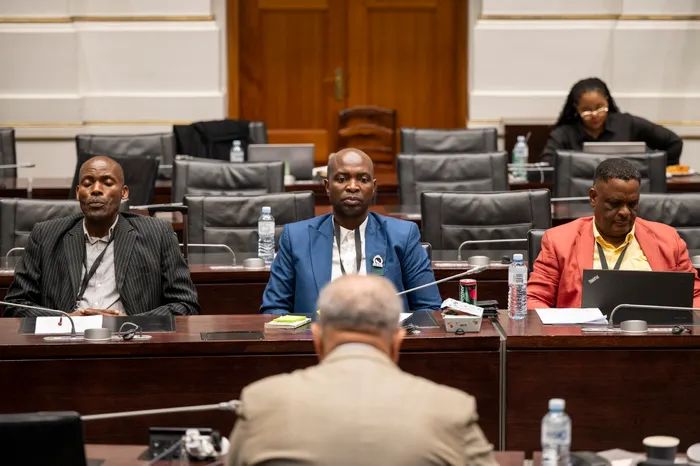
(From left) Captain Edwin Malatjie, Captain Samuel Ramalepe and Colonel Darius Ramolobe testifying before the Ad Hoc Committee probing the allegations that were made by KwaZulu-Natal Police Commissioner Nhlanhla Mkhwanazi.
Image: Image: : Armand Hough / Independent Newspapers
THREE police officers embroiled in a legal battle with former acting police commissioner and divisional head of forensic sciences, Khomotso Phahlane, claimed on Wednesday that their efforts to report serious criminal activities within the South African Police Service (SAPS) were ignored.
While testifying before the Ad Hoc Committee, Colonel Darius Ramolobe, Captain Edwin Malatjie, and Captain Samuel Ramalepe stated that they had consistently reported issues such as drug theft, irregular appointments, improper procurement practices, and instances of corruption or maladministration.
“Our efforts were ignored or not supported. As a result, we suffered occupational detriment, physical and psychological harm. This is the price we pay for reporting crimes committed by police officers,” said Ramalepe.
He provided his testimony while being led by evidence leader Advocate Norman Arendse, during the inquiry into allegations made by KwaZulu-Natal Police Commissioner Nhlanhla Mkhwanazi.
The officers informed the Members of Parliament (MPs) that their troubles began in 2010 when the Police and Prisons Civil Rights Union (Popcru) submitted a memorandum to the management of the Forensic Sciences Laboratory (FSL), expressing frustration over the lack of action regarding their grievances.
Ramalepe recounted that instead of receiving support, they were arrested and detained at the Sunnyside police station.
“We were released on bail and the case was withdrawn without any explanation,” he said.
Subsequently, a meeting was held with Khomotso Phahlane, who was the divisional commissioner, in November 2011, followed by another meeting with senior managers two months later.
The complaint was escalated to then acting national commissioner Nhlanhla Mkhwanazi, who had shown a willingness to address the issue but was subsequently removed from office.
Ramalepe also noted that when former national commissioner Riah Phiyega was in charge, she appointed an independent forensic firm, CPN Forensic, in 2013. During this period, Phahlane allegedly initiated a defamation case against the Popcru members, accusing them of ill-discipline after they issued a press statement.
“We were not happy that Phahlane was suing us, and at the time, we had a problem with Popcru when we sought intervention from the then minister,” Ramalepe stated.
“The case, as far as we know, is not concluded,” he added
He explained that after CPN conducted its investigation, Phiyega only shared the findings and recommendations with them in 2014. Ramalepe mentioned that Phiyega had instructed a certain 'Nkuwa' to implement the recommendations and had also promised to instruct Phahlane to withdraw the defamation case.
However, Phiyega was suspended before these recommendations could be put into action.
“Till today, nothing happened,” he said.
Although the report reportedly made no findings against Phahlane, it did call for further investigations into certain matters at the FSL. Ramalepe informed the committee about attempts made last year to discuss criminal activities at the FSL with Deputy National Commissioner Shadrack Sibiya.
The MPs learned that the officers were awaiting a report after National Police Commissioner Fannie Masemola instituted another investigation last October. “That is our plea to the committee, to get that report,” said Malatjie.
Ramapele revealed that matters arising from the CPN report had been submitted to the Public Service Commission, SARS, and IPID, but there had been no apparent response. “We did everything in our power but never got any assistance,” he stated.
He also mentioned that they had requested Masemola to assist in finalising the legal matter with Phahlane. Ramolobe expressed that the Ad Hoc Committee was their last hope.
“We have been to different platforms without any assistance. What we get is victimisation, and as a result, we are really suffering from depression due to work-related issues, because we are reporting theft of drugs in the laboratory. This has been for a very long period of time. We have been raising this issue, following internal processes,” said Ramolobe.