

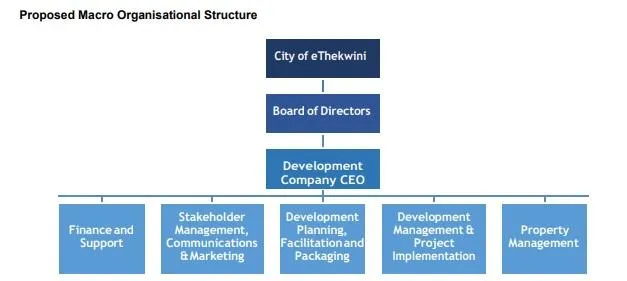
The proposed organisational structure of the eThekwini Inner-City Development Company. The municipality is calling for public comments on the proposed new Inner City Municipal Entity.
Image: eThekwini information statement
The eThekwini Municipality is proposing the establishment of a new Inner-City Municipal Entity aimed at improving service delivery, supporting tourism, driving investment, and enhancing overall management of the Durban Central Business District (CBD).
In an effort to address the decline in economic activity within the Durban CBD, the municipality is currently reviewing a feasibility study to create an Inner-City Development Company.
This initiative seeks to revitalise the area and encourage public participation, inviting residents to “Have your say on the Future of Durban’s Inner City!”
To support this initiative, external assistance has been sought to conduct assessments and provide recommendations regarding appropriate institutional arrangements for the inner city, following a council resolution made in April 2023.
In March 2024, the Government Technical Advisory Centre (GTAC), an organ of state under the National Treasury, was appointed to lead this effort. Following their work in 2024 and 2025, the municipality has proposed the creation of an Inner-City Development Company, which would function as a development agency, property developer, and manager of catalytic projects within the inner city.
According to the municipality, the operational boundaries of this initiative will encompass wards 26, 27, and 28. The findings from diagnostic studies indicate that the Durban Inner-City is grappling with several challenges, including:
The municipality's statement noted, “Property owners, tenants, and business operations, informal and formal, add pressure to a fragile inner city and lack in taking necessary responsibilities associated with operating in the inner city.”
These issues have contributed to a decline in economic activity, with a loss of investor confidence as more modern locations outside the inner city attract existing investments and new opportunities.
The diagnostic findings also highlight challenges related to the internal capacity of the municipality, including insufficient resources to effectively manage the inner-city strategy.
“While entities such as Inner-City Area Based Management (ITRUMP) and the Inner-City Office exist, they lack adequate authority, staffing, and coordination mechanisms. Line departments are equally stretched for resources and appropriate management strategies and are in urgent need to improve their resources and operations for the inner city,” the statement added.
Any institutional mechanism must address several interrelated issues and needs, including:
Saul Basckin, an ActionSA councillor in the eThekwini Municipality, expressed concerns about the proposal, stating that it is being presented as a solution, but he believes it represents a rebranding failure rather than addressing the root causes of Durban’s decline.
Basckin pointed out that one of the primary reasons for the deterioration of Durban’s inner city is not a lack of entities but rather a complete absence of consequence management. “The municipality already funds multiple departments and entities tasked with these exact responsibilities, including Durban Tourism, Economic Development, Metro Police, Real Estate, Parks, and Cleansing. Residents are paying for these structures every year — yet basic services continue to fail,” he said.
He further argued that instead of holding officials accountable for non-performance, the city now proposes:
“Durban does not need another entity. It needs leadership that enforces the law, fixes what exists, and holds officials accountable for failure.
“True inner-city regeneration will only be achieved through competent governance, proper oversight, and a return to basics — not through creating new structures to mask old failures,” said Basckin.